Keeping Things Straight, Sort Of

Dear Liza,

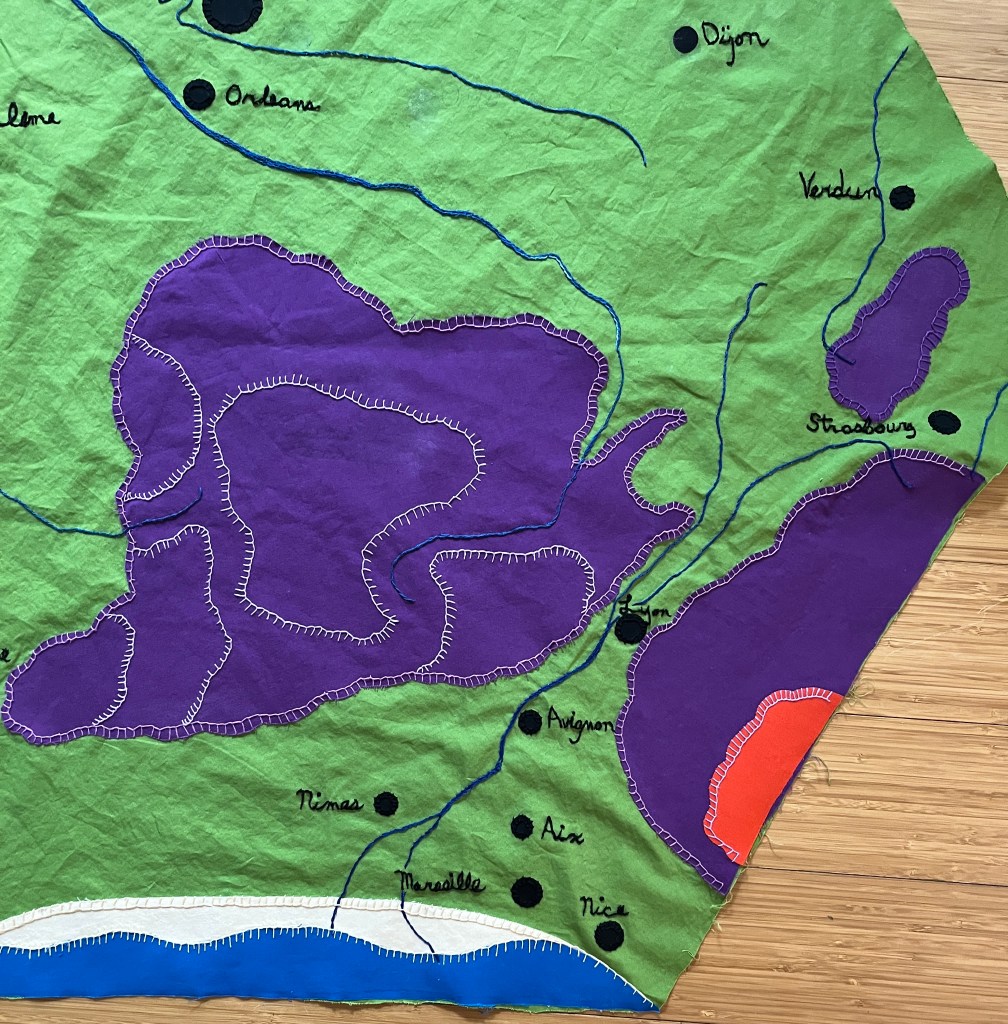
I am finally getting to the middle part of my French map quilt, and it is a challenge.

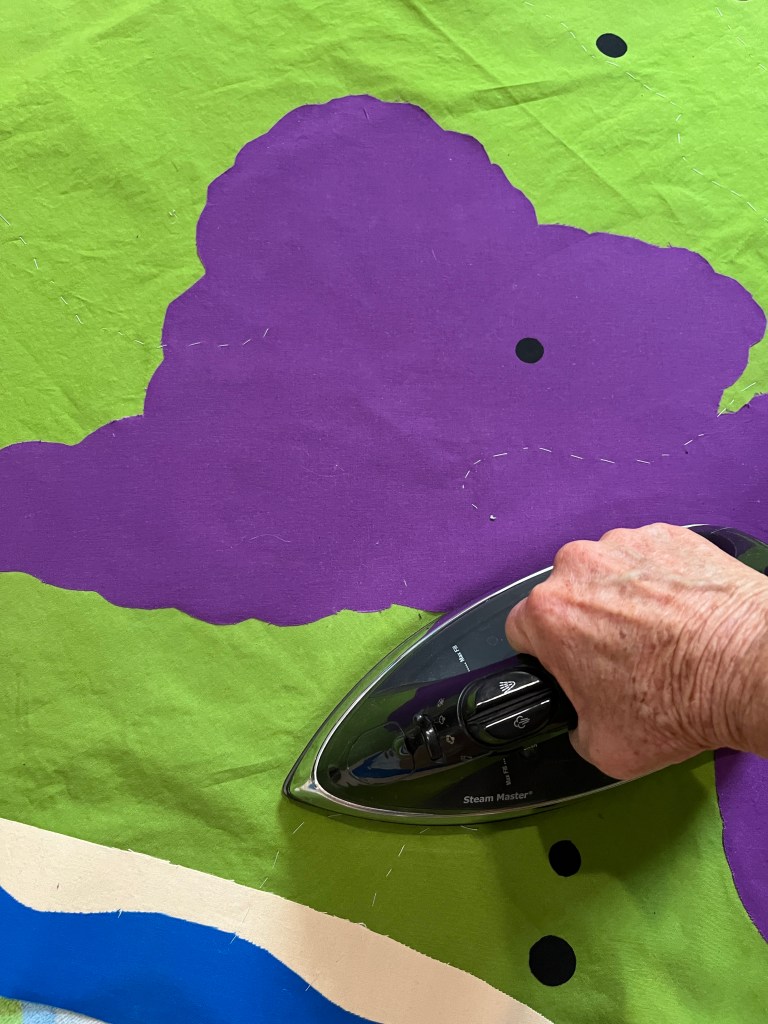
First, the iron-on adhesive that I used to stick the purple Massif Central to the green plains makes embroidering a real chore. Instead of sewing easily along, I am having to stab each stitch through, and it is tiring!

Also, I have realized that the “rows” in the west don’t line up with those in the east. They are a bit wonky, which is fine, but how could I make them look good together? I don’t want to see it out of whack every time I look at it.
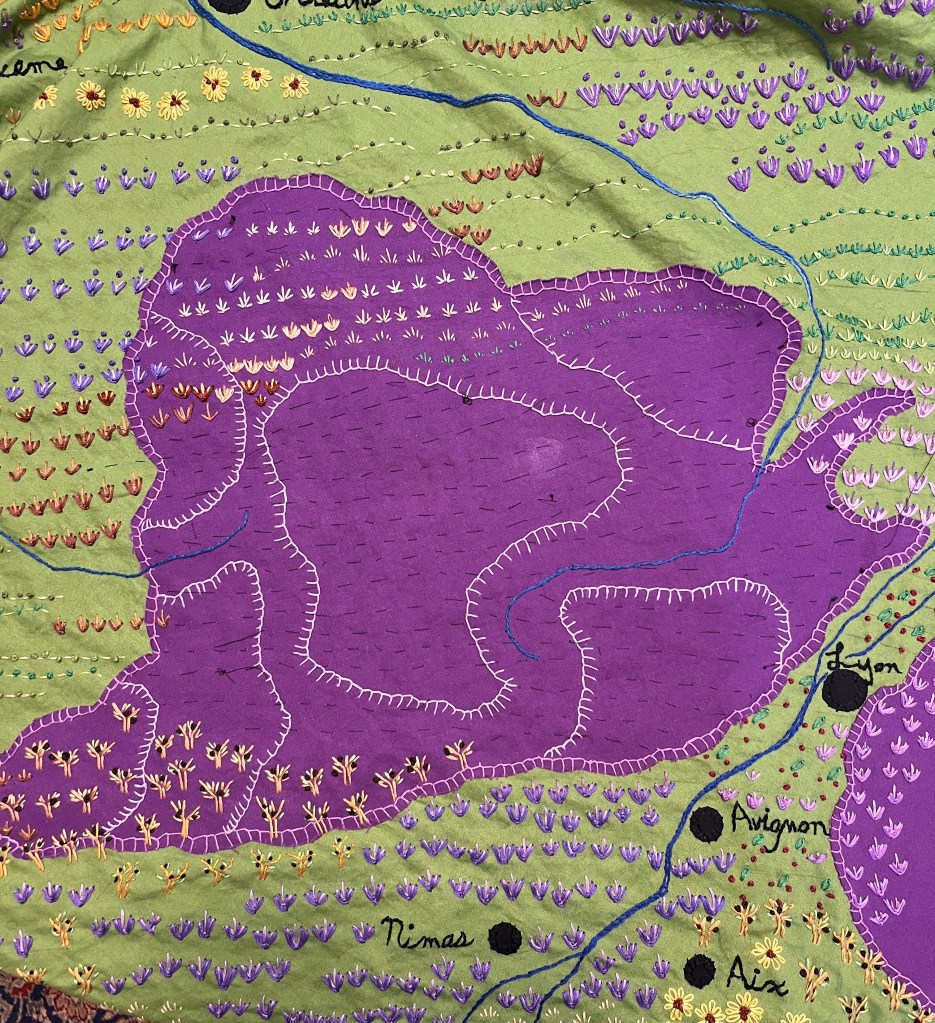
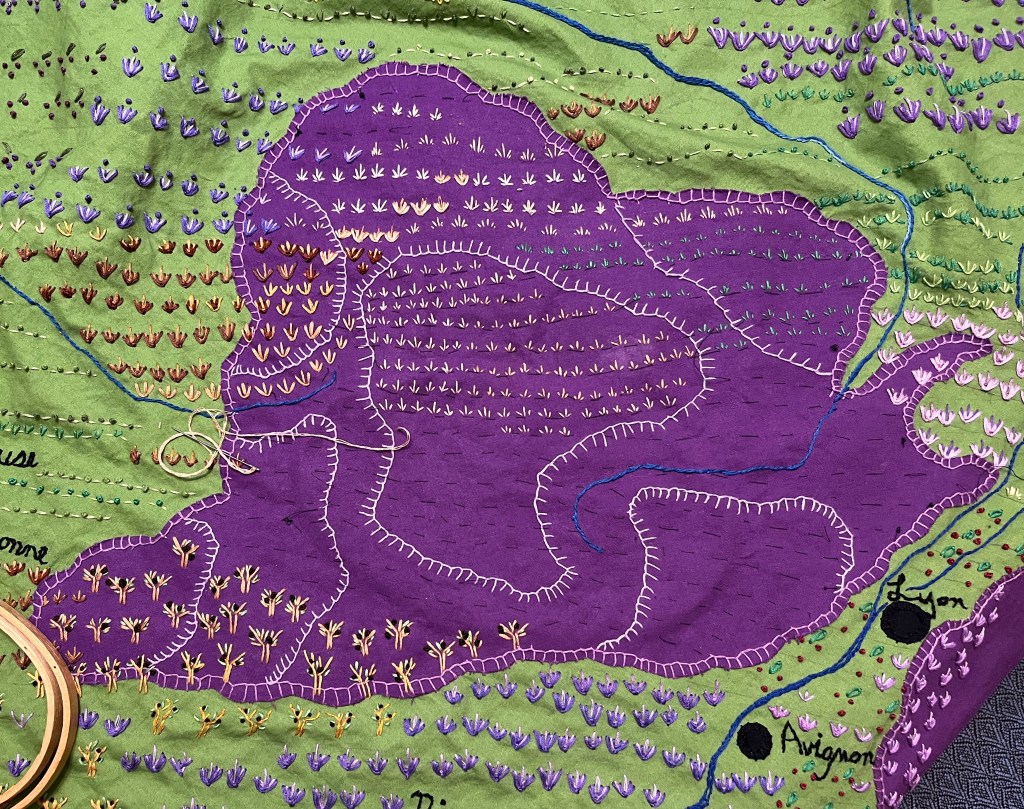
So I decided to baste some swoopy lines from east to west, to help me join the two sides in a cohesive manner. These took a few days to do, because of the thick fabric, but I think they will be worth the effort.
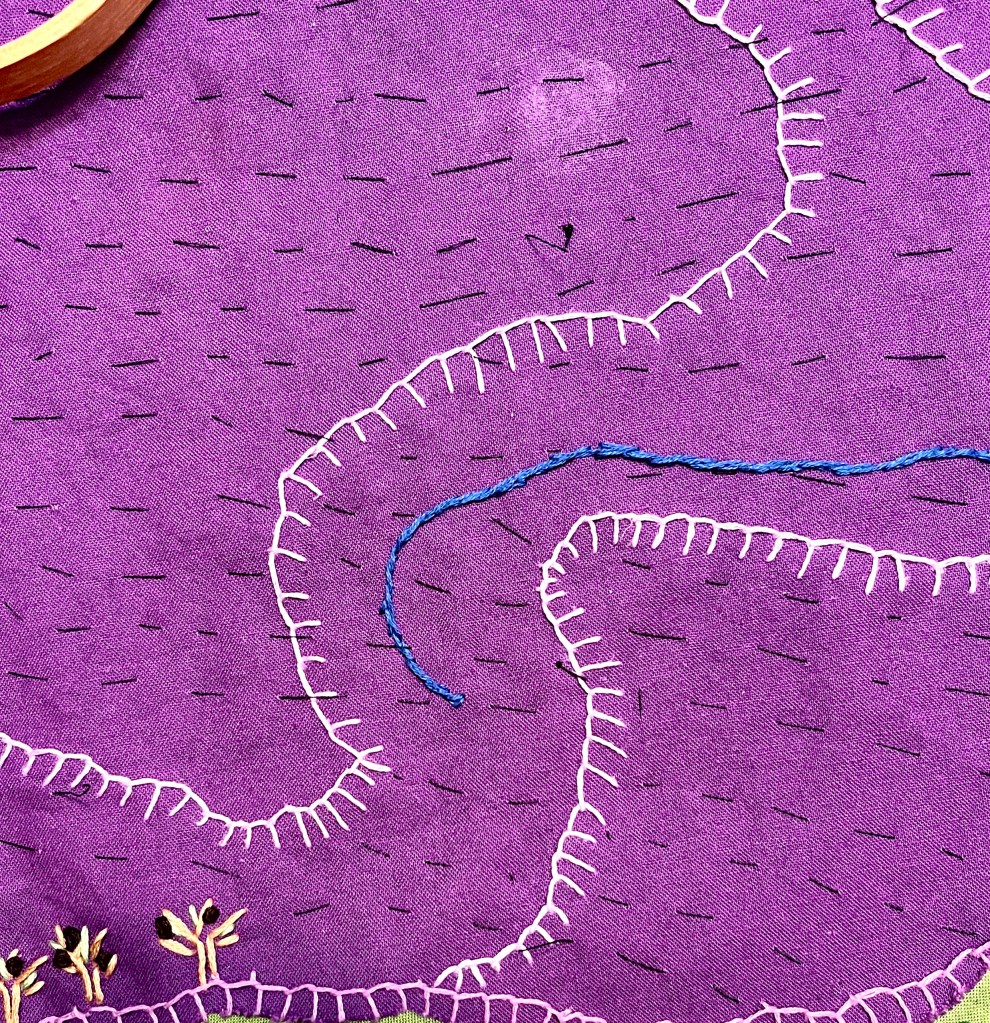
I’ve got a chunk of it done, and I like it so far.
Love,

Grandma Judy

Are We There Yet?

Dear Liza,

I’ve been working on the French Map Quilt for a couple of months now, and I think I’m almost done with the top.

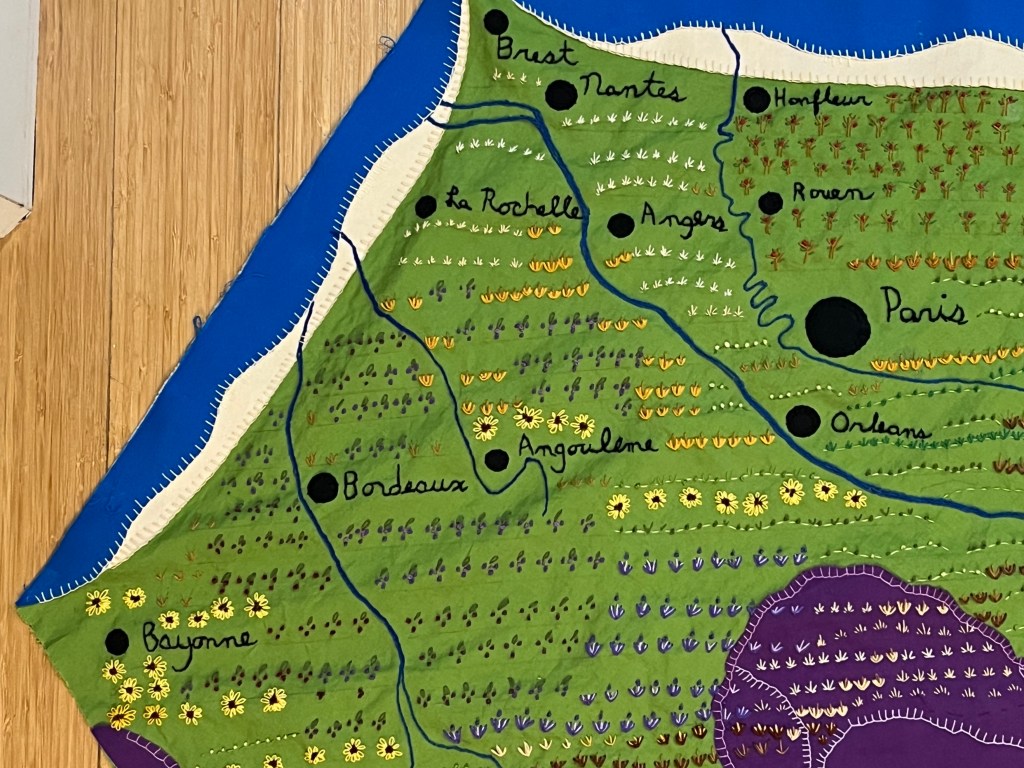
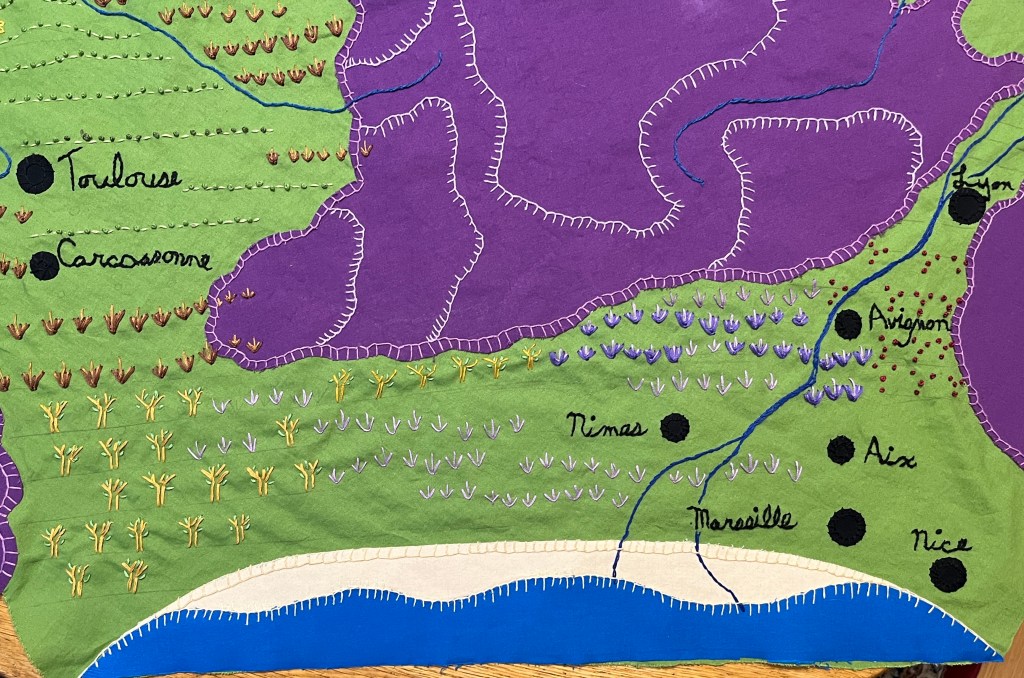
My problem is, I can’t look at the WHOLE thing at once, except when I take a picture of it. At about a meter across, it’s a lot to focus on. Below, I have broken it up into four photos.


Looking here, I can see that I need more ‘grazing’ icons on the Massif Central and heading up into the Alps.

Here, the Pyrenees Mountains look a bit bare. And should there be something at the shore? Wavy lines to show the foam and dunes, maybe?

It’s hard for me to be objective… what do you think?

For now, I’m going to fold it up and let it sit. I’ll get back to it when I can see it fresh.

Love,

Grandma Judy

Adding More …. And More

Dear Liza,

Once I realized what was wrong with my French map quilt, I got busy putting it right. Every inch on the embroidery is getting re-worked with more color, contrast, and texture.

For example, here is a section of Provence, in what I am now calling the Rough Draft stage. At the time, I thought it was done. But the olive trees are flat, and the lavender is almost invisible.

A few days later, I had added enough contrast that the area was what I wanted it to be… bright, vibrant, and inviting.

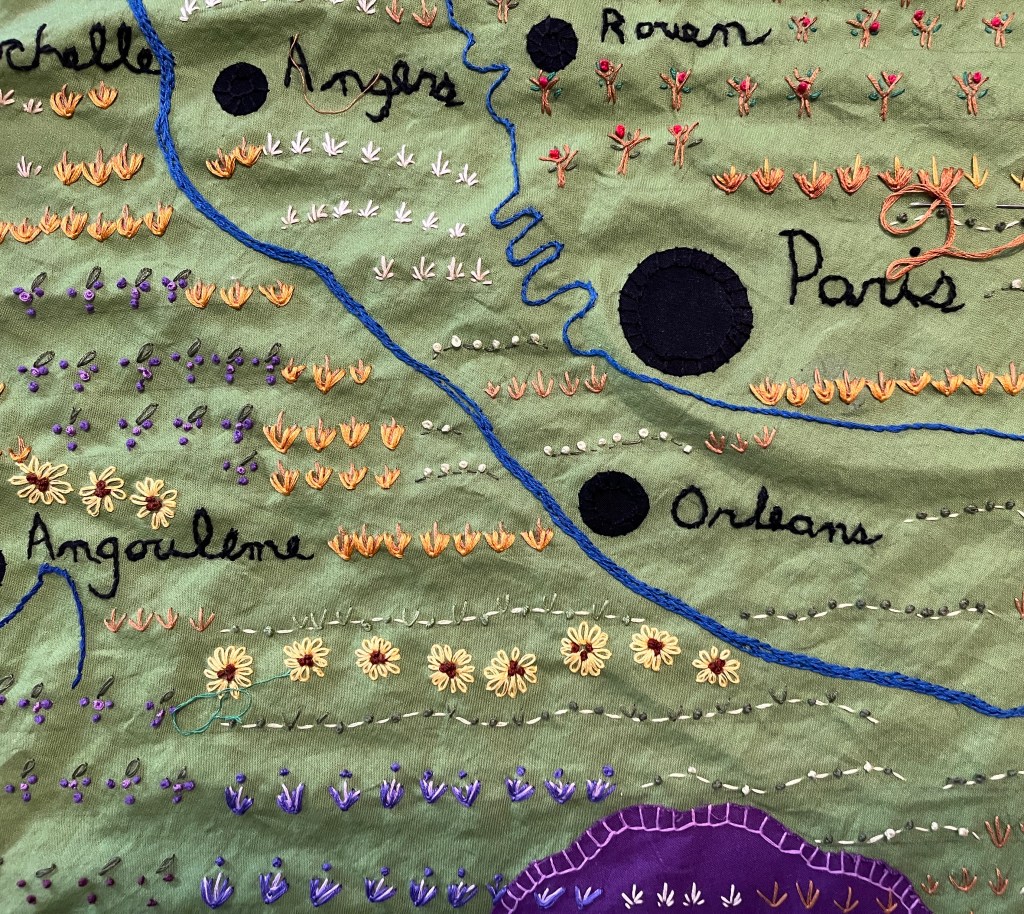
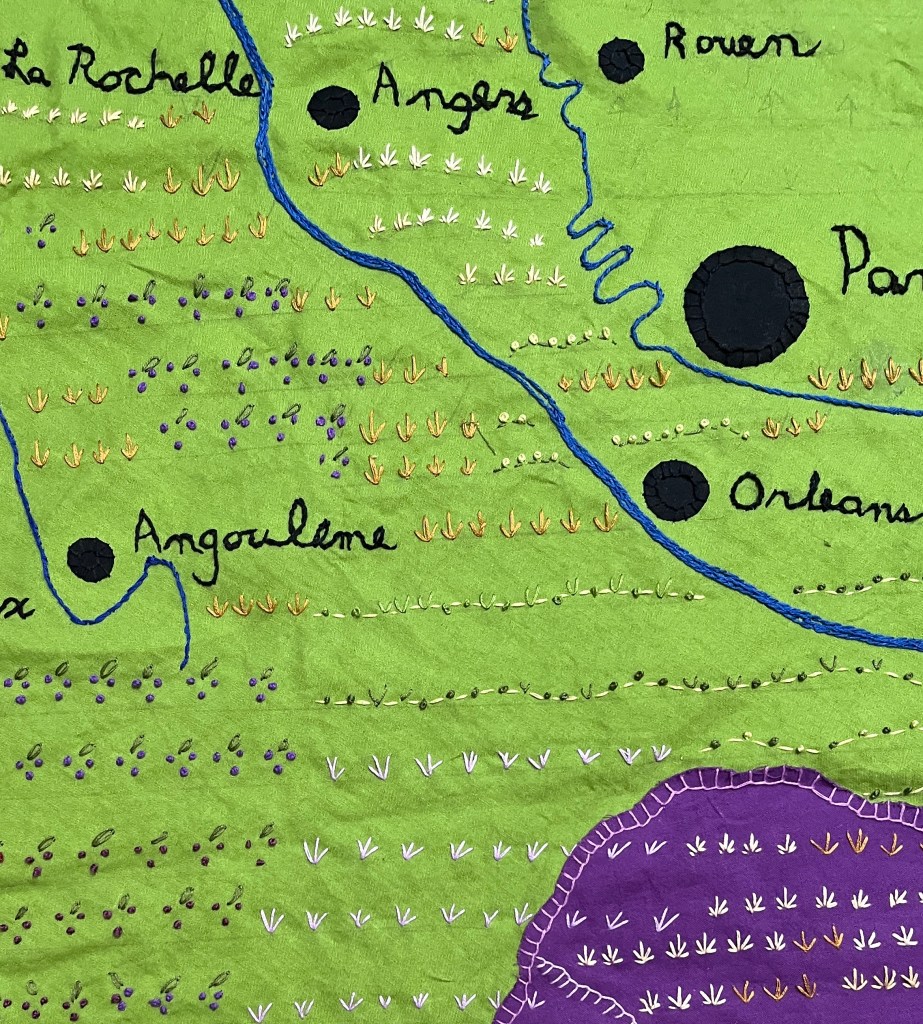
Looking further north, I realized that the glorious Loire Valley, the “Garden of France”, was looking very sparse. Too much flat fabric, not enough cultivation going on.

So I drew more lines of crops, and then more between those. Straight rows became waving hills and I got braver with colors. NOW the Loire seems like it’s living up to its potential!

I guess I’ll just keep adding stitches until it seems like I should stop!

Love,

Grandma Judy
Stepping Up My Embroidery Game

Dear Liza,

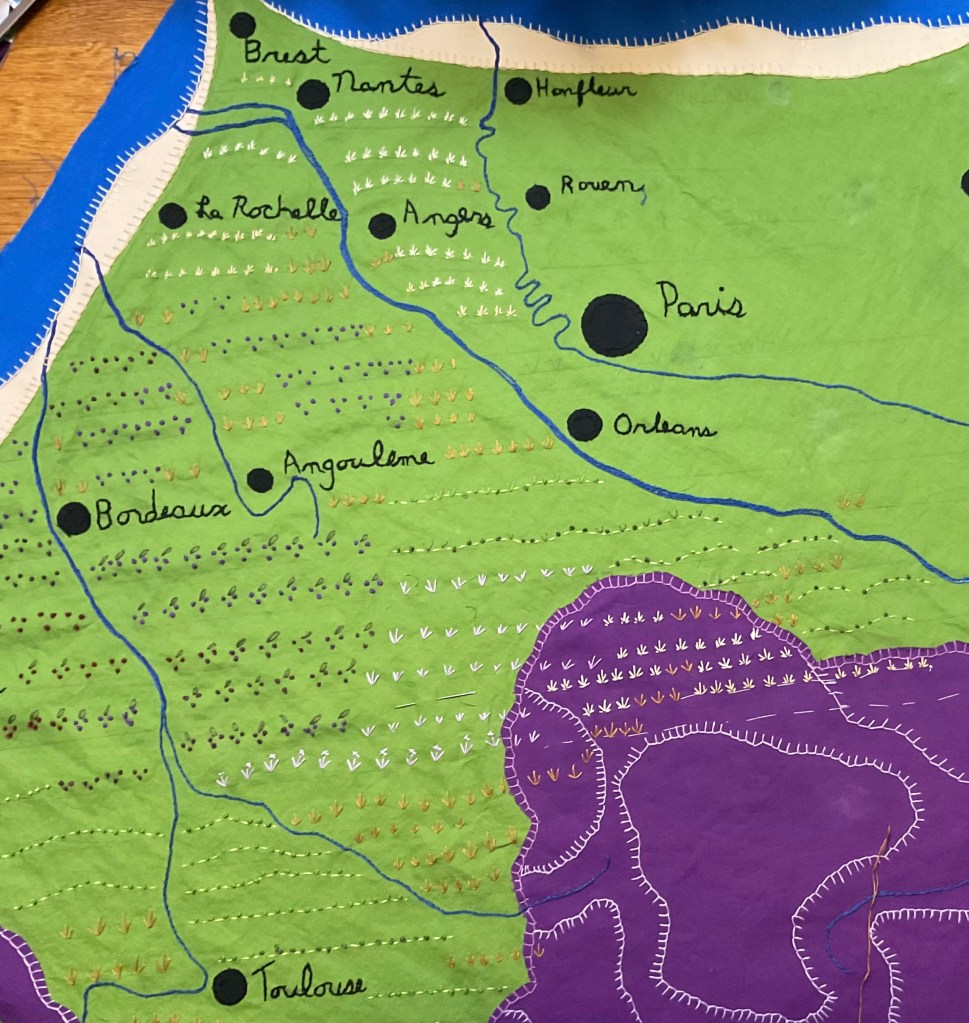
The French quilt was coming along. I mean, I kept putting in more crops row by row… but it was feeling very flat, and not very interesting.

The apple trees were an improvement, for sure. More color, more texture.

Then your Grandpa Nelson looked over my shoulder and said, “Where are the sunflowers?” Hmmm. Sunflowers. Because I was impatient to see the quilt finished, I had designed the symbols for the crops to be one color, simple, and easy to sew.

But I LOVE sunflowers, and I don’t want them to be easy. I want them to be pretty.

And they are! I love how the rows look, bouncy and bright. Trouble is, they made the rest look even flatter by comparison.

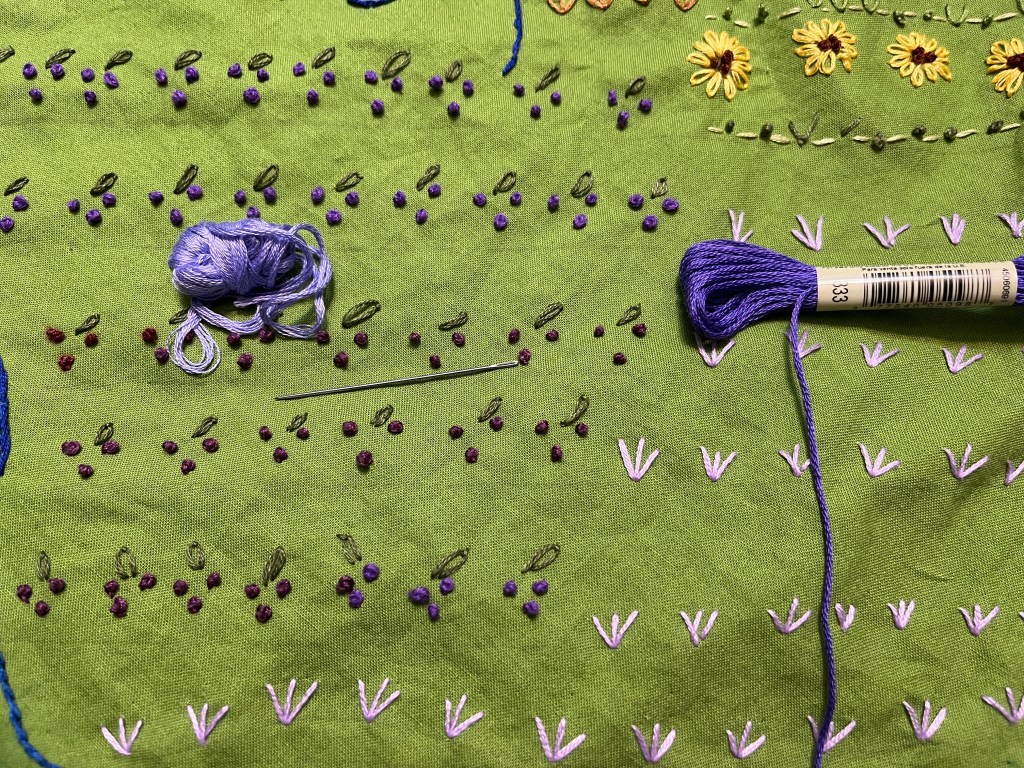
It was time to step up my embroidery game. I started with the lavender fields by Angouleme, giving them more color and texture.

So now I have had to re-think every single crop to make it worthy of the sunflowers. So far, the wheat and barley fields are coming out nicely.

I am so glad I did! The artistic process isn’t fast, but it sure is interesting. I’ll keep you posted.

Love,

Grandma Judy
French Map Quilt Update

Dear Liza,

I have been working on the French map quilt a little bit every day. Sometimes it goes smoothly and I get lots done. Other days, I hate every stitch and snip out the day’s work.

Such is the artistic process, I am told, and I am making progress!

I have laid in all the vineyards around Bordeaux, pastureland by Brest, and am now putting in all the apple orchards in Normandy.

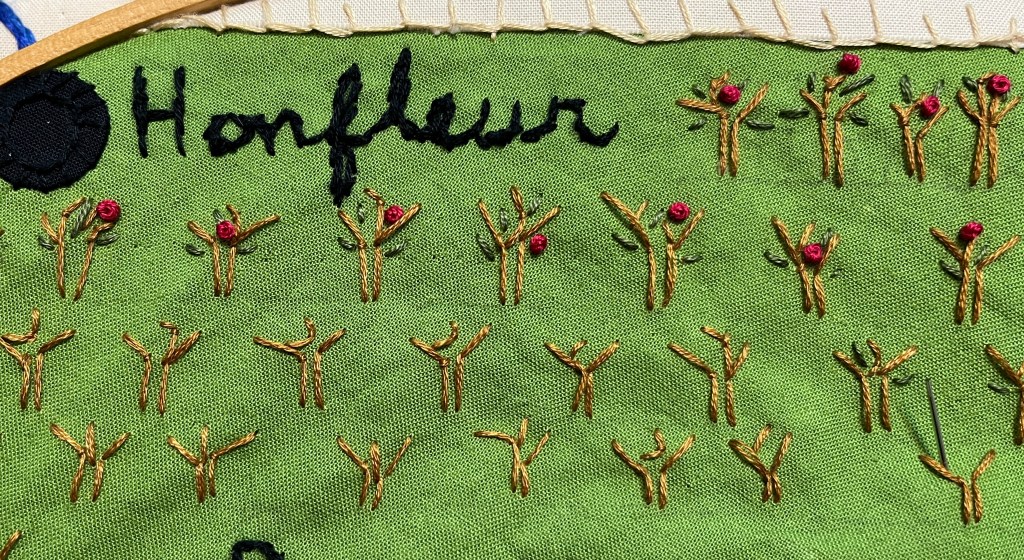
The apple trees were very challenging. I tried several different shapes, but they all looked wrong. Finally, I just ‘sketched’ a few with stitches, and found what I was looking for.

I like that each tree has three colors! (….Now maybe I need to go back and add more texture to my other icons?)

Moving forward, I have about half the country to go, and look forward to the next set of conundrums.

Love,

Grandma Judy

Acres and Acres of Stitches

Dear Liza,

As I stitch more on my map of France, adding dozens of icons for row crops, vineyards and wheat fields, I feel like I’m looking backward and forward at the same time.

I am remembering the shining wheat fields and castle gardens in the countryside, where our GPS stopped working and we got delightfully lost.

I am remembering the awe of walking along the Seine and seeing history standing before me.

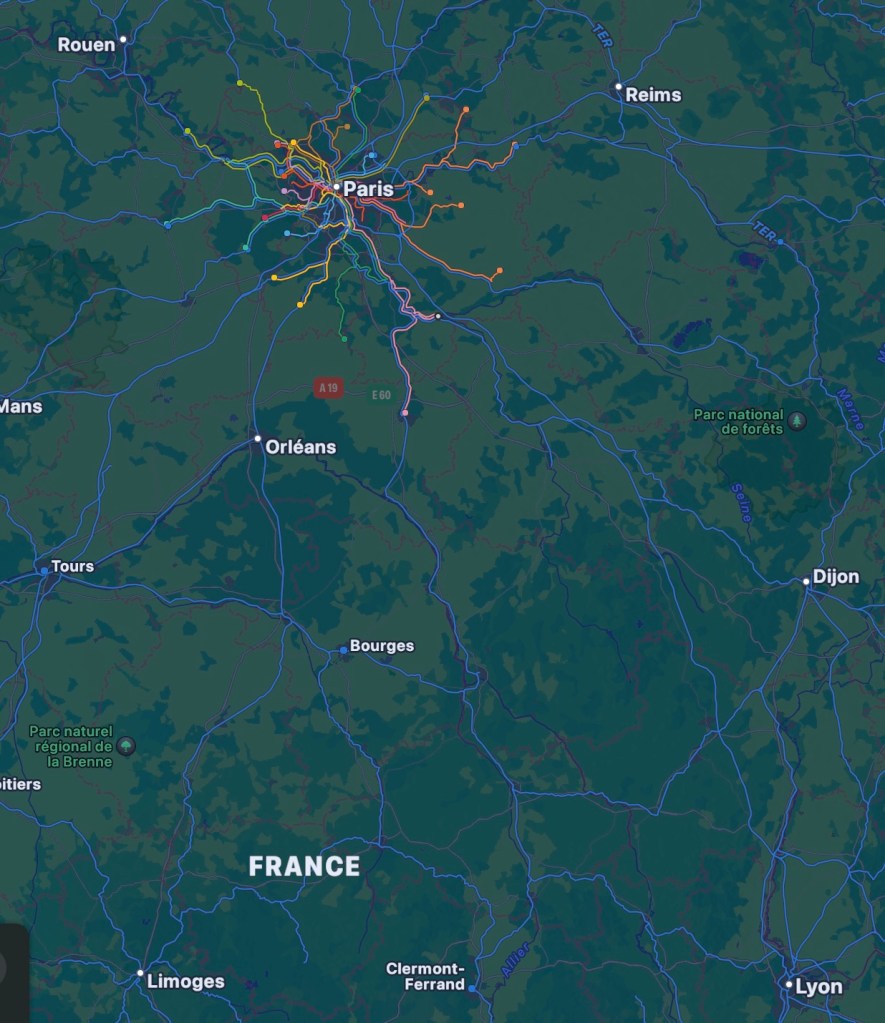
And, looking at maps and train lines, I am planning our next journey, from Paris to Lyon, then winding around to Orléans and up to Rouen. What will we see on our way? How will it let me see the country differently?

Screenshot

Honestly, I never thought embroidery could make me philosophical. But here we are.

Love,

Grandma Judy
Working out the Details

Dear Liza,

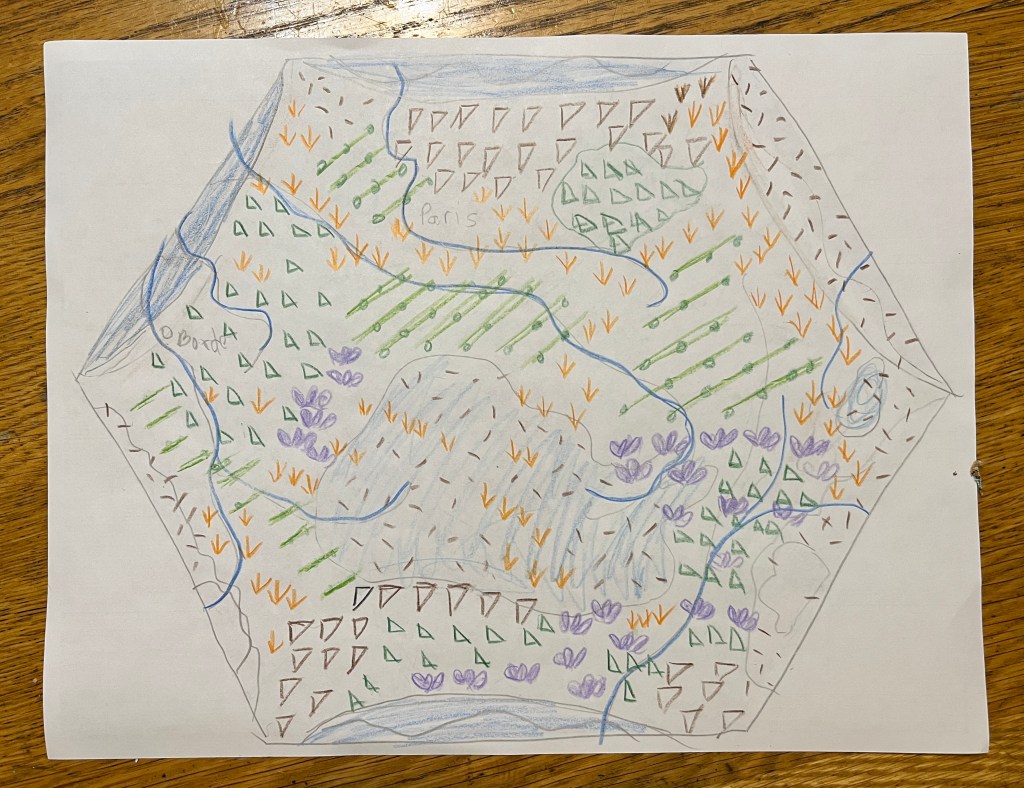
Now that I am ready to put the land-use icons on my map of France, I am getting a little worried. There are going to be hundreds of these little rascals!

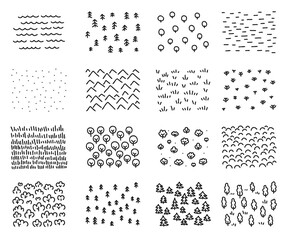
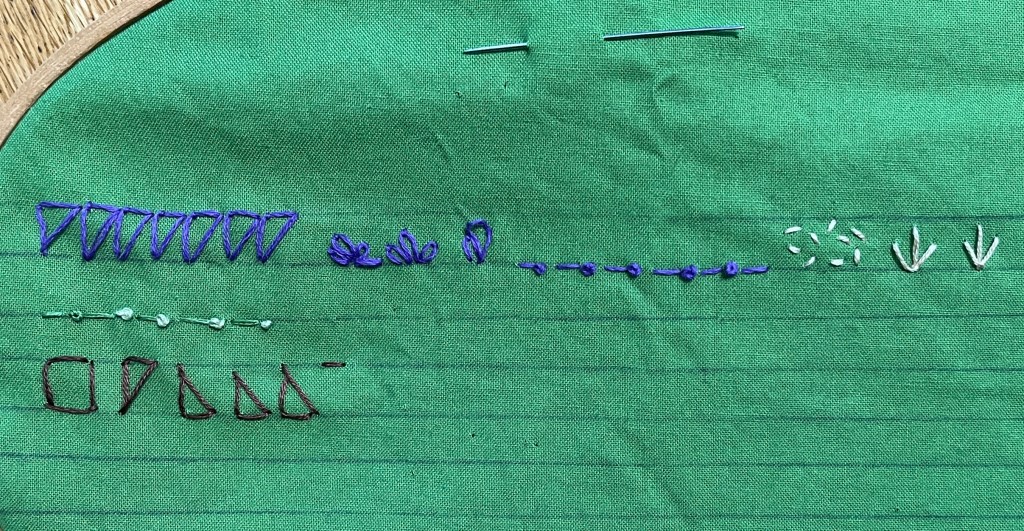
I want each icon to be easy to sew, of equal size, and to look vaguely like what it represents… a row of crops, a tree, or a vineyard.

Watching videos of embroidery, I noticed the importance of straight lines, so I practiced on some.

I am happy with some of these, but the squares and triangles were not right. I did more experimenting.

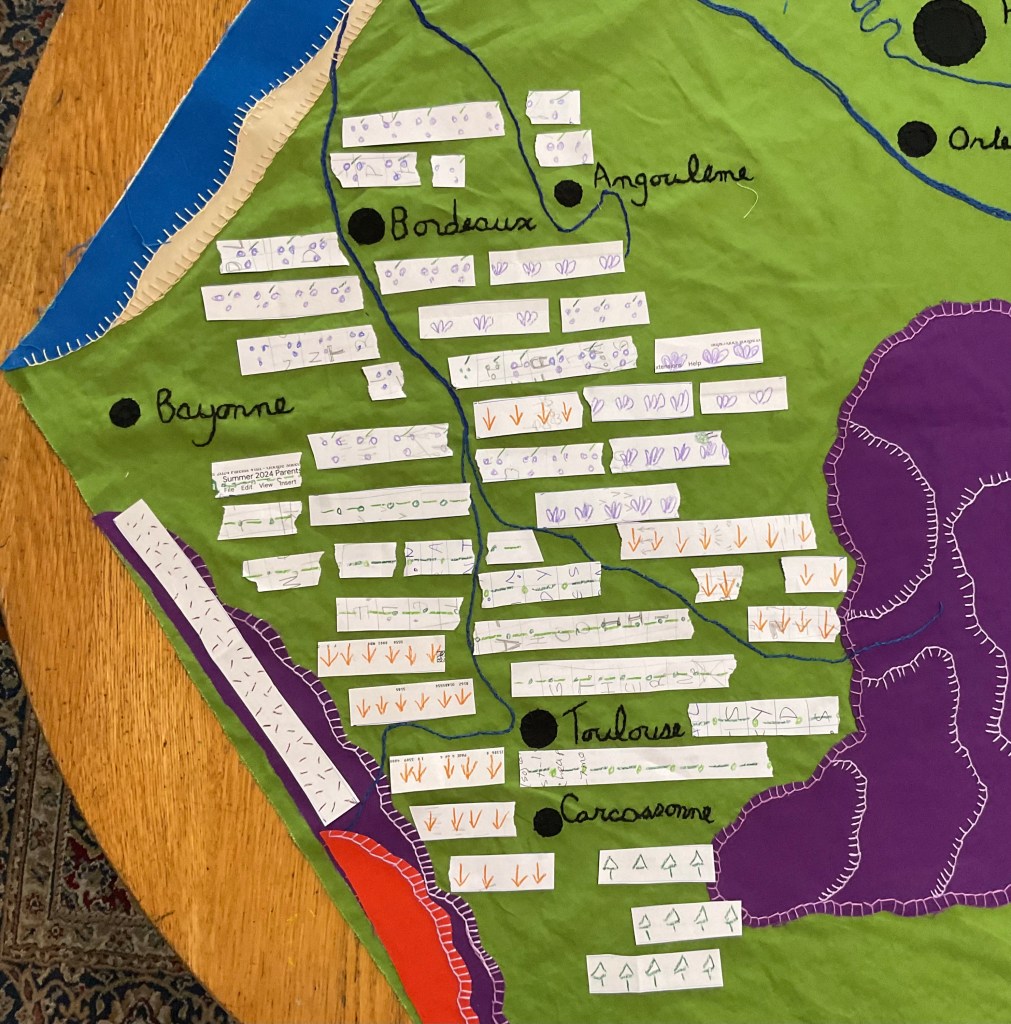
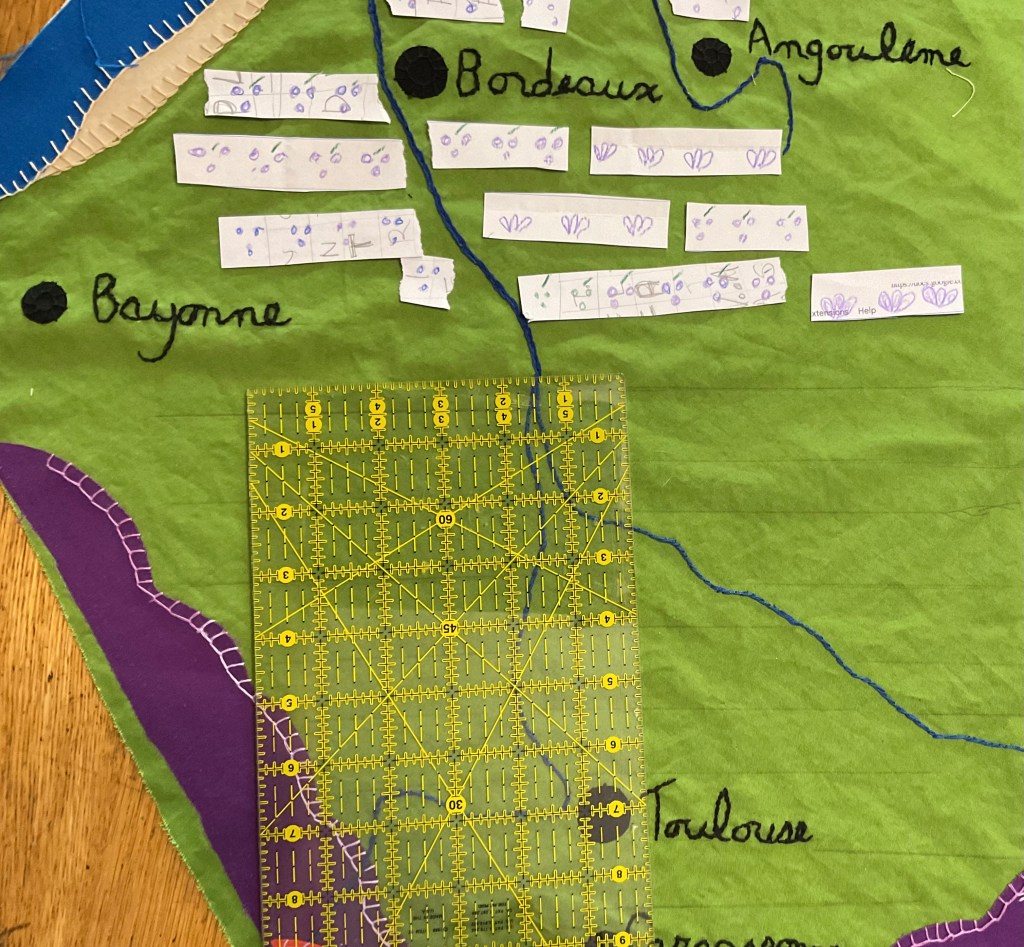
I also had to work out the right scale for the icons. Those first ones were 1 centimeter high, which I realized, since the whole map is about a meter wide, is TINY. So I tried some at 2 centimeters, which made more sense. I drew the 2 cm. icons on wider strips and laid them down according to the land-use maps I’ve been studying. I started with the south western part of the country

I took this picture to remind me what went where, then used my clear ruler to get the guide lines all straight.

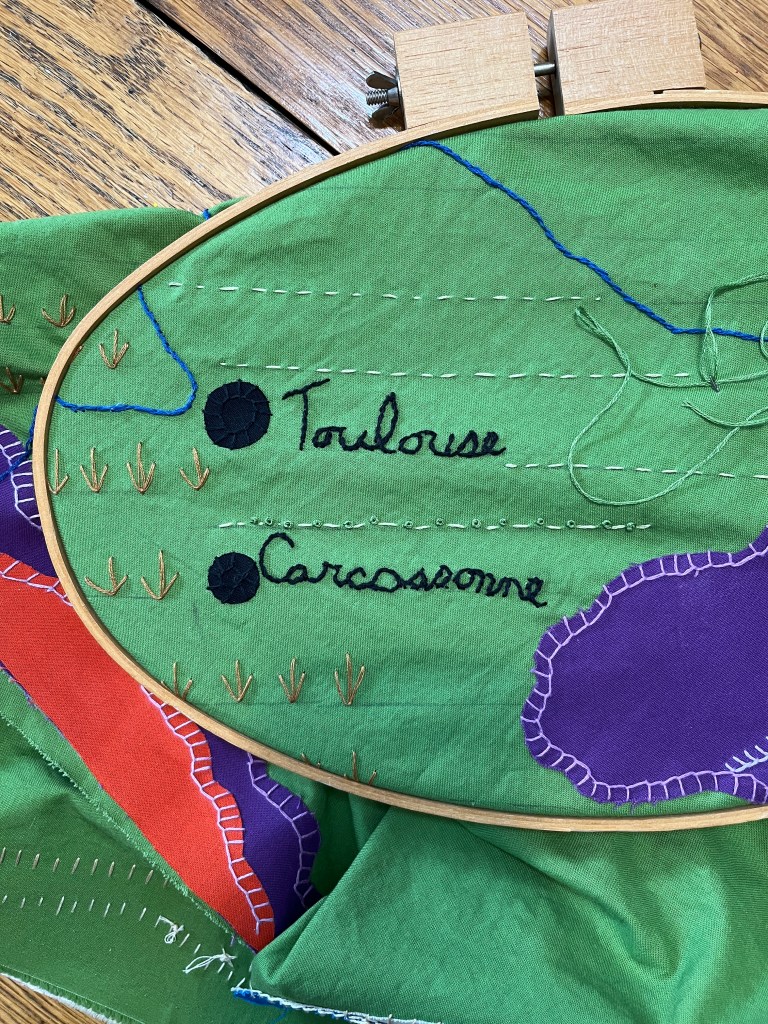
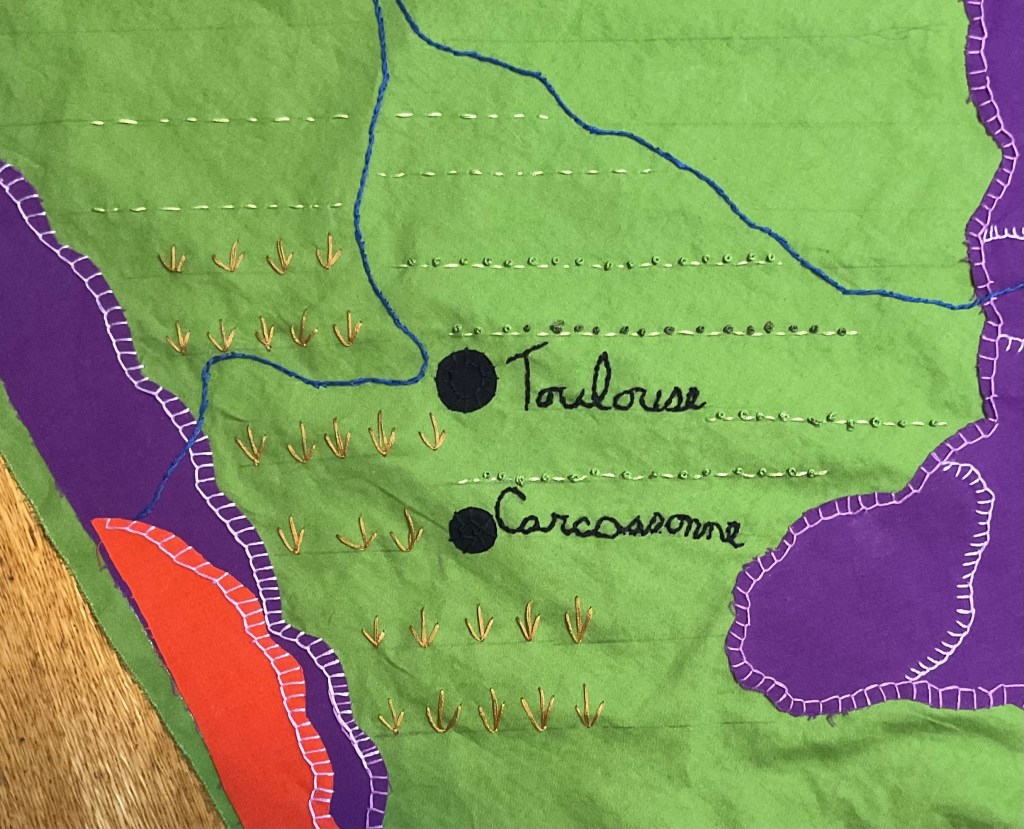
And now, I have started sewing the icons! These are for wheat fields and row crops.There are still a couple hundred yet to go, so it will be a good long time.

Again, patience.

Love,

Grandma Judy
French Map Progress

Dear Liza,

I have been working on my French map quilt steadily for a few weeks now, and I’m pretty happy with it so far.

The rivers are embroidered, the city dots are ironed and sewn into place, the mountains and highlands edged, and the coastlines nice and swooshy.

Of course, it isn’t done yet. There is all that land between the main features that looks like it wants some detail.

Rolling hills and grape vines, rocky crags and swampy spots, fields of wheat and rows of lavender, all need to add texture and interest.

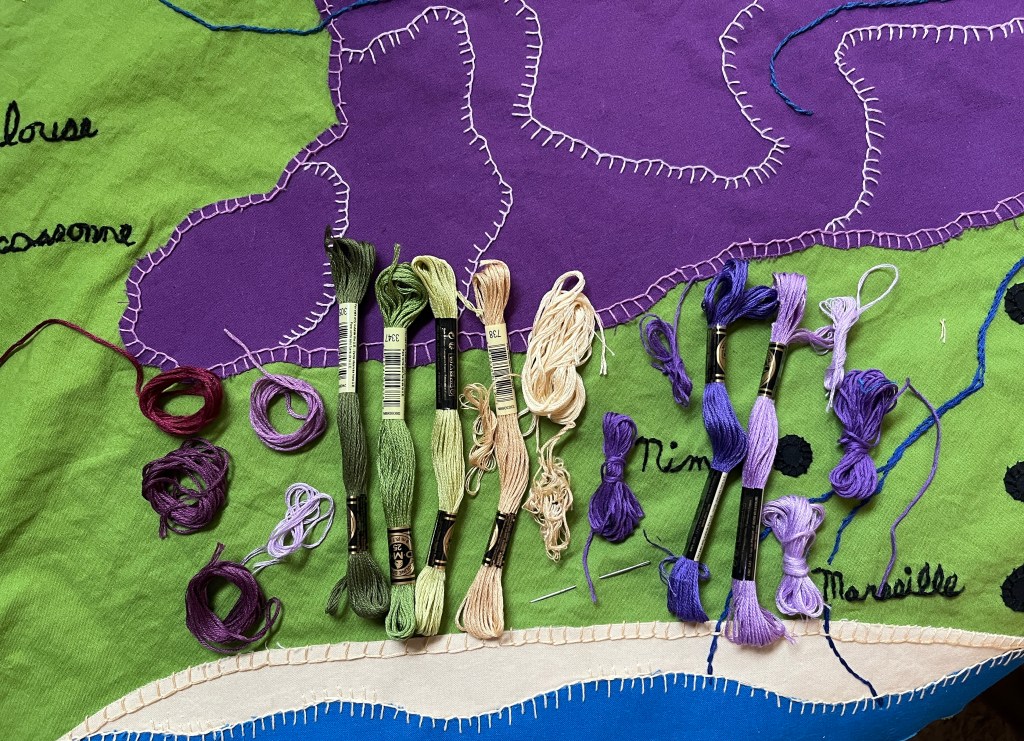
So I will get started on the next step. I have chosen my color palette, looked at the symbols used in paper maps. I have come to terms with the fact that this will not, and cannot be, an accurate depiction. It will be, like all maps, an interpretation.

And I’m okay with that.

Lovr,

Grandma Judy

Cities in Cursive

Dear Liza,

I love doing embroidery. It can be restful and contemplative, just making stitch after stitch and feeling a picture grow under my fingers. But sometimes I wonder if I have bitten off more than I can chew.


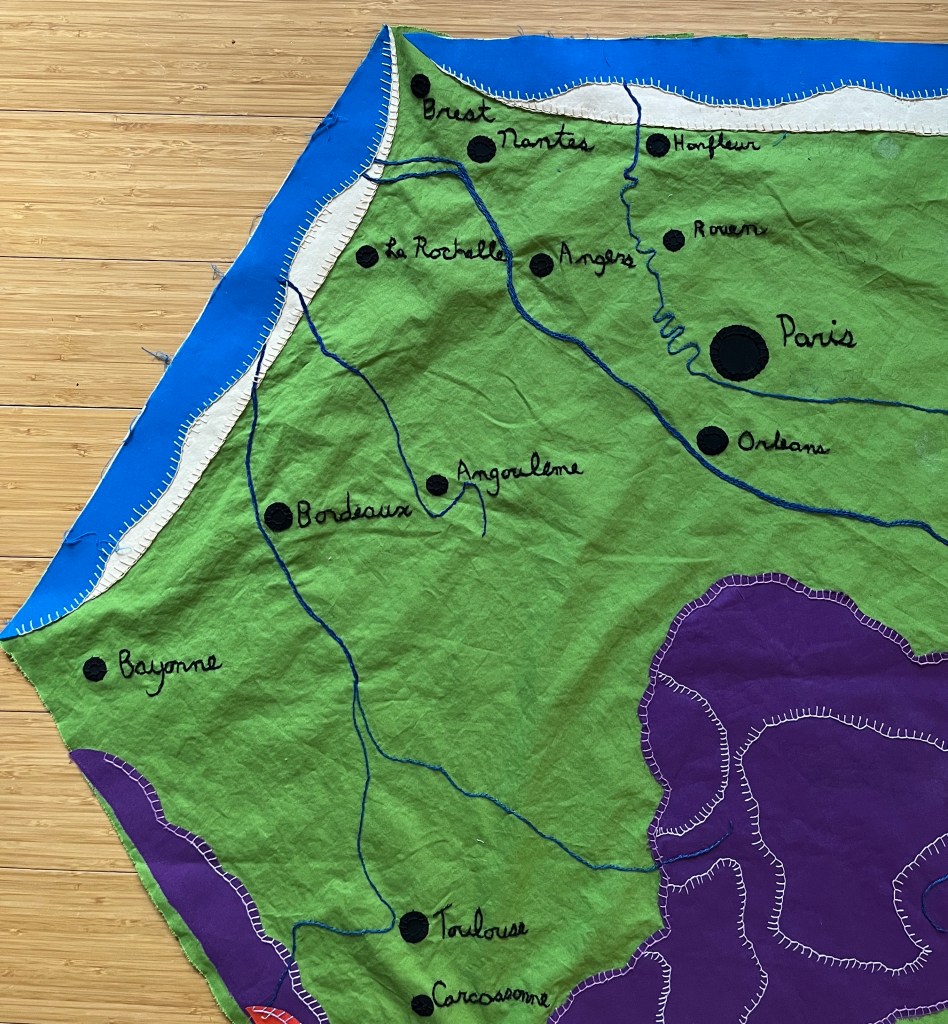
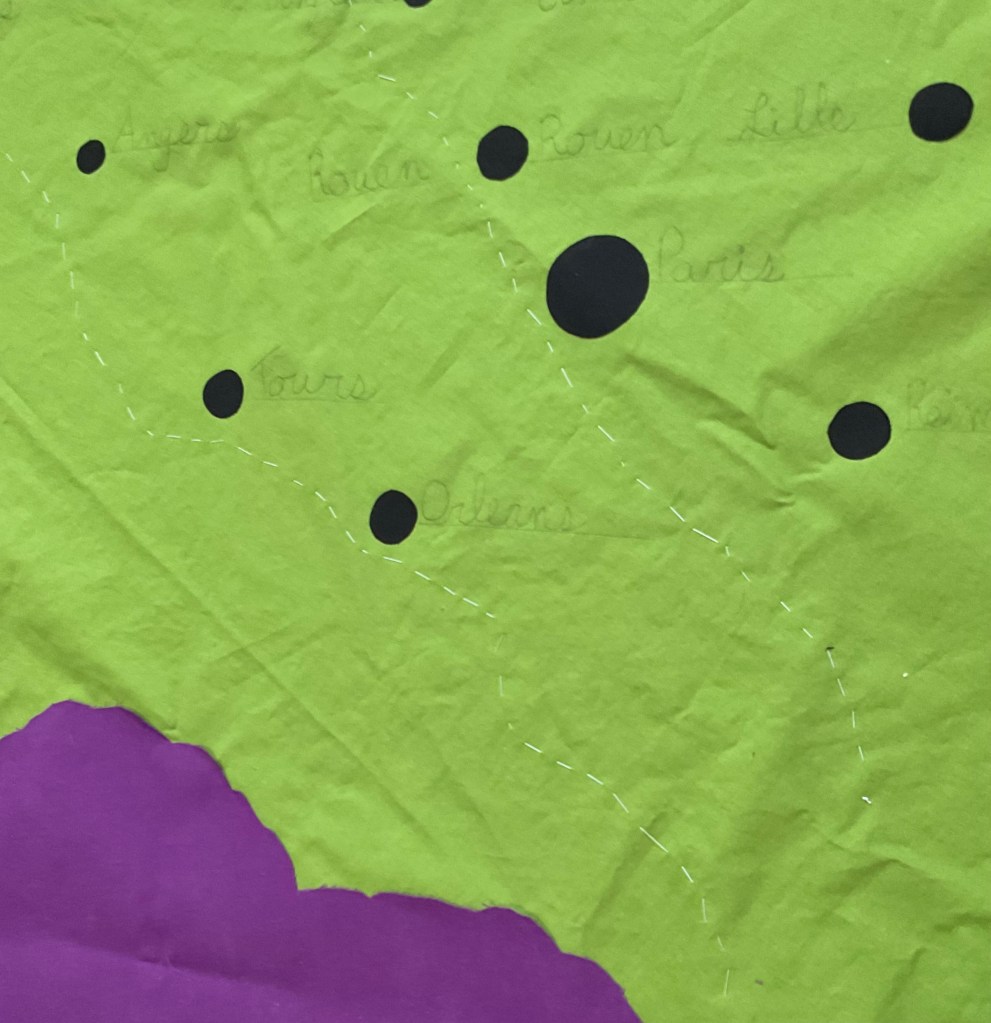
My French map quilt needs the city names, and these pieces of paper aren’t going to do the trick. The names need to be stitched. All 27 of them!

So I practiced a bit, and then wrote, in pencil, each name on the map. You need to squint a bit to see them, I’m afraid.

Then came the stitching.

I used the embroidery hoop because the fabric felt floppy and it gave me more control, and it worked pretty well.

Once the name was embroidered, I used a small blanket stitch to make sure the city “dots” stayed in place.

I’m still working on this, but making progress. Moving Paris and some other cities slowed me down a bit.

I ask your patience, and my own, as well. Breathe and stitch, Judy. Breathe and stitch.

Love,

Grandma Judy
Sticking the Cities on the French Map

Dear Liza,

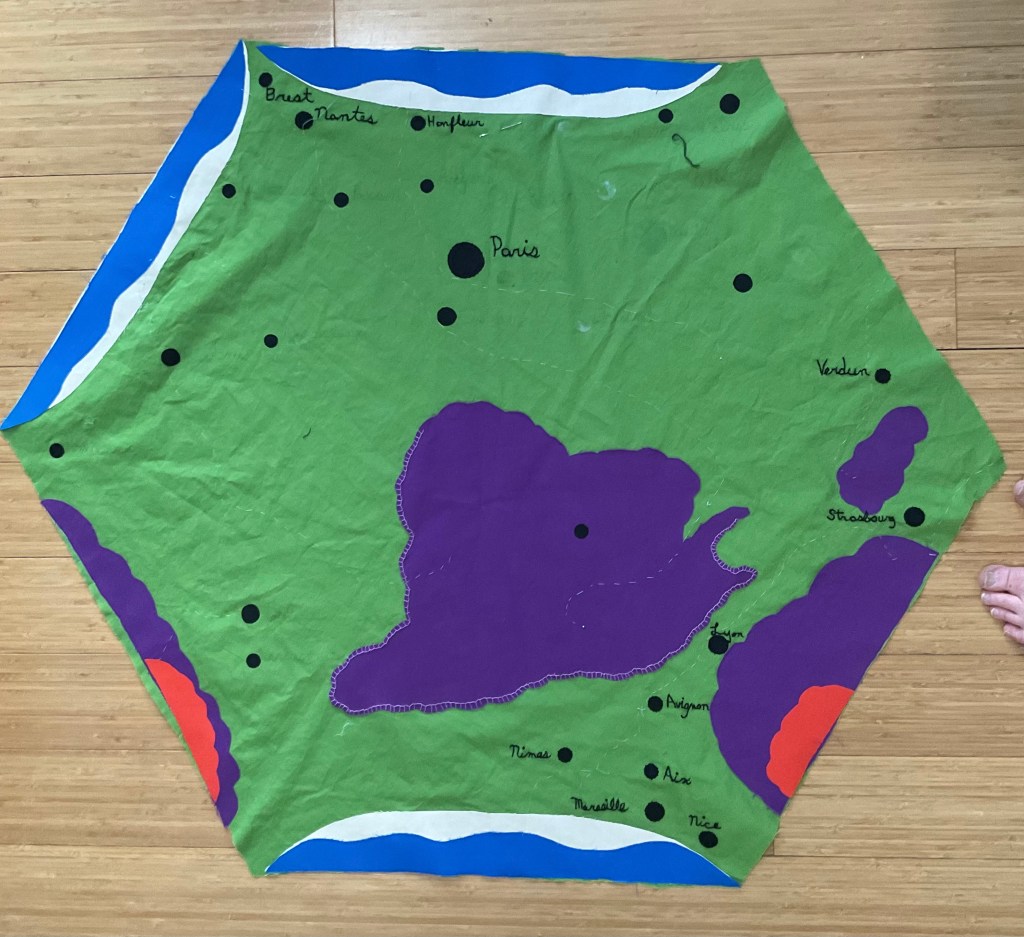
To put the cities in my French map quilt, I used the same Heat N’Bond fusible interface that I had used to attach the Massif Central and the shorelines.

I traced three different sized circles to show different sized cities. The cap of a vitamin bottle made Paris, a wine cork made the medium sized cities like Nantes, and the cap of a chapstick tube made smaller towns, like Angouleme.

I cut all the circles out during the Olympic beach volleyball matches, which made it much less monotonous. Each one was peeled, then placed and pressed into place.

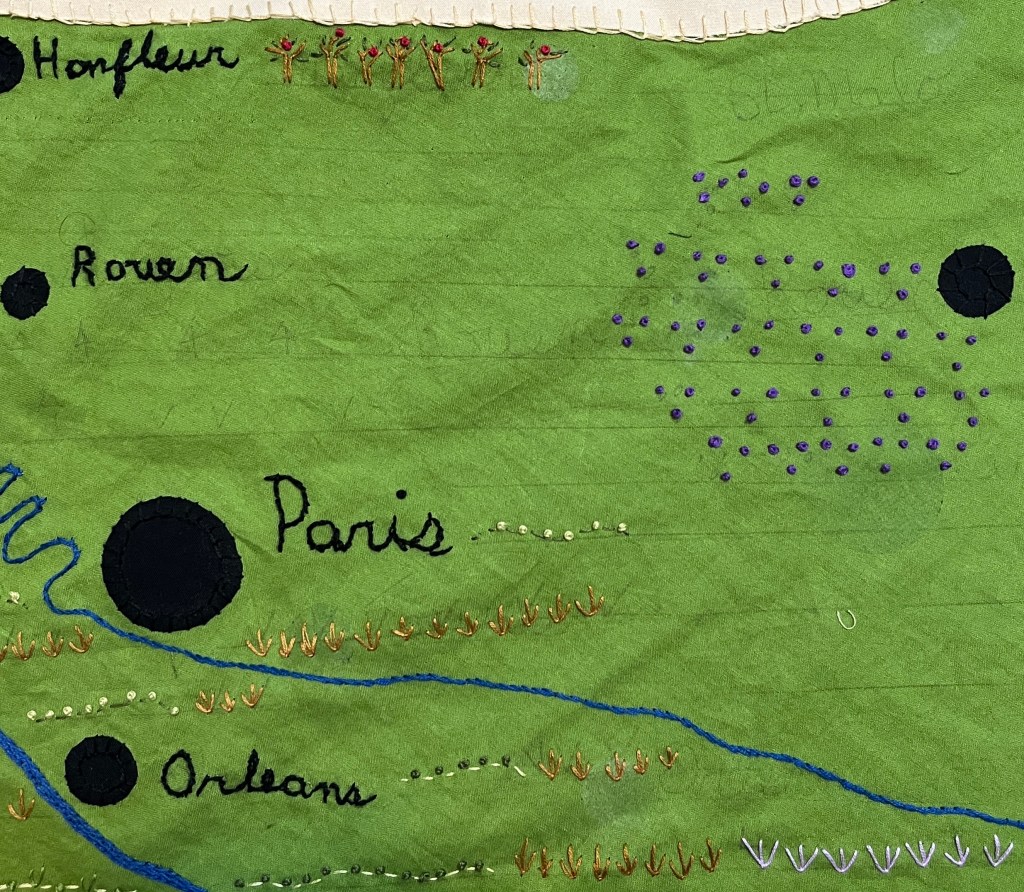
I realized, once they were all down, that Paris was a bit too far east and north. For a few days, I tried to convince myself that it was fine, and I was going to leave it where it was.


But every time I looked at it, the error bugged me. So I decided to move Paris… which meant I had to move the Seine, the Loire, and all the cities along both rivers.

There were bad words. I’m still in the process of removing and replacing the dots, and you can see where some of the adhesive is still there.

I managed to get “Paris”properly named, so at least I have a point of reference going forward.


I am embroidering each name in a cursive script, much like my own handwriting.

That’s going to take some time, too, but I am happy I corrected the error while it was still possible.

Again, I beg your patience.

Love,

Grandma Judy