Learning Something New at Fort Vancouver

Dear Liza,

I have been to Fort Vancouver a few times, and every time I go, I learn something new. I went with Cynthia last Friday and got so busy talking with the docents and guides that I almost forgot to take pictures!

I always have to remind myself that Fort Vancouver was not, in its earliest role, a military fort. It was the trading center for the Hudson’s Bay Company, a Canadian (therefore, English) run company.
At the historic reconstruction of the Fort, I asked about this symbol, which is posted prominently over the door of the Counting House.
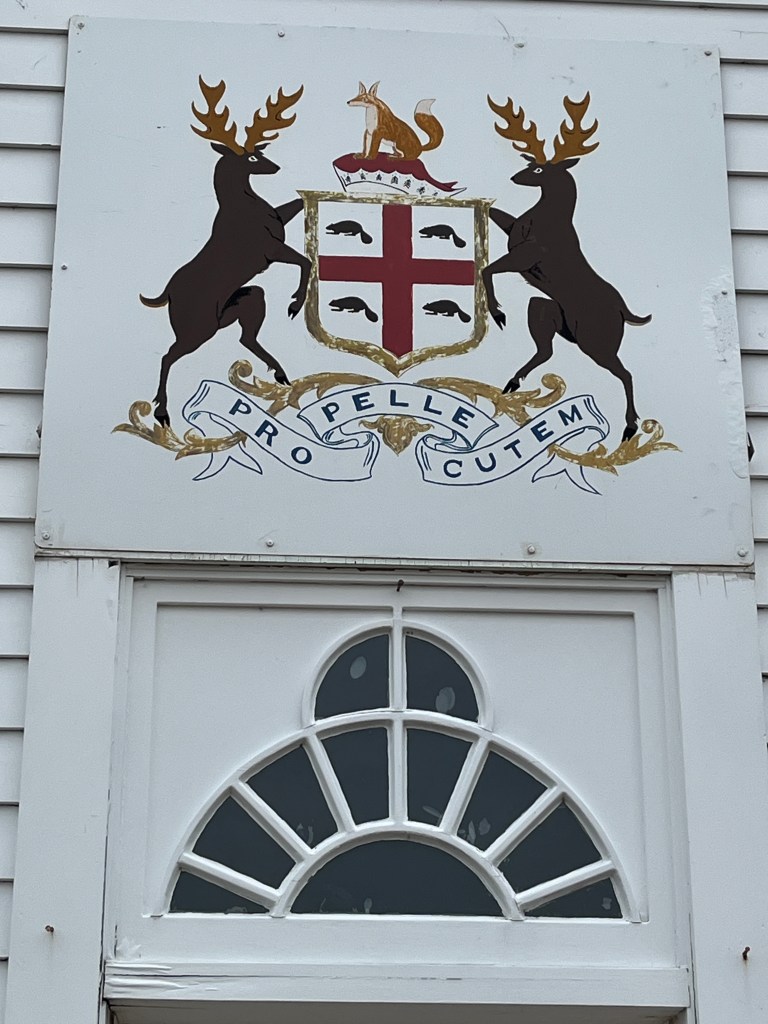
One of the fellows explained that “Pro Pelle Cutem” translates to “A skin for a skin”, meaning that the men of the Fort were literally putting their skin (their lives) on the line to acquire skins, or pelts, for the folks back in Europe to use. In the logo are deer, beavers and a fox, to show which skins are the most important.

Later, we went to visit The Marshall House, one of the houses for Officers built after the U.S. Army took over the fort.
This grand Victorian house had been built in 1886 for use by whoever was in charge of the Fort at any given time. It had 12 fireplaces, a steam heated boiler in the basement, and stained glass in some of the windows.

Our guide, a charming gentleman named Jim, explained that the house was set up to show how it was when General George Marshall lived there from 1936 to 1938. This was the man who had created and carried out the Marshall Plan that helped with the reconstruction assistance to Europe after the devastation of World War II.
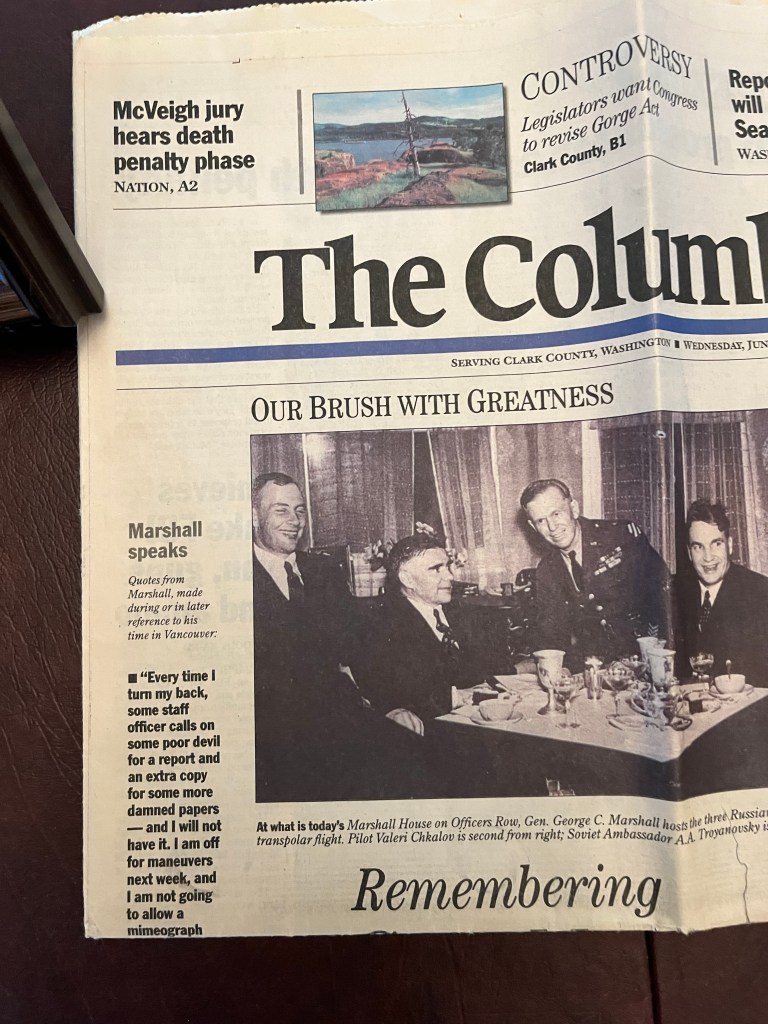
This was (to me) a whole new page from history !

In 1937, a Russian long-distance aircraft, called “Stalin’s Route”, and its crew of three flew 62 hours from Russia, over the North Pole, and were headed to California. Bad weather over the Pole caused them to run low on fuel and they had to land at Fort Vancouver.

The folks at the fort were caught by surprise, but in spite of the language barrier, did all the right things. The soldier manning the air field allowed the plane to land and protected it from being disturbed. General Marshall had the pilots escorted to his house where he provided baths, breakfast, and suits to wear, since all they had were their dirty flight suits. The crew were interviewed for the local newspaper and General Marshall invited them to sleep at his house.

The crew had a month-long tour of the U.S., ending in Washington D.C. where there was a state dinner with President Franklin Roosevelt before heading home to Russia.

Always something to learn, if you keep your eyes open.

Love,

Grandma Judy

Meeting Eloisa at Fort Vancouver

Dear Liza,

Fort Vancouver, Washington, is a historically accurate re-built fort that the Hudson’s Bay Company used as the hub of its fur trading network here in the northwest from 1825 to 1866. Seeing it again this week with a proper guide, I learned so much!

Britt, a wonderful Lone Fir volunteer who portrays “Bunko Kelly” on the Tour of Untimely Departures, had made the arrangements after learning that some folks connected to the Fort are buried right here in our own Lone Fir Cemetery.

Tammy Williams was our guide. She is so knowledgable and enthusiastic that she made the fort come alive! Her explanations of artifacts and the actual smells of the cookhouse let us feel the daily routines of trading pelts for goods, cooking for twenty people or more at a meal, and raising children of white, Indian, Hawaiian, and mixed lineage.

In particular, Tammy told us of Eloisa, one of Chief Factor John McLoughlin’s children. McLoughlin is often called the Father of Oregon for his running of Fort Vancouver in support of the American Pioneers who first came to Oregon.

Eloisa was born in Fort William, Ontario, while her father was stationed there. She was seven years old in 1824, when her family came to Fort Vancouver.
She married William Glen Rae, a man of violent temperament. They moved to Fort Stikene, Alaska, when William was assigned to the Hudson’s Bay Fort there. Eloisa hated the place, which was badly run and riddled with alcohol-fueled violence. She gave birth to her second child on the boat from Alaska back to Oregon.


William moved to another of the Company’s forts in Yerba Buena, what we call San Francisco. After her recuperation from childbirth, Eloisa and the children joined him.

Created with GIMP

Eloisa described Yerba Buena as a vibrant, interesting place. She saw bull and bear fights and partied with Spanish ladies and gentlemen.

William’s drinking and bad decision-making lead to his death by suicide, and widowed Eloisa and her children returned to Fort Vancouver. She re-married a manager of The Hudson Bay Company, Daniel Harvey, and had three more children. Sadly, Eloisa was a widow again at age fifty.

Eloisa’s life was exciting and tragic, full of experiences that were rare for women of her age, like traveling by steamship to Hawaii, and common, such as being widowed twice by age fifty. Eloisa passed away in 1884 at the age of 66, and is buried in our own Lone Fir Cemetery, alongside Daniel Harvey, Sr., and her sons Daniel Harvey, Jr., and James William McLoughlin Harvey. I will visit her next time I am in the neighborhood.

Love,

Grandma Judy

The Art at Fort Vancouver

Dear Liza,

The Visitor’s Center at Fort Vancouver is small, but full of wonderful information and beautiful art.

Walking into the Center, I was struck by how this sign affected me. Growing up, when I saw this sign, I knew we were in for a treat. My dad loved the Park Service and always made our visits special. The National Parks were his Happy Place.

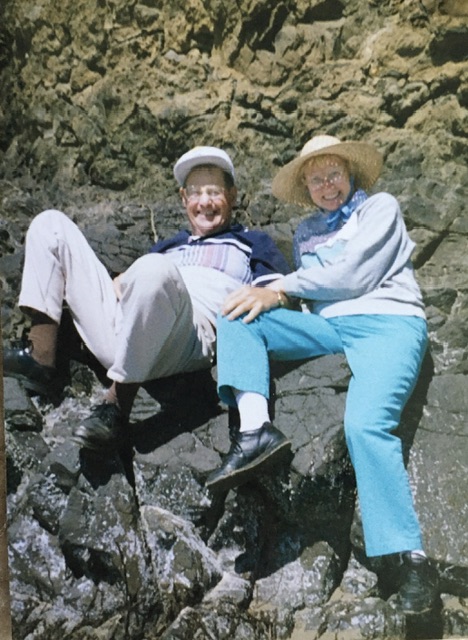
This picture of he and Momma was taken on our last outing together at Point Lobos in California.


The Visitor’s Center displays were full of the art and history of the place.
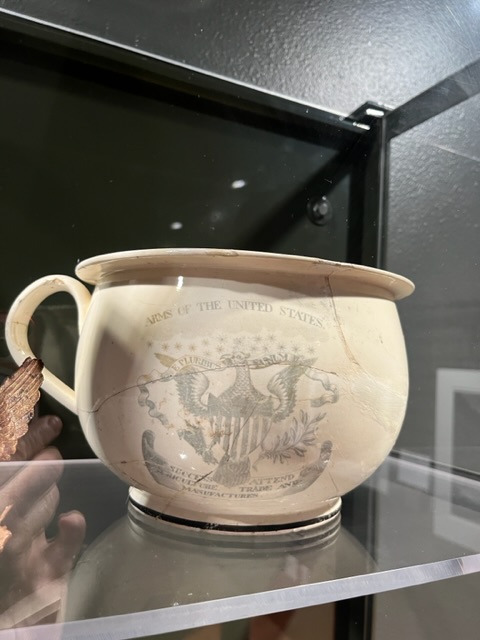
And since there was history, there was a chamber pot. This was from the Fort’s time under American rule at the beginning of the 19th century. It was found by archeologists who are still studying the fort’s past.

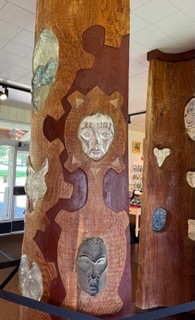
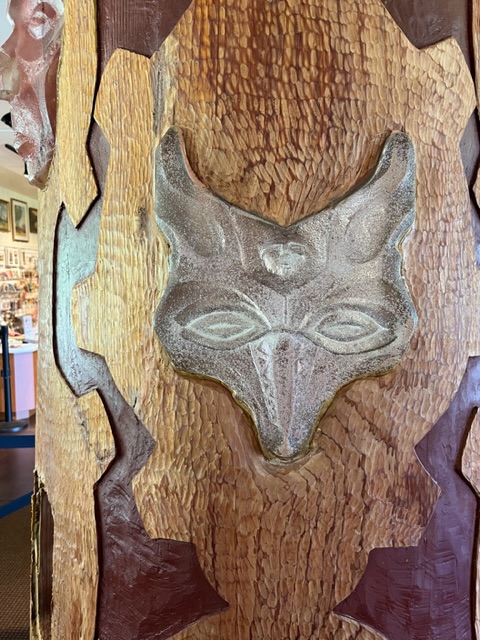
In the main part of the space was a wonderful display of contemporary Native art. Toma Villa’s imposing but inviting sculpture called Spirit Pole was made of one massive cedar tree which he cut in half longwise and hollowed out, making two tall, curved pieces. He then carved openings which he filled with cast glass pieces representing people, air, water, fire, and animals of the northwest.

The skill and vision this piece displayed was amazing. I couldn’t stop looking at it.

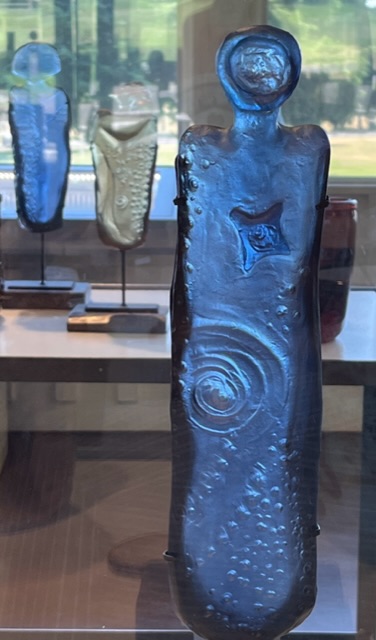
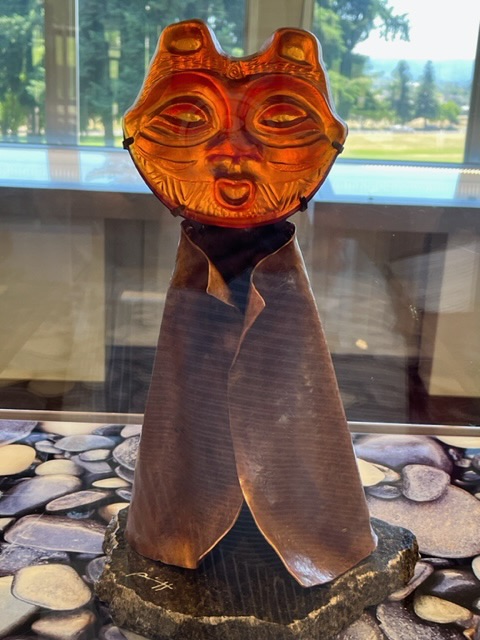
The unique glass and ceramic art of Lillian Pitt were also featured. I love that art by contemporary indigenous people is valued here.

These hand-formed glass pieces have air bubbles and textures that let the light play inside them, allowing them to come alive in my imagination.

What a great gift to all of us!

Love,

Grandma Judy

Fort Vancouver

Dear Liza,

After our delicious lunch at Twigs in Vancouver, we got in our cars and headed just a little out of town to visit historic Fort Vancouver. This was first founded by the British in the 1820s as a way of protecting their settlers in the area when this part of the Pacific Northwest was claimed by England, along with the rest of Canada.

The fort was home to hundreds of soldiers, merchants, and indigenous people, along with native Hawaiian craftsmen hired to keep the fort running. It was a very diverse population for its time.


In 1846, after a shift in the border between Canada and the US, the English abandoned the Fort Vancouver and American troops took over. They let the fort fall into disrepair and it eventually burned down under not-so-mysterious circumstances.

The Fort Vancouver we can walk around in today is a 1970s reconstruction, based in maps and descriptions from the 1820s. Still, it lets us see what life was like for all those folks so many years ago.

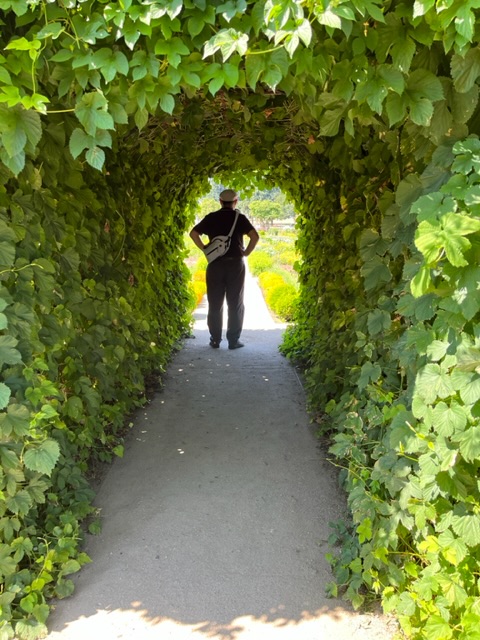
This thick, cool arbor made for fine summer shade and grapes to be harvested in the fall.

The bakery must have been kept busy all day making biscuits for travelers as well as bread for the hundreds of folks at the Fort.


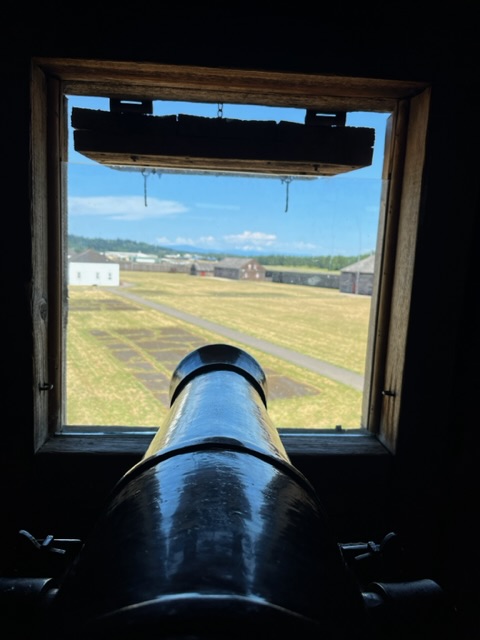
The view from the bastion tower was very cool. I hope they never had to fire this one! It’s pointed into the fort!

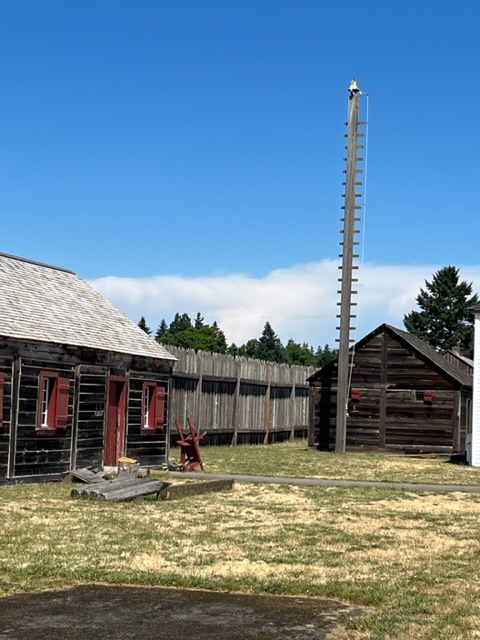
Grandpa Nelson and I walked around the 1976 reconstruction of the old fort, which was enclosed by pointy wooden ramparts. It included a replica of First Factor Dr. McLoughlin’s beautiful house and buildings for the bakery, the jail, the infirmary (doctor’s office) .

On that hot afternoon, we could certainly sympathize with the soldiers who had been stationed here, exposed to heat and cold, rain and snow, with only thin wooden walls between them and the elements.

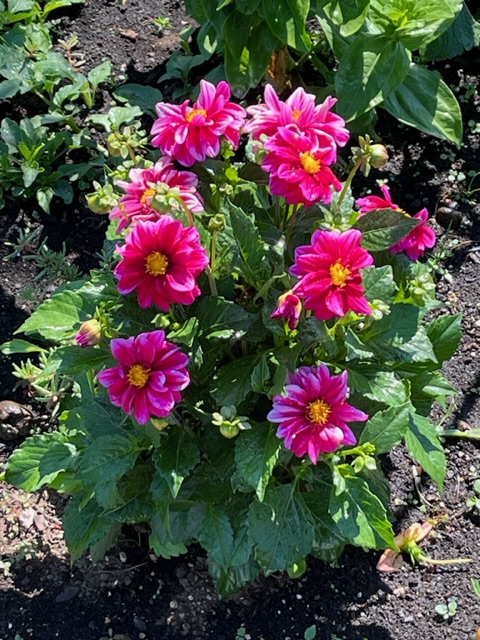
The gardens and livestock were outside the gates, where there is now a lovely, well kept flower and vegetable garden. I imagine it was a bit more rustic when every drop of water had to be carried by bucket. Still, the dahlias were gorgeous.

There are other sections of Fort Vancouver, including stately officers’ houses from the World War II era when General John Marshall was in charge here, but we didn’t visit those. We ran out of oomph and went for ice cream at Ice Cream Renaissance , then said good-bye to dear Julie and Carl and headed back across the river to have a nice rest at home.

Love,

Grandma Judy