Kawandi News

Dear Liza,

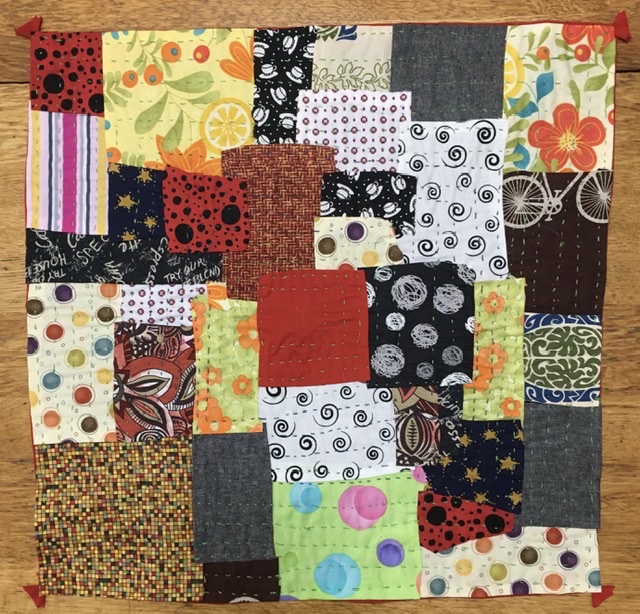
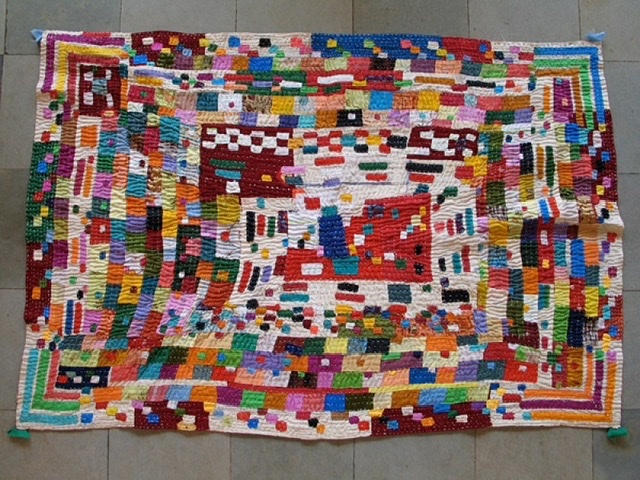
A few weeks ago I told you about discovering the art of Kawandi quilting, and how the Siddi people of southwest Africa brought it to India hundreds of years ago. I posted about my first try, then my second quilt made with Ruth Andresen’s tie silk.

And then something wonderful happened! I got a message from Irmgard Jacob, a lady who who lives in Ontario, Canada, and we wrote back and forth about Kawandi. “Isn’t it nice we can connect and work together like this across so many miles?” She said. She has even visited India and has family there.

This is the second time my blog has led to connections with friendly, interesting strangers, and it is like opening another door to the world.
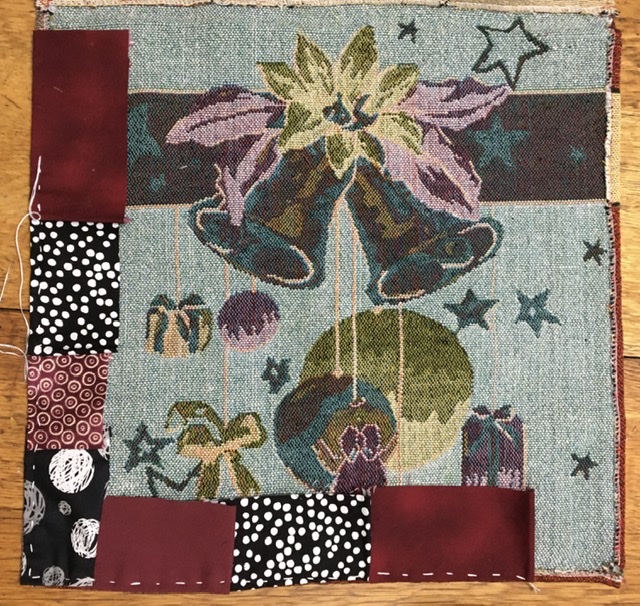
Six colors, cut in more regular shapes….

I took time off from Kawandi to do another project (which I will tell you about when the time is right) and then wanted to do another one. Auntie Bridgett found this old piece of Christmas decoration that she wasn’t happy with, and offered it as a backing for my next piece. Thanks, Bridgett!

Since I would rather use what I have than go buy something at a shop, I dug into my fabric box and came up with six colors that go together.

This time, instead of random squares and rectangles, I cut most of the pieces the same size, about a 2×4” rectangle. That allowed for easier overlapping and fewer stray corners. It also made for some very thick overlaps, so next time I will use thinner fabrics.

Since this was my third Kawandi, it went a lot faster. I had the hang of the long stitches and the more regular lines of color.
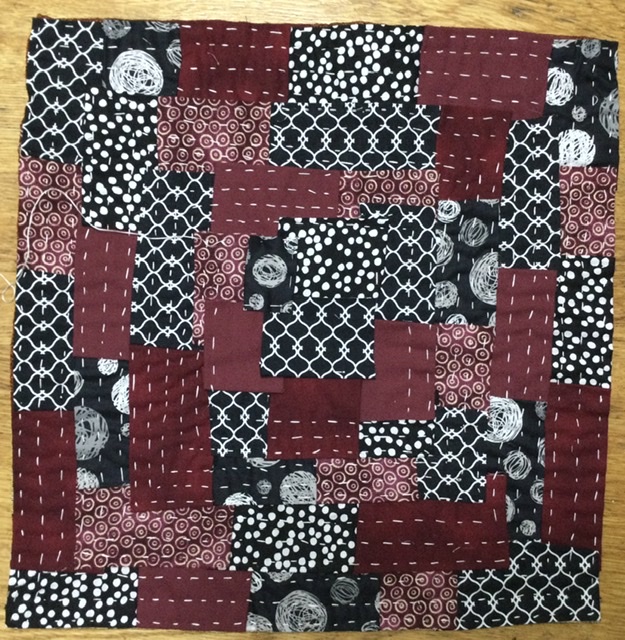
Almost done!

I got it done and am mostly happy with it. I don’t think I will do any more for a while, because I need to sit at the work table to do it and my back gets tired of being hunched over. I do enjoy playing with the colors and how quickly a piece comes together.

I think my next piece, whatever kind of needlework it is, will be of brighter colors. The rich reds and blacks of the Kawandi, and the dark greys and greens of my other project, are lovely. But I want to use some hot yellows and oranges, I think, to celebrate the summer.

And I’ ll show you that one when it happens!

Love,

Grandma Judy
Beginning Kawandi Quilting

Dear Liza,

This week, I have learned about a whole new kind of quilting! It has been an adventure in history, geography, and craft.

Kawandi quilting is from Western India and Pakistan, but it was brought there by immigrants from Africa. These Africans, called Siddis, introduced the kawandi quilts to India.

Kawandi are made from small pieces of fabric. They are not not patchwork quilts like we make in America, but an appliqué type. Each little piece, called a tikeli, is sewn onto the backing fabric using long straight stitches. A layer of batting or fabric is laid in between the top and bottom layers to make the quilt thicker.

Instead of outlining each piece, you sew in straight lines, following the square shape of the backing fabric. Most people who make Kawandi start on the outside edge, so that’s how I started. I looked at a few YouTube demos, and off I went.

Starting on the outside edge, I folded the edge of the backing fabric and the edge of the tikeli down to hide the rough edge, and sewed them together using stitches in a brightly colored thread. Unlike most types of quilting, you want the stitches to show. Before I got to the edge of the tikeli, I overlapped it with another, folded the edge under, and kept sewing in the straight line. Each bit got incorporated as I continued sewing.

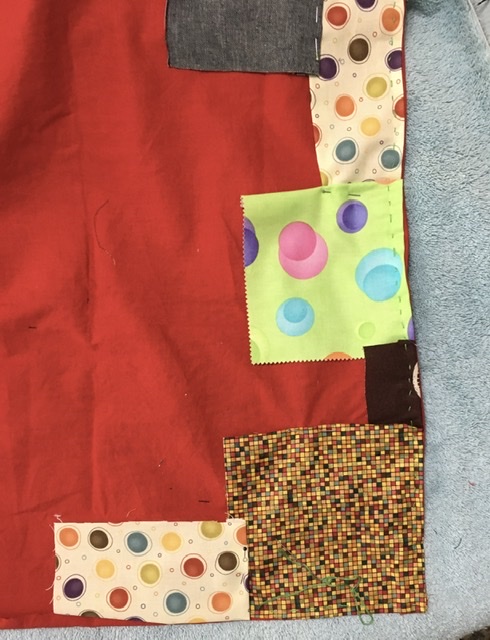
Once I had the whole outside frame done, I cut a piece of green Hawaiian fabric a little smaller than the whole piece and tucked it in so that it was enclosed. You can see it, very bright, in this picture. That’s the part of the quilt that still needs doing.

I continued sewing in straight lines, bringing in pieces of fabric that looked good. I had trouble with some tikeli whose edges didn’t fall in line with the stitching. I have since learned that you solve this problem by making sure your pieces DO line up as you add them. Well, yeah….


Each kawandi quilt is finished off with small triangles that stick out at each corner. These ‘phula’ serve no practical purpose, but the kawandi isn’t considered finished without them.


There are many things I like about kawandi quilting. It is new and interesting, and the results are really colorful. They are a great way to use up bits of fabric. You just cut squares and rectangles to get started. You choose the colors of fabric, but the exact pattern can be sort of discovered as you go along. It is delightfully improvisational. “Oh, I need a lighter patch here… hmmm, yes, this is nice!”

I know there are lots of things about Kawandi that I don’t understand yet, but I have just finished my first Kawandi quilt and have gotten the hang of the basics. My next one will be better. Stay tuned!

Love,

Grandma Judy

.