
Dear Liza,
This week, I have learned about a whole new kind of quilting! It has been an adventure in history, geography, and craft.
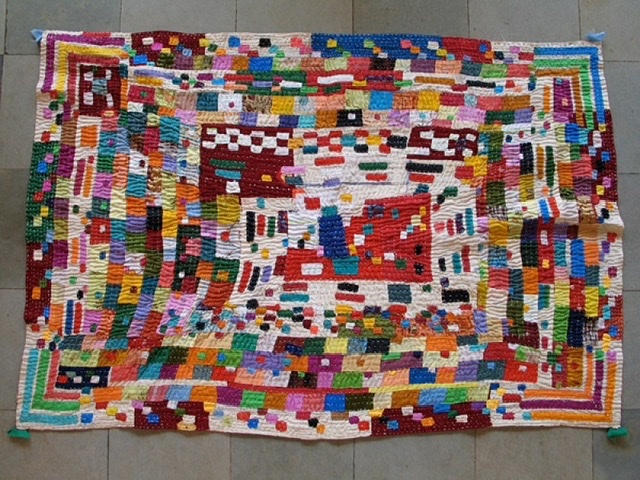
Kawandi quilting is from Western India and Pakistan, but it was brought there by immigrants from Africa. These Africans, called Siddis, introduced the kawandi quilts to India.
Kawandi are made from small pieces of fabric. They are not not patchwork quilts like we make in America, but an appliqué type. Each little piece, called a tikeli, is sewn onto the backing fabric using long straight stitches. A layer of batting or fabric is laid in between the top and bottom layers to make the quilt thicker.
Instead of outlining each piece, you sew in straight lines, following the square shape of the backing fabric. Most people who make Kawandi start on the outside edge, so that’s how I started. I looked at a few YouTube demos, and off I went.
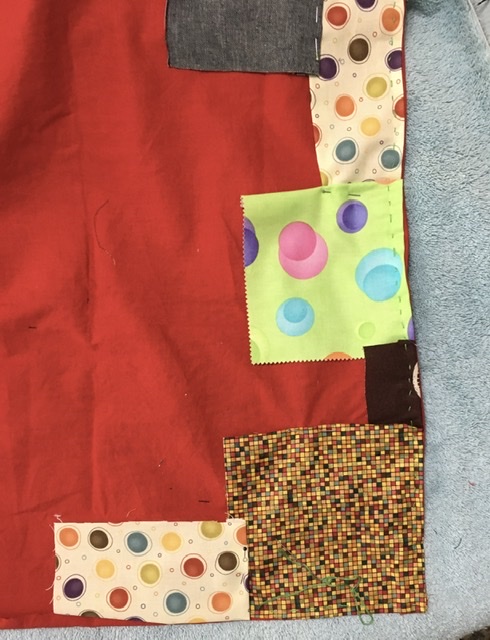
Starting on the outside edge, I folded the edge of the backing fabric and the edge of the tikeli down to hide the rough edge, and sewed them together using stitches in a brightly colored thread. Unlike most types of quilting, you want the stitches to show. Before I got to the edge of the tikeli, I overlapped it with another, folded the edge under, and kept sewing in the straight line. Each bit got incorporated as I continued sewing.

Once I had the whole outside frame done, I cut a piece of green Hawaiian fabric a little smaller than the whole piece and tucked it in so that it was enclosed. You can see it, very bright, in this picture. That’s the part of the quilt that still needs doing.
I continued sewing in straight lines, bringing in pieces of fabric that looked good. I had trouble with some tikeli whose edges didn’t fall in line with the stitching. I have since learned that you solve this problem by making sure your pieces DO line up as you add them. Well, yeah….

Each kawandi quilt is finished off with small triangles that stick out at each corner. These ‘phula’ serve no practical purpose, but the kawandi isn’t considered finished without them.
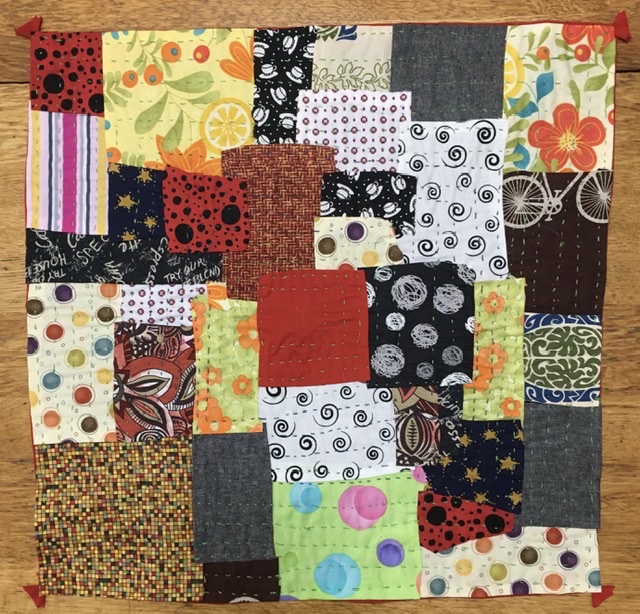
There are many things I like about kawandi quilting. It is new and interesting, and the results are really colorful. They are a great way to use up bits of fabric. You just cut squares and rectangles to get started. You choose the colors of fabric, but the exact pattern can be sort of discovered as you go along. It is delightfully improvisational. “Oh, I need a lighter patch here… hmmm, yes, this is nice!”
I know there are lots of things about Kawandi that I don’t understand yet, but I have just finished my first Kawandi quilt and have gotten the hang of the basics. My next one will be better. Stay tuned!
Love,
Grandma Judy
.

 Dear Liza
Gotta go play Bridge with the girls. I’ll need more time to absorb all this. Are you planning to tackle something like this in your lifetime?
LikeLike
Sent from my iPad
LikeLike
This a news quilting idea for me especially since I enjoy engaging scraps. Will be thinking on a kawandi quilt for a first-baby. Thank you!
LikeLike
Having read as much as I could online, I think that the tikeli (which translates as ‘jewels’) are just the little colourful patches which are randomly sewn on top of the main pieces of fabric. I don’t think all the pieces are called tikeli.
LikeLike
Thanks for the information!
LikeLike
Thanks for the information, Suzanne.
LikeLike
Thank you for the information! I’m hoping to learn this technique soon! Just wanted to clarify the Africans who brought this technique to India were not “immigrants.” They were slaves held by Portuguese slave holders. Their descendants remained in India and still have communities in remote areas of India where they’ve retained much of their African culture.
LikeLike
Hello Susan, Thank you so much for the information! I love learning more about the history of (well, everything) crafts and the people who make them. Thanks for reading my blog!
LikeLike