Taking the Banfield to Edgefield, Part 2

Dear Liza,

Yesterday I told you about the Multnomah County Poor Farm at Edgefield, just east of Portland. Today I will tell you what The McMenamin brothers, Mike and Brian, did with the farm.
IMG_7909.jpg
Down the Rabbit Hole?

The brothers had been successful at creating restaurants and pubs out of scruffy buildings, but had never taken on a project this big. There were 292 acres and every inch of every building and every square foot of land needed work. Flooring was damaged from broken windows letting in animals, vandals and rain.img_79111.jpg
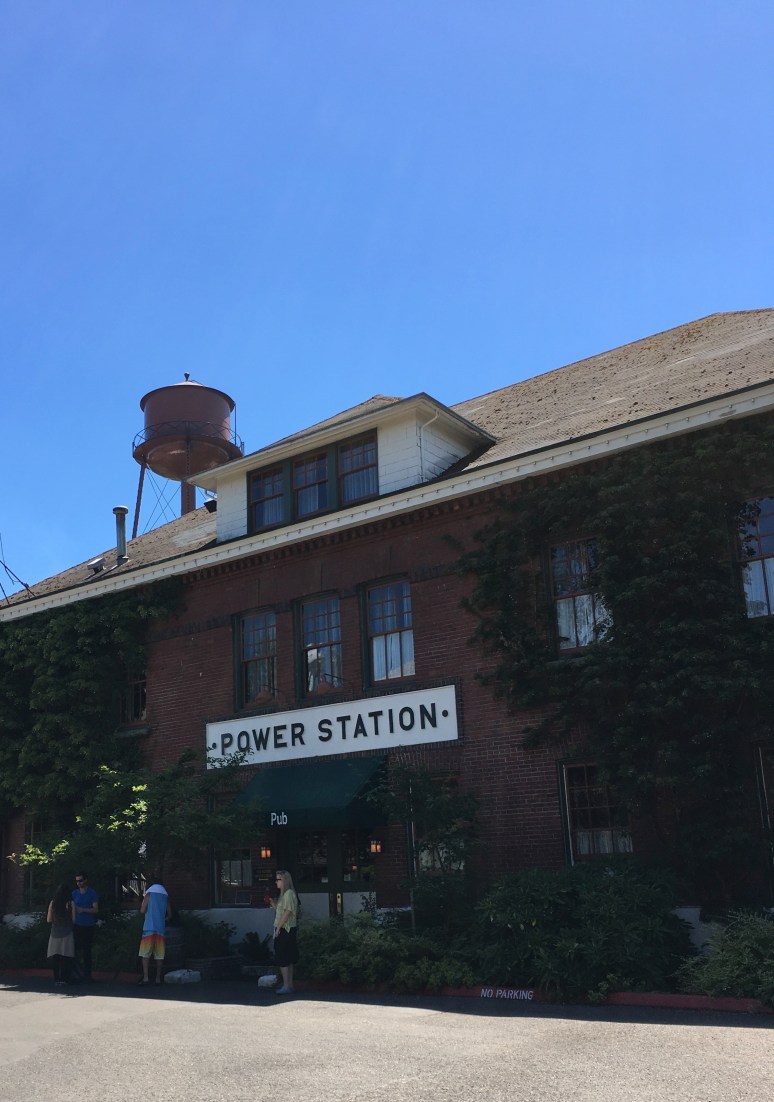
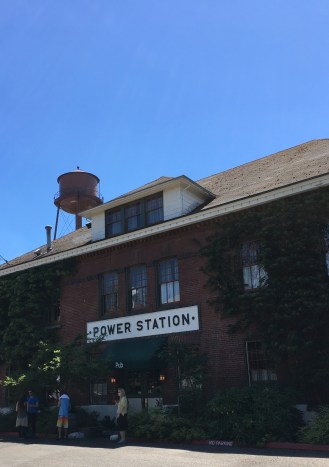
The first building they got up and running was the Power Station in 1991, as a guest hotel, theater and restaurant. People came, stayed, paid, and the brothers’ bankers realized this could be a success.

The brothers envisioned what they called a “down-the-rabbit-hole” experience, a place like nowhere else. There would be no phones, no televisions, no smoking, just food and wine, beer and cider, sunshine, rain, gardens, art and comfort.
IMG_7892.jpg
ART!

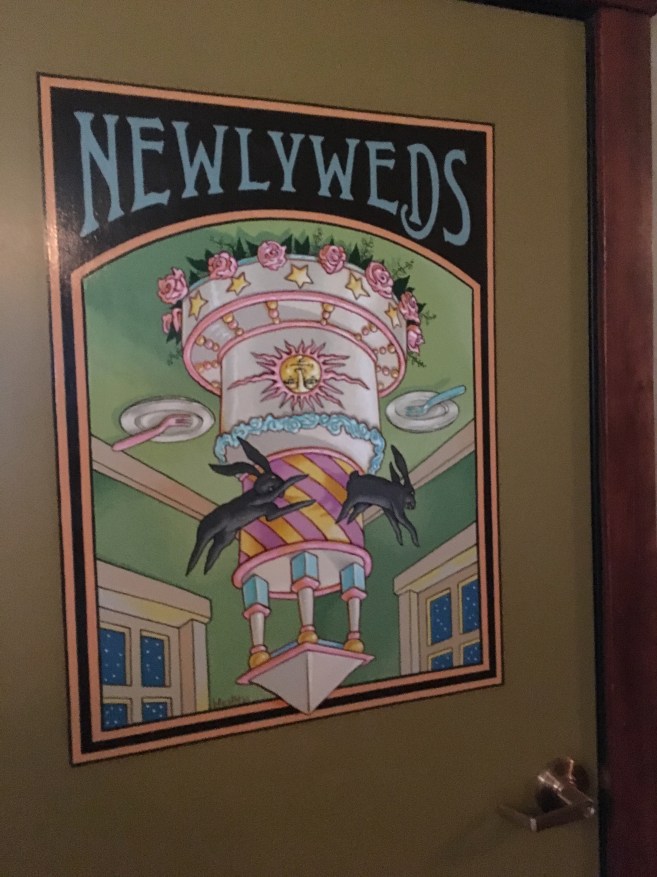
Once the Power Station was up and running, work on the main building, called The Manor, got under way. Having been built for people in wheelchairs, all the doors were really wide. The brothers decided that rather than replace every single door, they would have a staff of artists paint each one, making each room a unique place. That worked so well that they hired more artists, and now art covers all the doors, ceilings, and is hung on every wall.

The building had been vandalized while it was empty, including someone painting a pentagram at the head of the main staircase. The brothers wanted good energy, not bad, in their place, so they hired a troupe of bagpipers to come out. The musicians formed a circle around the pentagram, played “Amazing Grace,” and painted over the evil symbol.

IMG_7906.jpg
Thursday at McMinamen’s

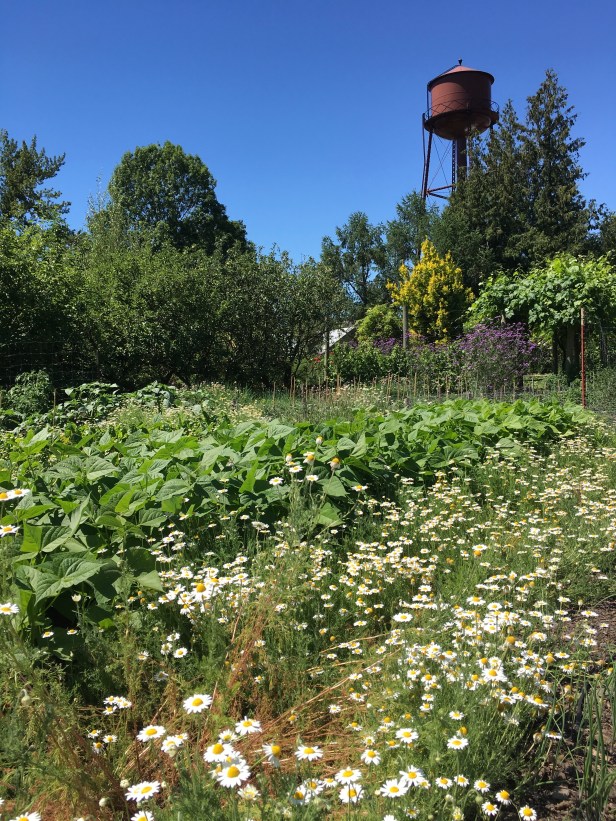
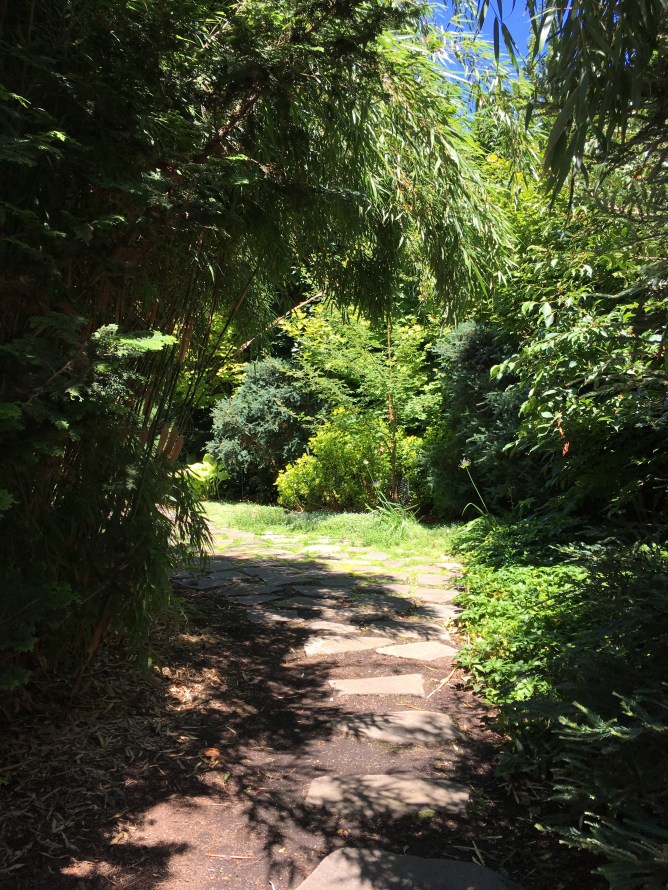
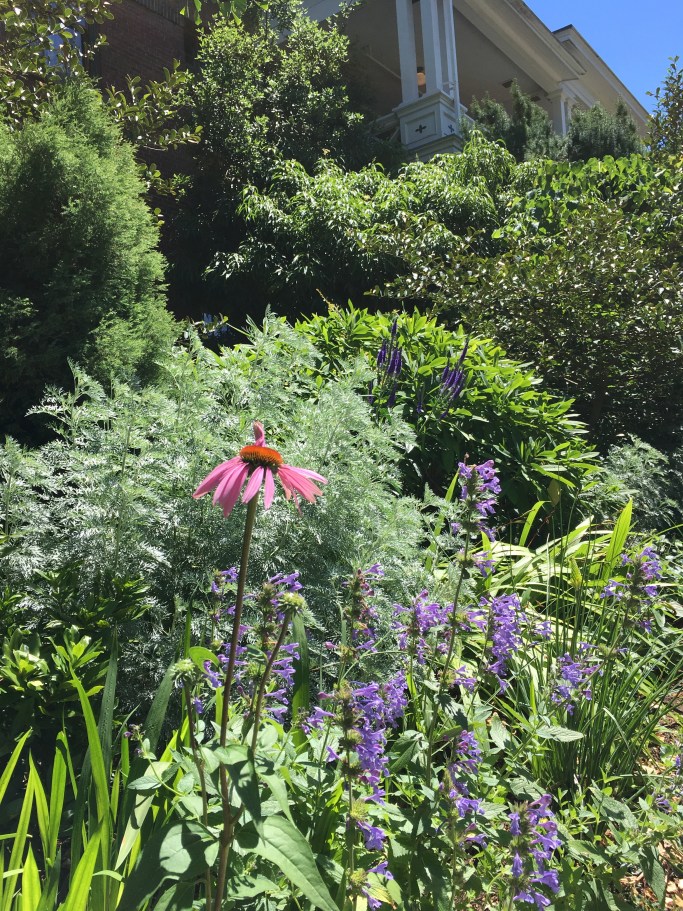
The gardens needed redoing. Patrick McNurney was the landscape guru for the property. There were almost no trees, and lots of weeds, but he knew that the land was fertile. He was instructed that there shouldn’t be any straight lines in the gardens, and that the plants should all dance together. He succeeded beautifully.
IMG_7908.jpg
Flowers Dancing Together

There is an herb garden, fruit and vegetable garden, and winding paths through groves of aspens and birches. There is a spa with a serpentine hot tub to float and nap in. There is currently a winery, brewery, bakery and distillery on the premises. Yes, it IS heaven.
GetFileAttachment-1.jpg
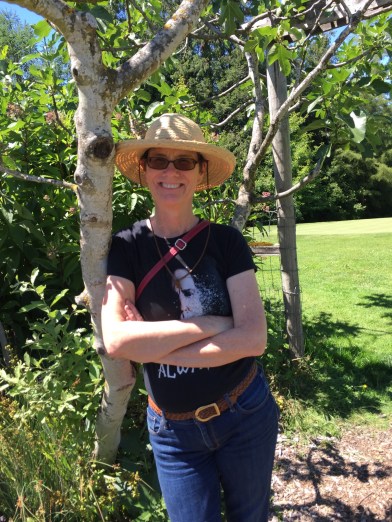
A Very Happy Grandma Judy

We enjoyed our day at Edgefield. On the way to the place, we found Ben Pilchuck and his partner blowing glass in the old shop. We had brunch The Black Rabbit Restaurant (there’s a story in the name, too), then a tour around the place with Thursday, who has been working for McMenamin’s for 35 years. She is funny and knowledgeable, and I will be talking to her more, I hope.

It would take weeks to see the whole place, and pages more to tell you all about it. I will show you this wonderful place when you come to visit.

Love,

Grandma Judy
 

Taking the Banfield to Edgefield, Part 1

Dear Liza,

Yesterday we had a road trip, going 14 miles east of home. We actually got on a freeway!  ( Not nearly as common for us here as in California). The number 84 freeway is also called the Banfield. We went out to visit Edgefield.

IMG_7857.jpg
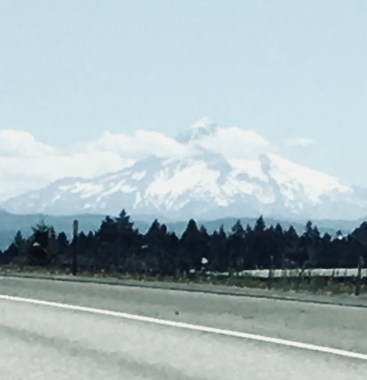
Mt. Hood in the distance

Edgefield is a beautiful, interesting place with an even more interesting past. From 1911 to 1982, this complex of buildings and farms was the county poor farm, 292 acres of land where people came when they had no where else to go.

There was a real farm, with cows, pigs, chickens, orchards of fruit and acres of vegetables, which was tended by the folks who lived here. They provided food for their own tables, as well as to the county jail and juvenile facility.

IMG_7895.jpg
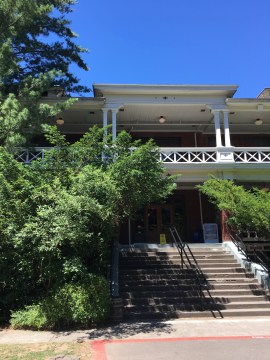
Main Building

There was a power station to supply electricity for the place. The staff had farmers, nurses, cooks, and administrators. The residents weren’t required to work, because some were old and sick. But if you could work and did, you ate better than if you could work and didn’t. The Depression, when many people were poor, filled the place up, and World War II, when lots of work was needed, emptied it of able bodied people, leaving just the old and sick.

IMG_7949.jpg
Gardens and Original Water Tower

After the war, Social Security and other social safety nets came into being, and fewer people needed to live on the farm. A hospital was built as the population got older. By 1982, the buildings were too old and out of compliance with safety laws, and there were so few residents that the County moved them to other hospitals and closed Edgefield down.img_7911.jpg

It stood, abandoned, for eight years. It was big, old, in need up repair, and quite a way out of town. No one knew what it could be used for.

Then The McMenamin brothers, Mike and Brian, who are known as The Brews Brothers because of their work developing the microbrewery industry in Oregon, came along. These men had, by 1982, created more than a dozen bars and restaurants out of historic, abandoned buildings. They had been successful in re-imagining spaces they felt were worthy of saving. In 1990, they saw Edgefield  and fell in love.

I will tell you what they did next tomorrow!

Love,

Grandma Judy

Friends, Pizza, and Art

Dear Liza,

IMG_7830.jpg
View of the Lan Su Chinese Garden from across the street

My projects continue to keep me busy. I am finishing Cousin Kestrel’s princess kitten birthday present and had to change my story a bit. Did you know that in America in early 1900s, classes in the U.S. didn’t go on field trips? At that time,  they were not considered valuable. So I needed to remove a field trip from my 1903 story. Sigh.

Yesterday I also had a nice surprise. A former student and his wonderful family came to visit! First they visited famous Powell’s City of Books, and then came to see me at Auntie Katie’s Books with Pictures. They had fun and bought tons of books! Then they invited me to have lunch with them at Old Town Pizza, a “haunted” pizza parlor downtown.

IMG_7835.jpg
Lovely friends!

Of course, I said YES! Pizza, friends, ghosts? I’m there!

The pizza was good and the air conditioning most welcome, as it has been hot here. (Hot for US, like 80 degrees. I understand many places are really suffering.) I didn’t notice any ghosts. After Kyle, his sister Gillian, Mom Heidi and Dad Paul headed off to the Creo chocolate tour, I caught the Orange train back to Auntie Katie’s shop and rode my bike home.

Since it was First Friday, we walked up to Ankeny Tap and Table for street tacos, grilled Brussels sprouts, beer, cider, and french fries. Yum! We walked over to the Sidestreet Gallery to see Auntie Bridget’s new art, as well as all the other new things. I got to meet Dawn Panttaja, Erin’s aunt, creator of lovely, odd sculptures. This one is called “Miss Fortune”, with a skirt made of old prophesies. Creepy and beautiful.img_78521.jpg

Auntie Bridgett was going to stay and talk to folks, but Grandpa Nelson and I walked to the Laurelhurst Theater to watch “Jurassic World: Fallen Kingdom”img_7854.jpg, which was a fun roller coaster ride with an ending that surprised me.

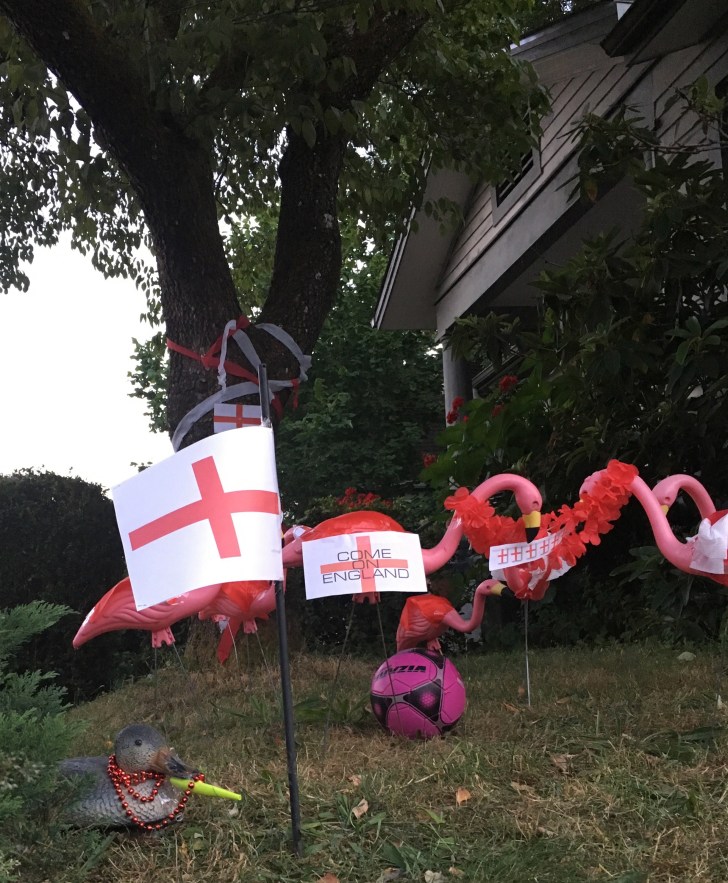
Walking home, we swung by the flamingo house, where the birds are apparently enjoying the World Cup Soccer games.

Happy July!

Love,

Grandma Judy


Bioswales

Dear Liza,

Portland is known for getting a lot of rain. Not now, of course, it has been dry and in the 80s! Most years, in fall, winter and spring, we get about 36 inches, or three times as much as you do in Salinas. Building a city where there is that much rain has its own problems.

You want to make sure the streets drain nicely so houses don’t flood. You want to make sure soil doesn’t erode and turn hills into mud slides. And you want to make sure that pollution and trash from city streets don’t end up in the Willamette River.

City engineers work hard at making sure the first two problems are solved. Storm drains are kept clear and streets are graded so they carry water away quickly. But keeping trash and pollution out of the river has become something a lot of homeowners are helping with.

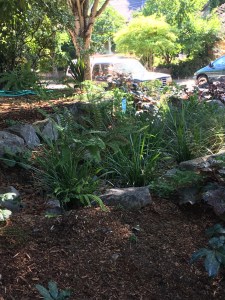
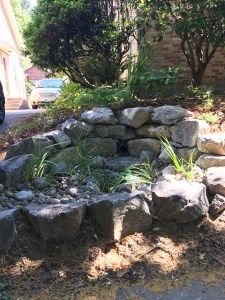
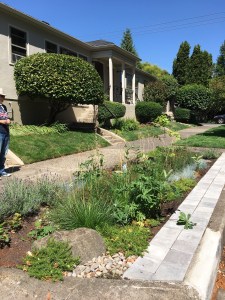
Bioswales are part of this solution. They are a sunken part in a garden, designed to catch rainfall from the roof of buildings. The water flows into the bioswale and slowly soaks into the ground water, or aquifer. This keeps it from running along the street picking up oil and trash, and also helps clean it before it goes back into the water cycle.

I am noticing small bioswales in front yards all over our neighborhood. They are all set up with conduits from the downspouts to direct rainwater into them. They are lined with rocks and gravel to resist erosion, some lined with plastic except at the bottom. The prettiest ones are landscaped with plants that are comfortable being very wet (even underwater) for part of the year.

I love that people here are taking responsibility for helping keep our beautiful Willamette River clean. For many years, factories along the river dumped all sorts of nasty chemicals into the river, hoping they would just wash away. Now there are companies helping clean the river, and people want to help, too.

Yay Portlanders! Yay bioswales!

Love,

Grandma Judy

Baseball on the Fourth

Dear Liza,

img_7785.jpg
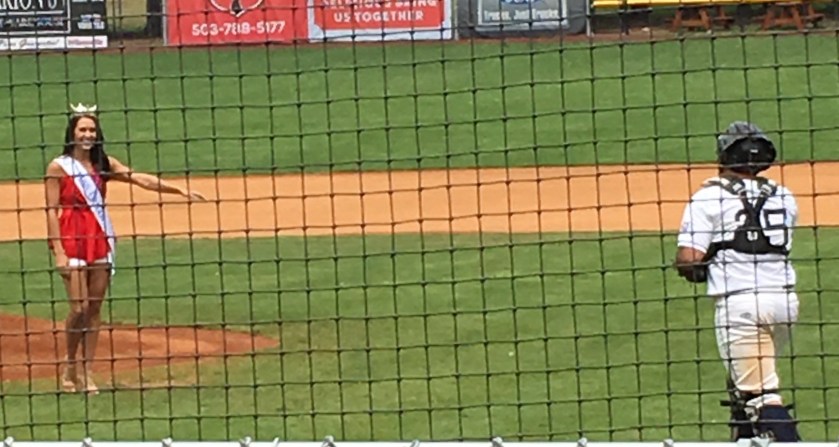
The First Pitch, Courtesy of Miss Oregon

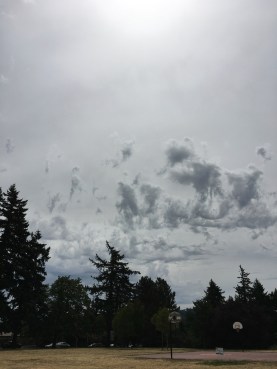
For the Fourth of July, Grandpa Nelson, Auntie Bridgett and I went to Lents Park, in the far southeast part of the city, to watch some baseball. Portland doesn’t have any professional teams, so these were teams made up of young men from colleges from all over the west. We watched the Portland Pickles play against the Gresham Grey Wolves.The weather was very warm, with interesting grey clouds.

IMG_7765.jpg
Clouds!

Lents Park has tennis and basketball courts and baseball and soccer fields. There are a few Little League baseball fields, as well as the main field, which holds 1,500 people. Before the game we got to see the new Miss Oregon throw out the first pitch, and another young lady sing a lovely version of the National Anthem. There was also a goodly amount of country music. It felt a hundred miles away from hipster downtown Portland, instead of only five.

During the game, it was fun watching all the people. The grownups were trying to stay cool and eating every piece of fried food they could lay their hands on. The kids were walking around and around the stadium, eating gallons of snow cones.

The teams played well, and it was interesting to see young men from Hermosa Beach, California (where Grandpa Nelson lived when I met him) playing against kids from Eugene, where I was going to college when your daddy was born. The starting pitcher for the Pickles is a student at Cal State Monterey Bay, right close to you!

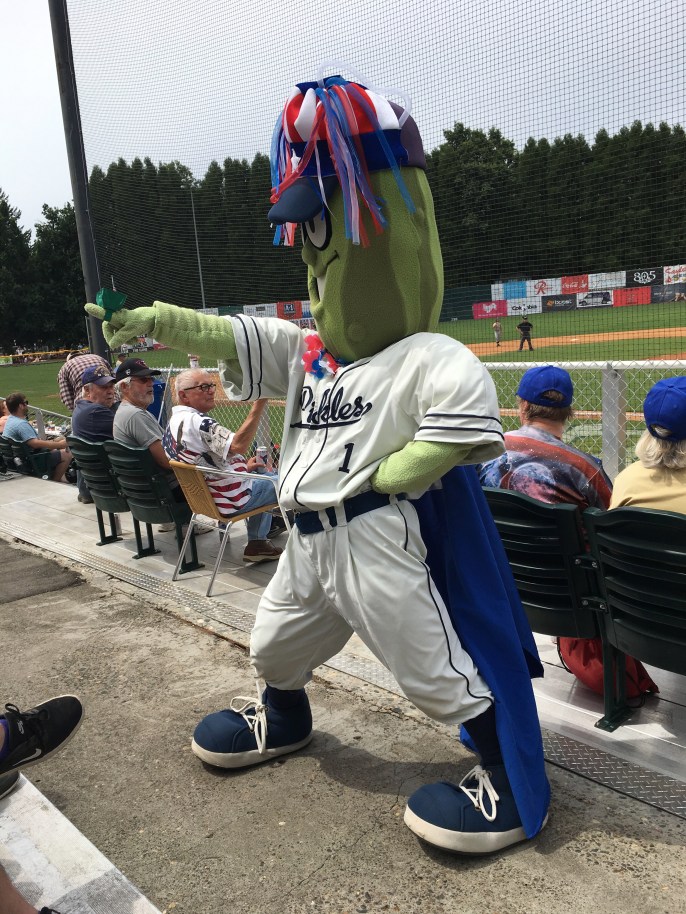
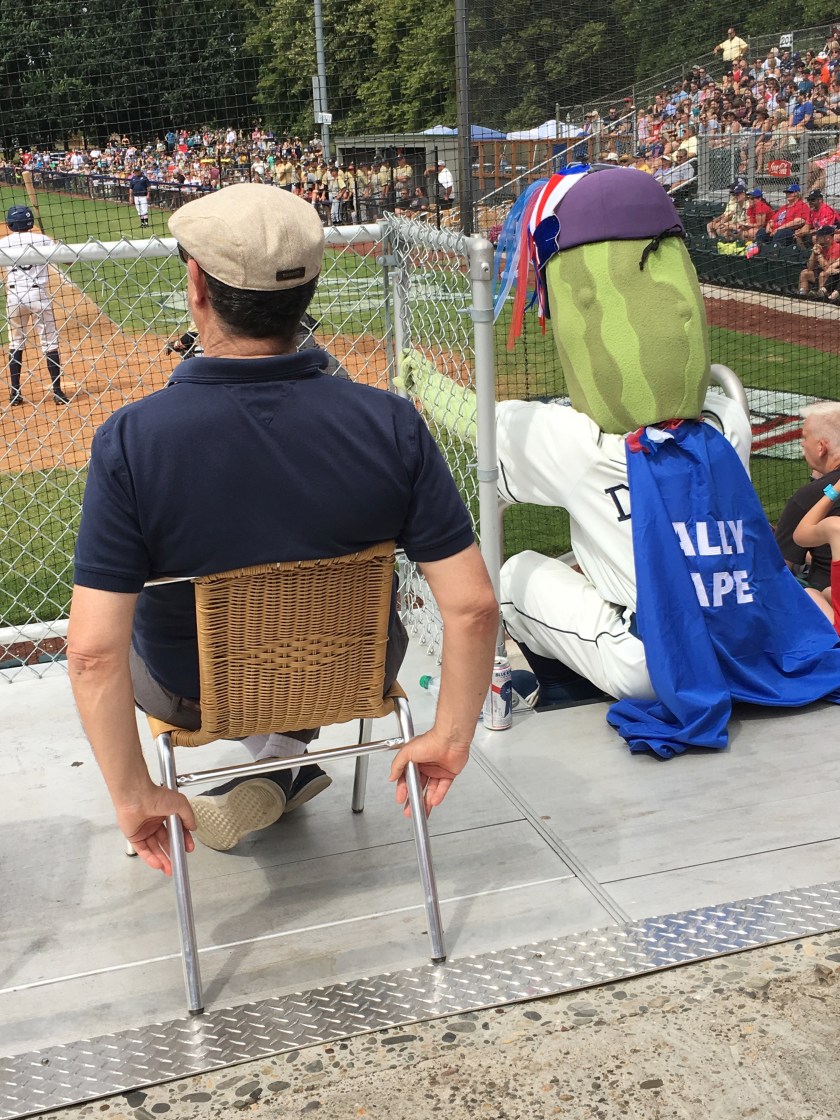
Dillon, the dill pickle mascot of the Portland Pickles, came out and visited with the crowd. Kids gave him high fives and he stood for dozens of pictures, though it must have been over a hundred degrees in his heavy costume. If you will excuse the pun, he is a bit of a ham.

IMG_7802.jpg
Dillon the Pickle Mascot

Since there was going to be a double header (that means two games in one day) , each one was going to be short, just seven innings instead of nine. That was okay with us, really. The Pickles were not playing well and we lost, 3-1, to the Grey Wolves. It was hot, we were tired, and ready for a lay-down before fireworks this evening.

After we got home and rested, the clouds came in heavier and it actually rained! So much for fireworks! We played Scrabble, which Bridgett won in a landslide, and watch “Yankee Doodle Dandy” with James Cagney.

IMG_7804.jpg
Grandpa Nelson and Dillon, Chillin’

I hope you and the family had a wonderful Fourth of July!

Love,

Grandma Judy


Dr. C. Gee Wo

Dear Liza,

I love researching history! Since my story takes place in 1903 Portland, I am getting to know about people who lived here then, and how things were for them. One thing that was really different was that there were laws against some people living here. These were called Exclusion Laws.

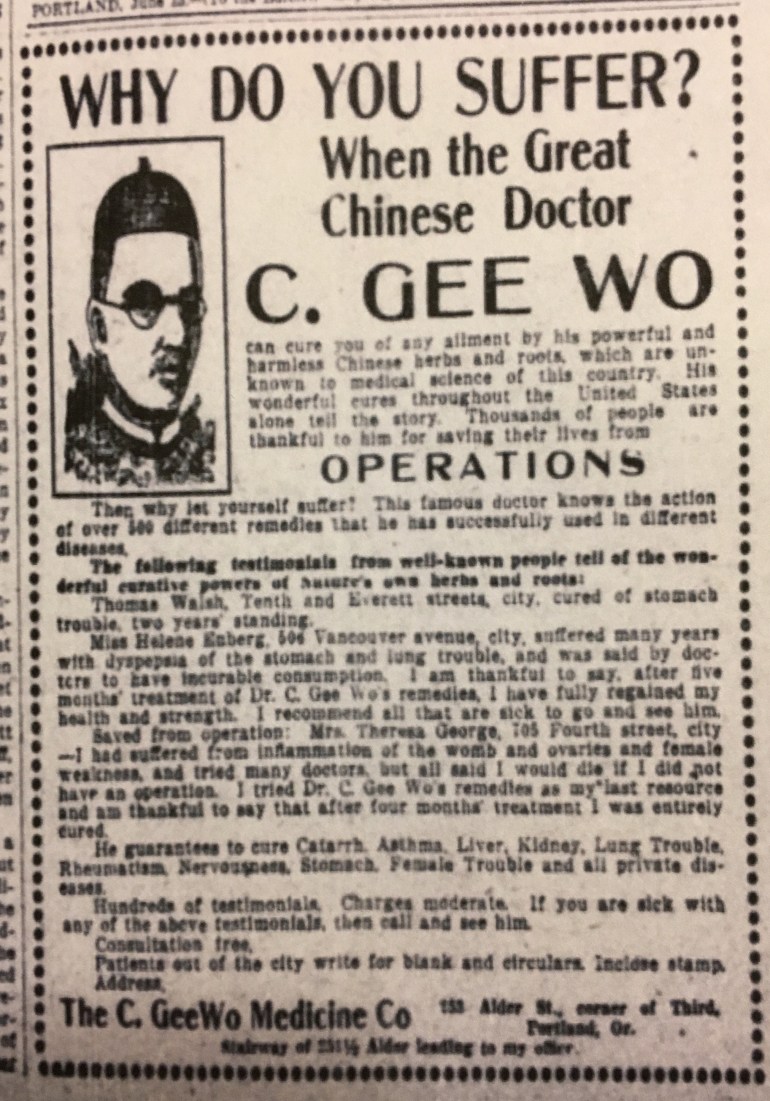
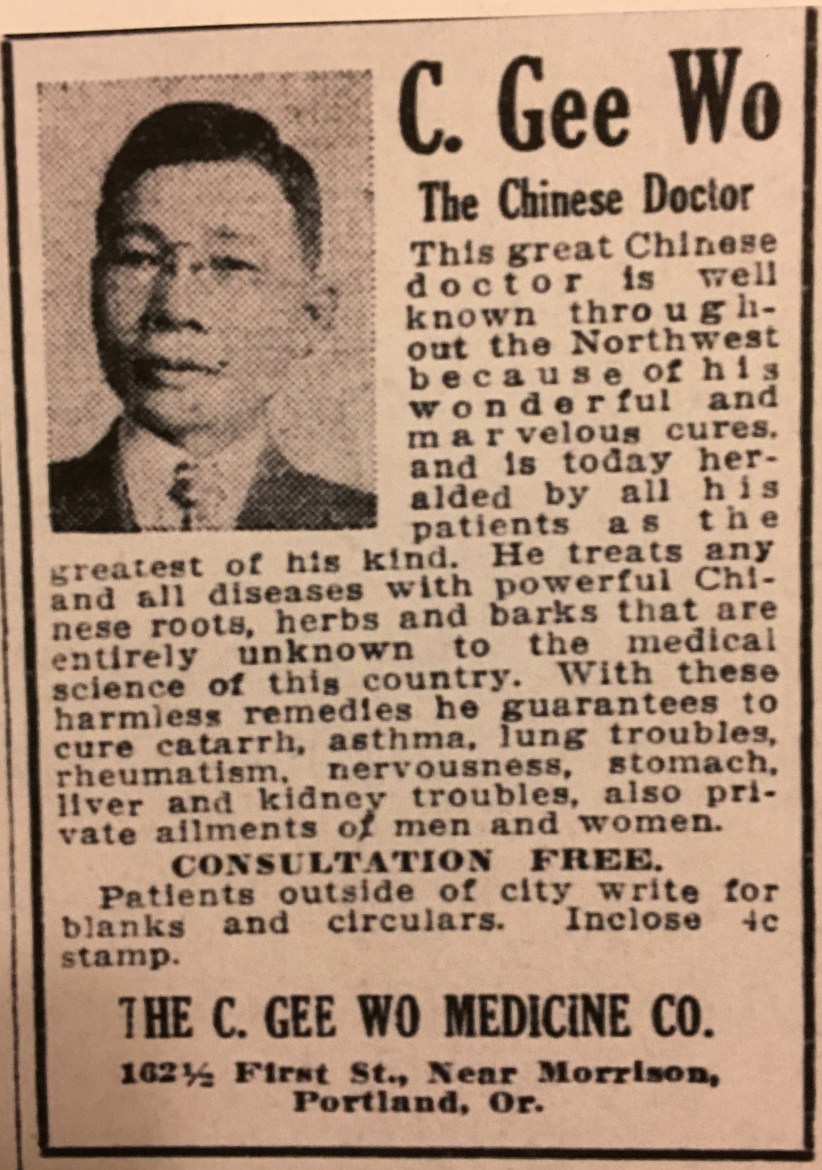
But life usually finds a way, as in the case of Dr. C. Gee Wo, a real Chinese person I have learned about and put into my story. Dr. Wo was from China and was an herbal doctor, using teas and herbal medicines to help make people better. He studied for many years, in China and America, to be good at his profession. He moved to Omaha, Nebraska, where he had a popular practice for eleven years, from 1889 to 1900.

img_7753.jpg
Dr. Wo’s ad in Portland newspapers, 1900 to 1910

During that time, he married a white lady name C. DeWitt (I can’t find her first name anywhere, just her first initial. Maybe Caroline? Celestine? Charlotte?) In 1900, they moved to Portland, Oregon, and Dr. Wo opened his herbal medicine practice.

At that time, the Exclusion Laws said Chinese people couldn’t own property, so Chinese needed to rent apartments, mostly in the neighborhood on the west side of the river. But Dr. Wo’s wife was white, so she could buy property where they wanted. They bought a small house, and, when business was better, built a bigger house next door.

img_7754.jpg
His ad from 1910 to 1920

As the years went on, Dr. Wo became a respected member of not just the Chinese community, but of the city of Portland. He donated to victims of the San Francisco Earthquake in 1906. He contributed to local causes and invested in businesses. He helped the city grow.

Dr. Wo retired about 1915, but stayed active in the community at least until 1921, when he made a large contribution to the local Community Chest fund. I haven’t found any information about him after that time, but I will keep looking. Being a history detective is exciting!

Love,

Grandma Judy


Inspiration from Everywhere

Dear Liza,

Welcome home! You just got back from your long visit with Grandpa Victor and Baba Alla in Moscow. I enjoyed all the photos you sent. I imagine you are speaking very good Russian by now.

I have been doing several projects here, dividing my time between them. The first is finishing Ruth’s quilt, which I got done, folded, and sent off yesterday. It should be arriving in Salinas this week.

The second project is making Cousin Kestrel’s birthday present. She is turning seven this week, and is celebrating with a Princess Kitten themed party. I am working on a pillow (or maybe it will be a wall hanging) of a princess kitten. Here it is, as of now. There will be lots more curlicues.

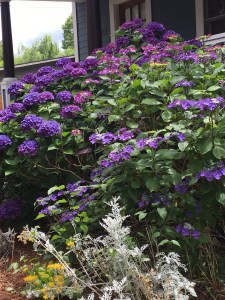
I have also been walking around the neighborhood. The hydrangeas are all coming out so blue!! That may be a usual thing here, but it is sure a surprise to my California eyes! Also, the lilac bushes here smell like lilac….in California, you were never quite sure.

Working on my story is taking up some time, too. It is getting better, but since it is a history story, I want to have all the facts right. I am reading about the Chinese Exclusion Laws, which said that Chinese people weren’t allowed to live in Oregon. Remember last week we visited the Lan Su Chinese Garden? So you can see how that turned out. Studying history lets me see how foolish it is to try and keep people out because they are different.
My last ongoing project is studying French. We hope to travel in Europe some more, and it’s just good to keep my brain busy, so I spend half an hour a day on Duolingo or reading in French. Duolingo is FREE online and goes at my own pace, so I can keep trying until I get it right. C’est tres amusant!

Have fun at your next summer adventure, sweetie.

Love,

Grandma Judy

Dinner at Sunnyside

Dear Liza,

Friday is usually our night to go out to eat, but this Friday the weather was so beautiful we decided to eat OUT, like outside, instead!

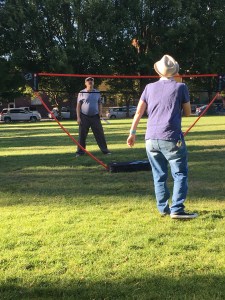
I roasted some vegetables and chicken during the day, and made a nice salad. We packed up food, a nice red wine, and the badminton set, and walked the three blocks to Sunnyside School. I like a lot of things about Sunnyside. The two story brick building from 1925 is beautiful. It houses both an elementary school and an environmental middle school. And the playground becomes a public park when school is not is session.

We picked our “table”, a flat spot under a sycamore tree, and spread out the blanket. The tickets are free to this human theater. While we ate we watched dads play catch with kids, teenagers shoot hoops, girls giggle on the steps, and toddlers chase pigeons.

After food and wine, it was probably silly to try the first game of badminton of the season, but we did it anyway. We were just as awful as we were last September, when the set was new, but we improved as the wine wore off and we remembered how long the rackets made our arms. Our longest volley of the evening was 11 hits without a drop.

It wasn’t pretty, but it sure was fun!

When we had thwacked our last birdie, we packed up and walked home in the evening light. Fluffy clouds floated by and. trees rustled. We got into pajamas, watched the Giants win, and fell asleep on the couch.

I woke up this morning painfully remembering that I am not 20 anymore, but happy for the adventure. More badminton…..soon.

Love,

Grandma Judy

Rally for Families

Dear Liza,

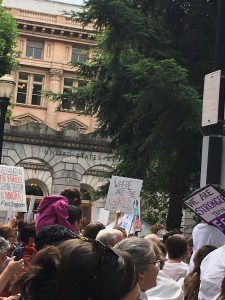
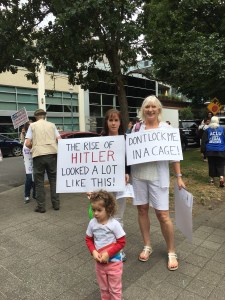
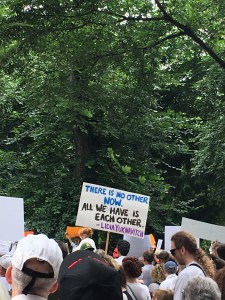
Saturday morning, Auntie Bridgett and I took the number 20 downtown to the North Park Blocks to join several thousand other people for a political rally. A rally is a demonstration to show your support of something. I have been to sport rallies in high school, and political rallies for candidates for Mayor, Governor, and President.

But this was a rally for families. Our President, Mr. Trump, has decided that people who want to come to America are committing a crime, and that this crime is so bad that parents are arrested and sent to jail, and separated from their children, who are also sent to jail. Yes, children, in jail.

So all over the country, people planned big get togethers to show their support for these families that have been pulled apart, and against Mr. Trump’s policy of separating families. People made signs, made up chants, and even wore some costumes. There was a brass band called TheUnPresidentedBrassBand, playing to keep everyone entertained. There were speeches by our Senator, Ron Wyden, a minister, a social worker, and many people who had come to America from different countries.

This is a very sad thing, breaking up families. The children aren’t told where their parents are or when they will see them. The parents are not told how to find their children, not told where they are. Lawyers can’t always get in to see or help these people and they are not told that they have any rights. No other crime in the country is dealt with like this. This is cruelty.

Now Mr. Trump is saying these people are “invaders” and “an infestation”, as though they were soldiers or, worse, rats or bugs. He equates them with dangerous gangs and criminals, saying that we have to lock them up to protect our country.

sometimes laws are wrong. Slavery was legal. Forbidding women from voting was legal. We have to pay attention to history so we can see what is happening from a longer perspective, and not always believe what people tell us. Laws can be wrong, and when they are, we need to say so and act on what we believe to change them.

This wasn’t as fun a post as many, but I wanted to let you know what I, along with about five thousand other people in Portland, were up to today.

Love,

Grandma Judy

Giving Back

Dear Liza,

While we were living in Salinas, I got to be friends with a wonderful lady named Ruth Andresen. Ruth is the mother of Pete, one of the most involved parents University Park ever had, and grandmother of four of our students. Ruth was born in 1921, so she is exactly the age your great grandma Billie would be.

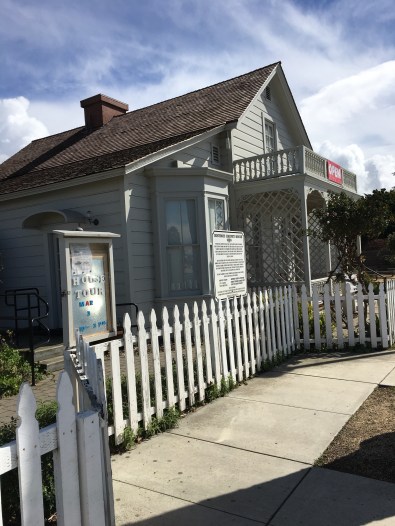
I met Ruth because we were both active at The First Mayor’s House, also called The Harvey Baker House, the oldest building in Salinas. Ruth has lived in Salinas since the 1940’s and actually knew some of the people who lived in this historic house, Florence Baker and her sister Helen. They were little old ladies when she was a young wife and mother in the 1950s, and she used to go visit them. They would tell her stories of their childhood in 1890s Salinas. She heard history, as they say, from the horse’s mouth!

The First Mayor’s House

When I was learning about Salinas history to write stories and curriculum for the House, I started visiting Ruth. We talked about history, but she also told me about her life. She was a geology student at Stanford University when the Japanese attacked Pearl Harbor, which started the western end of World War II. As a graduate, she worked in Washington to help create maps that helped with the Normandy Invasion! “It was such an exciting time to be a young woman in the world”, she said. “There was important work to be done and we got to do it.”

Ruth is still helping people learn about history. She does spinning demonstrations to show people how pioneers turned wool into yarn, and gives lectures about the “Old Days”.

She also helped organize the very first Founder’s Day Celebration in Salinas. The first one was so small, even the newspaper didn’t say much about it, but by the second in 2017, there were hundreds of people! In 2018, thousands of people came to visit the Harvey House, attend lectures, play carnival games, listen to music, and have pony rides. It took dozens of people to make it happen, including my dear friend and former Principal, Mary Randall, but at the center of it was Ruth. In my carelessness, I do not have a photo this wonderful woman! (I was probably enjoying our conversations so much I hated to interrupt for a photo.) Silly Grandma Judy.

img_4685-1.jpg
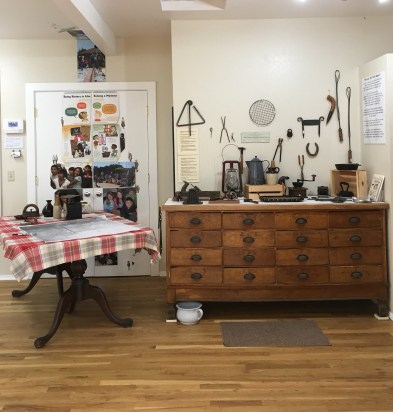
Display at Founder’s Day

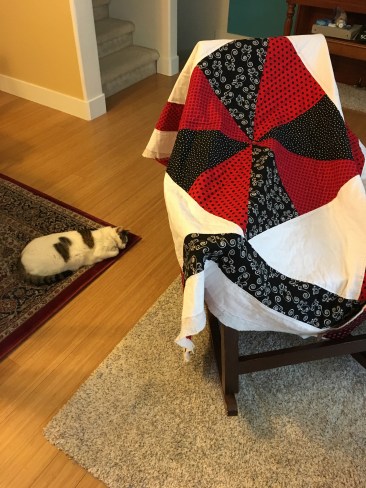
Anyway, for the second Founder’s Day, there was going to be a quilting booth, showing folks how to quilt and displaying old and new quilts. I was going to make a small one during the day as a demonstration. But so many other groups wanted booths, the quilting booth didn’t happen.

IMG_7581.jpg
Almost done quilt, and Mouse the cat

And now, with the extra time that comes from not preparing lessons and teaching every day, I have gotten it out and am almost done. It will be wrapped up and returning to Salinas very soon. Thanks for all the stories, Ruth!

Love,

Grandma Judy