I want to share with you some stories about my dear friend and former teaching partner, Laurel. We met in 1988, when we were being interviewed for two Developmental Kindergarten positions in Salinas.
This was going to be my first professional position, but Laurel was making a change in profession, from Physician’s Assistant to teacher. I grew to admire her wealth of knowledge and skills, as well as her “we’re going to get this done” attitude.
We made a perfect partnership, really. She was great at planning, but I was better at ad libbing when the plans went off the rails. We both loved working hard and making our classroom a rich, beautiful learning environment.
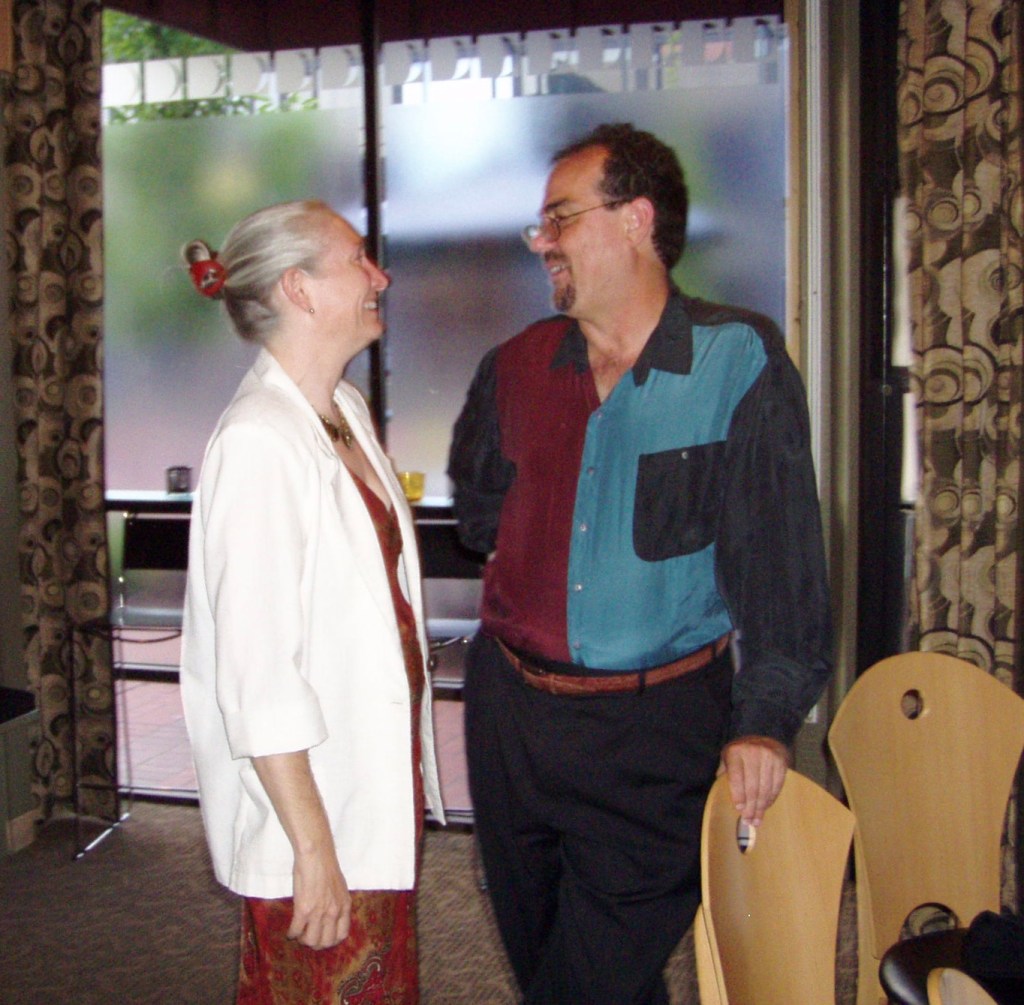
The four years we worked together were the most rewarding, exhausting years of my 30 year career. And since then, I have been blessed to have Laurel in my life. She celebrated weddings in the family…
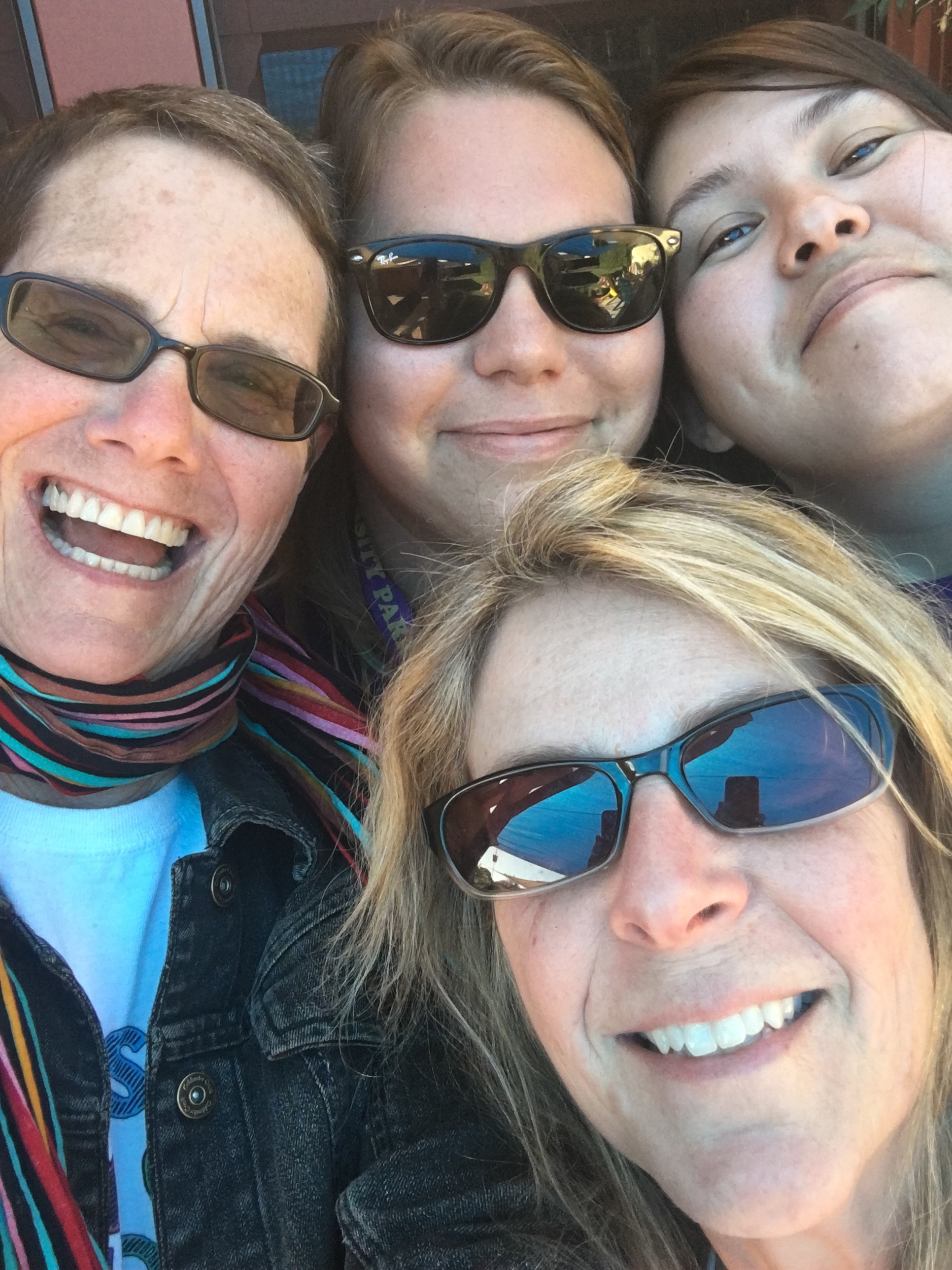
Celebrating in 2004
and came around for Mother’s Day brunches at Katie’s house.
Hanging out with Cousins in 2018
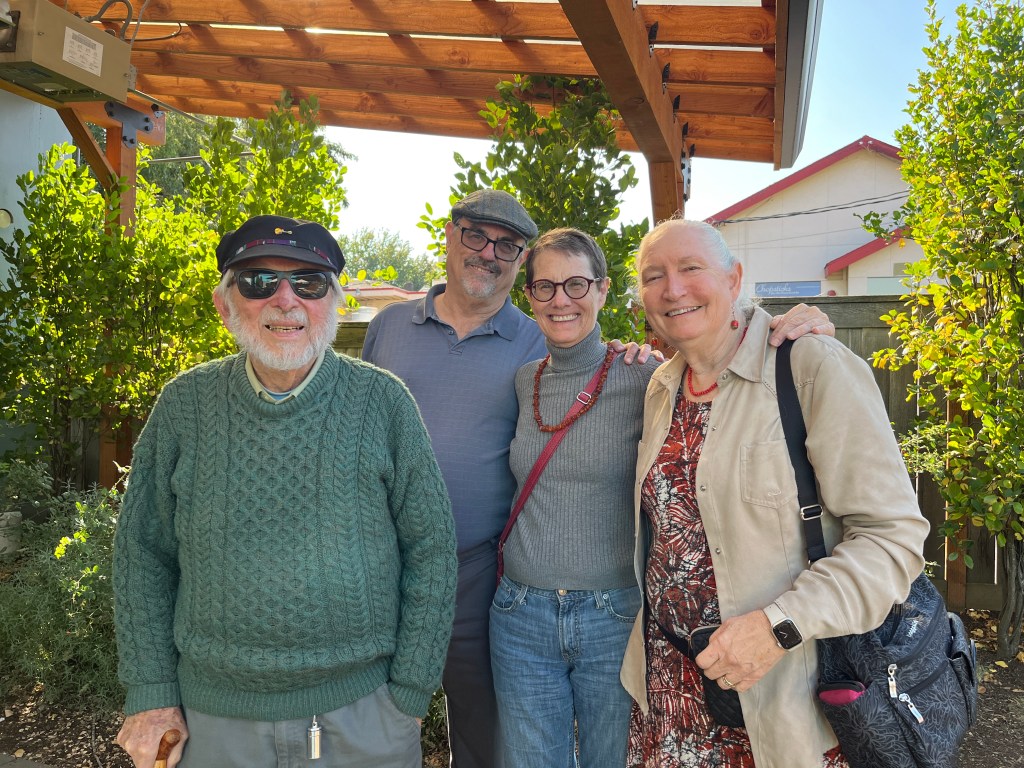
We moved to Portland years after she moved to Ashland, and even though we are at opposite ends of the state, we get together occasionally. I had lunch with her, her husband Milton, Auntie Bridgett and Grandpa Nelson just this past weekend!
Laurel is still in my life, and my life is better for it.
A few summers ago, Auntie Bridgett sold her art at the Quatorze Juillet Fête put on by the Alliance Français at Jamison Square.
When we were packing up, one of the organizers gave Bridgett two big bunches of lavender.
It was a lovely gesture, and the car smelled great on the way home.
That lavender has been sitting in two large vases in the front room ever since.
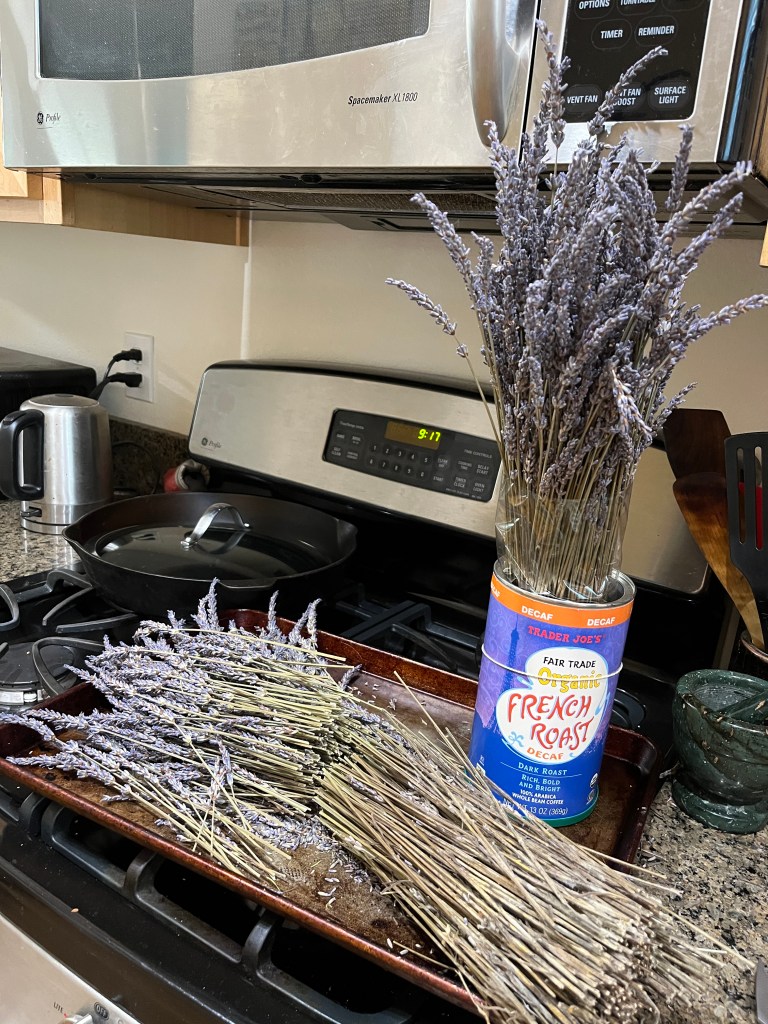
And with Halloween decorations going up, we decided it was time to process all that lavender goodness. It’s not a difficult process, but a bit fiddly.
The bits of stems and dried blossoms tend to fly everywhere. I plucked and rubbed with both hands over the biggest pan I have and still got seeds on the floor, the stovetop, and on the counter top across the way.
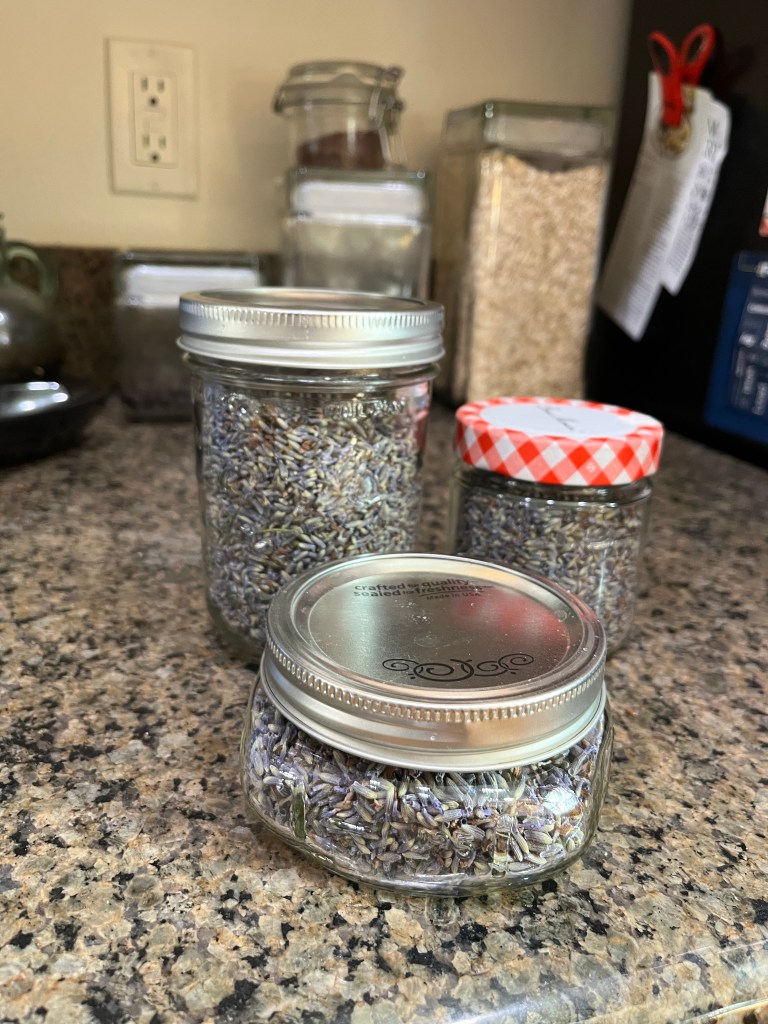
But after twenty minutes or so, those two huge bunches were scooped up and stored into three pretty jars to await their future in sachets for Christmas presents.
Now, I just need to decide what the sachets should look like. Crazy Patchwork? Embroidered? Painted? Maybe all three?
You know how much I love visiting the dead folks at Lone Fir Cemetery!
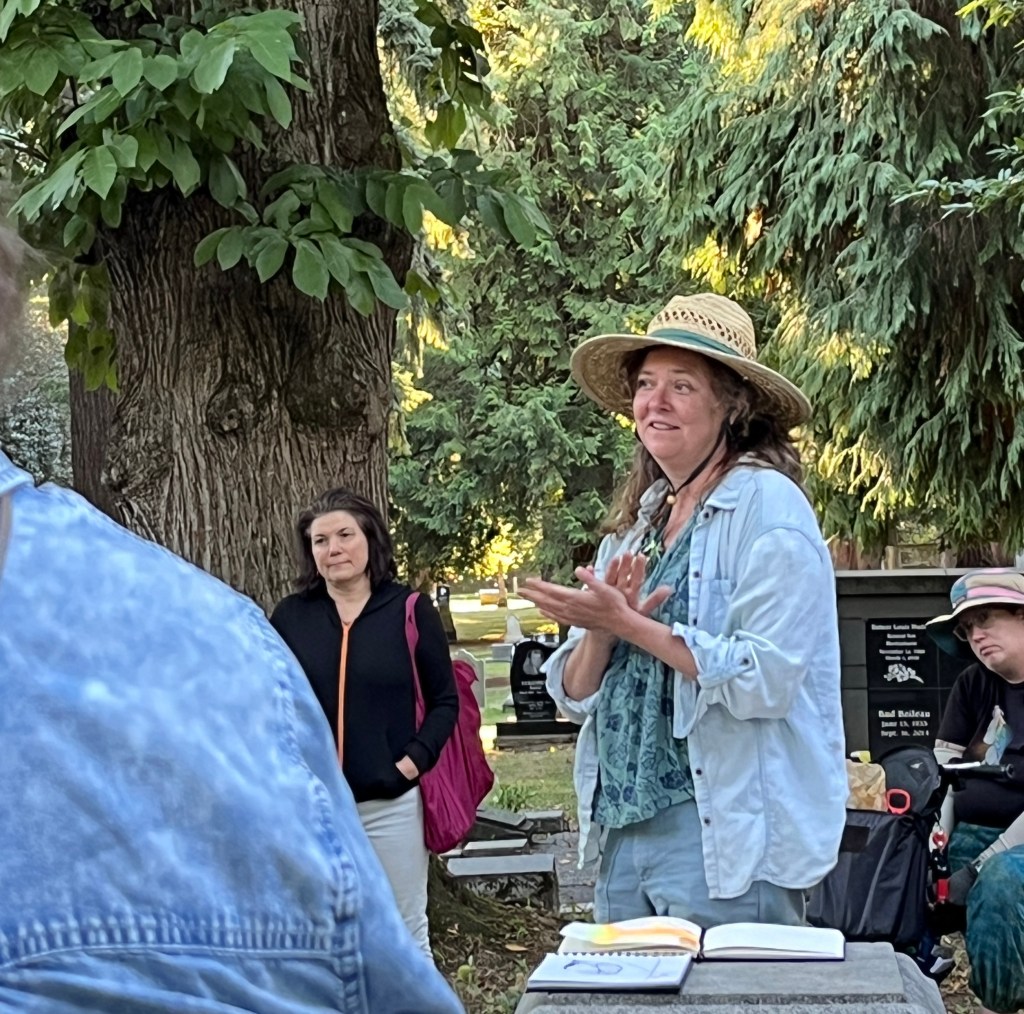
Well, yesterday Auntie Bridgett and I joined a sketching group there. It was led by a lady named Jen whose full time job is elementary school teacher (just what I used to do!)
Jen is also a fan of Lone Fir, and wanted to find a way to earn some money to help maintain this fragile old space. She put a notice on The Friends of Lone Fir website, and people pay $10 a head to join the group. The money goes to Friends of Lone Fir, the same non-profit organization that runs the Twilight Tombstone tours I will be helping with later this month.
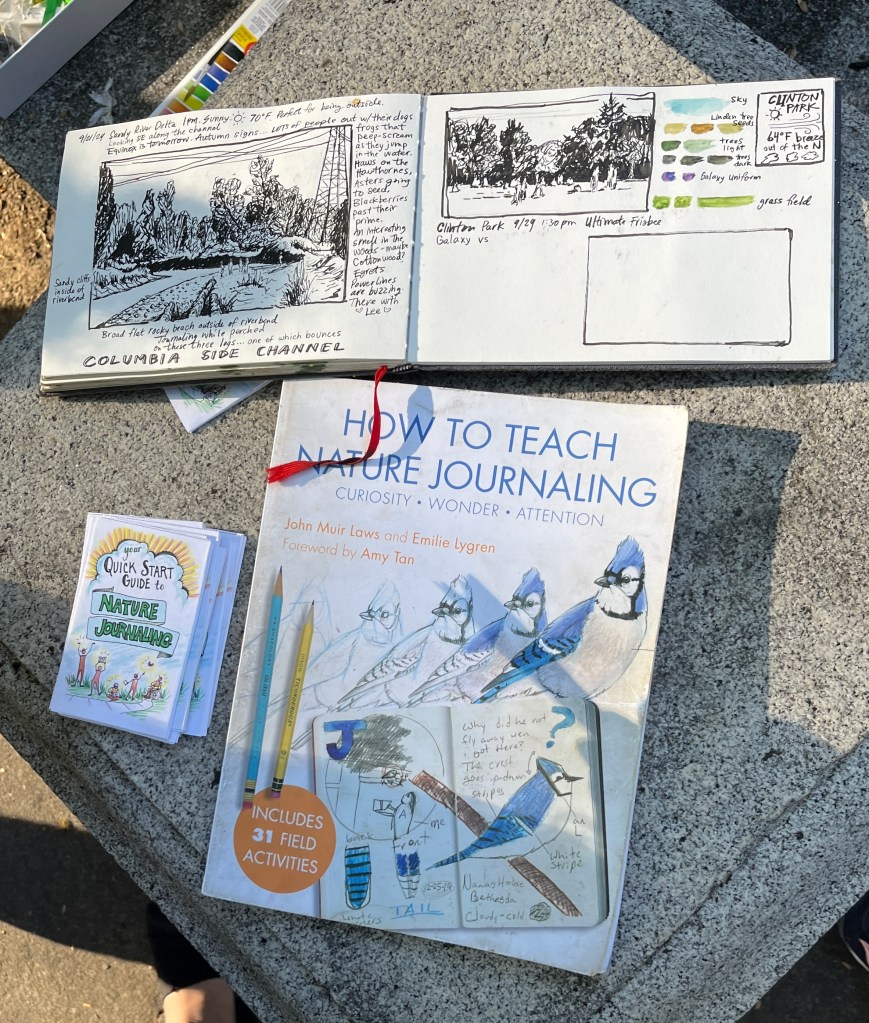
Being a ‘real’ teacher, Jen has a ‘real’ curriculum, this book by John Laws. It lays out a lot of steps and philosophy about nature jour along, and I’m sure it is a fine book.
But I was interested in a quick guide to start with. Once our group of thirty (!) people were gathered, Jen gave us just that.
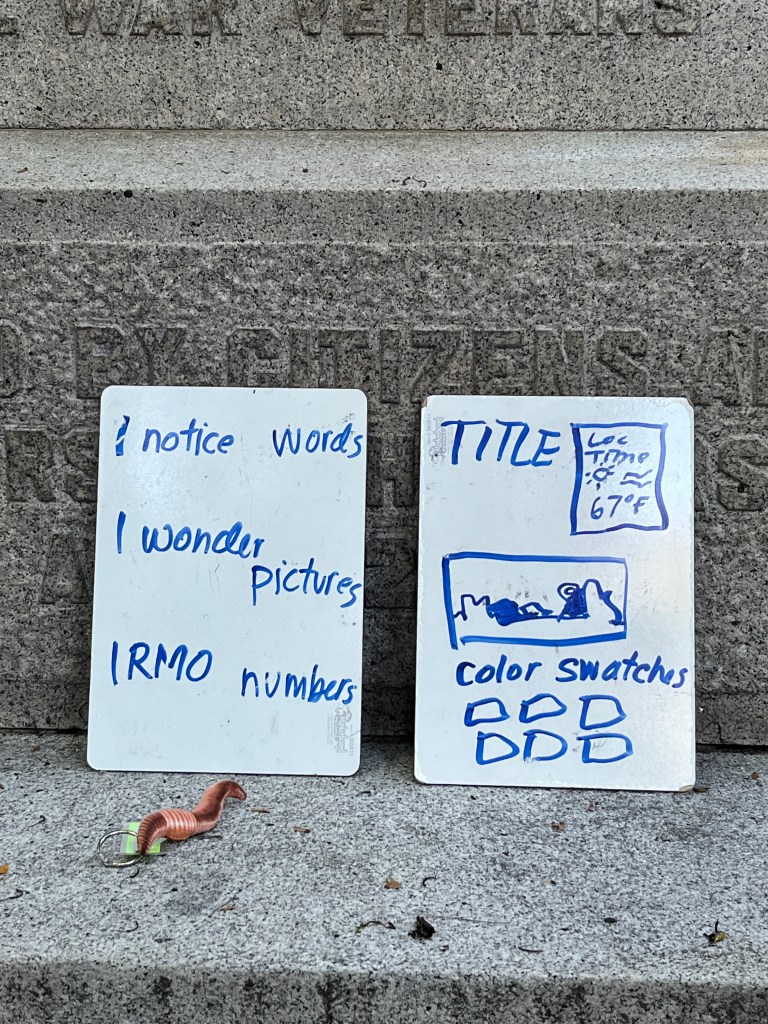
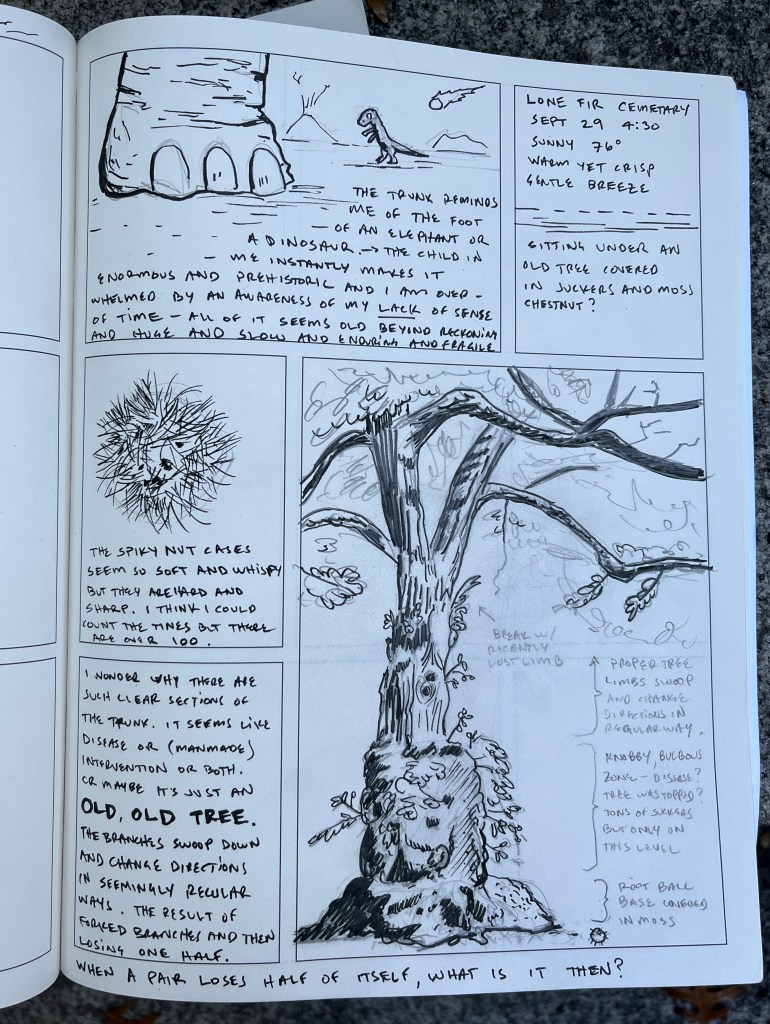
She suggested quick info about day and weather and then prompts of “I notice” “I wonder” and “It reminds me of”, and really close looking at whatever you choose to draw. It could be a tree or a leaf, a patch of ground, or anything in the area.
“If you think it’s boring,” she said, “keep looking and you’ll be amazed how much you see.” We all went off to our own areas and had one hour to draw.
I chose this wonderful old chestnut tree by the rose garden. If I got far enough away to see the whole tree I’d miss the detail, so I could only draw part way up the trunk. I was fascinated by the dappled light and how the patches kept shifting as the sun went down behind me.
When our hour was up, we assembled back at the Soldier’s Memorial and did a “gallery walk” of everyone’s journals. I was impressed by the variety of drawings and the close observations.
We shared our experiences and said what we liked about other folks’ sketches. I liked that we were complimenting the sketch, not the artist… it was less personal, less embarrassing, and more meaningful.
We all enjoyed our time at the cemetery, and being able to share it with other folks made it even better. And next month, Auntie Bridgett and I get to join Jen and the sketchers again!
Since I retired from teaching, my brain is like a kid in kindergarten, always finding something new. I opened a cupboard and found things to write about, so I wrote… for months and months.
Writing and writing..
Then I opened another cupboard and there was fabric, so I sewed.
Sewing and sewing…..
And now I have found the paint cupboard. First gouache, then watercolors. And, like a kindergartener, I have friends with ideas that feed my ideas. “Come join my painting group,” said Ruthie. I did, and it has been wonderful. Art, silliness, and learning all come together in the magic proportions that teachers strive for.
Painting little crabby friends….
I posted the islands I was painting and dear Elaine said, “I’ll bet you could put those islands on fabric, and maybe even quilt them.” Well, it turns out that you can paint on fabric with regular acrylic paints if you add a bit of “gac” paint medium. Auntie Bridgett had some, because of course she did.
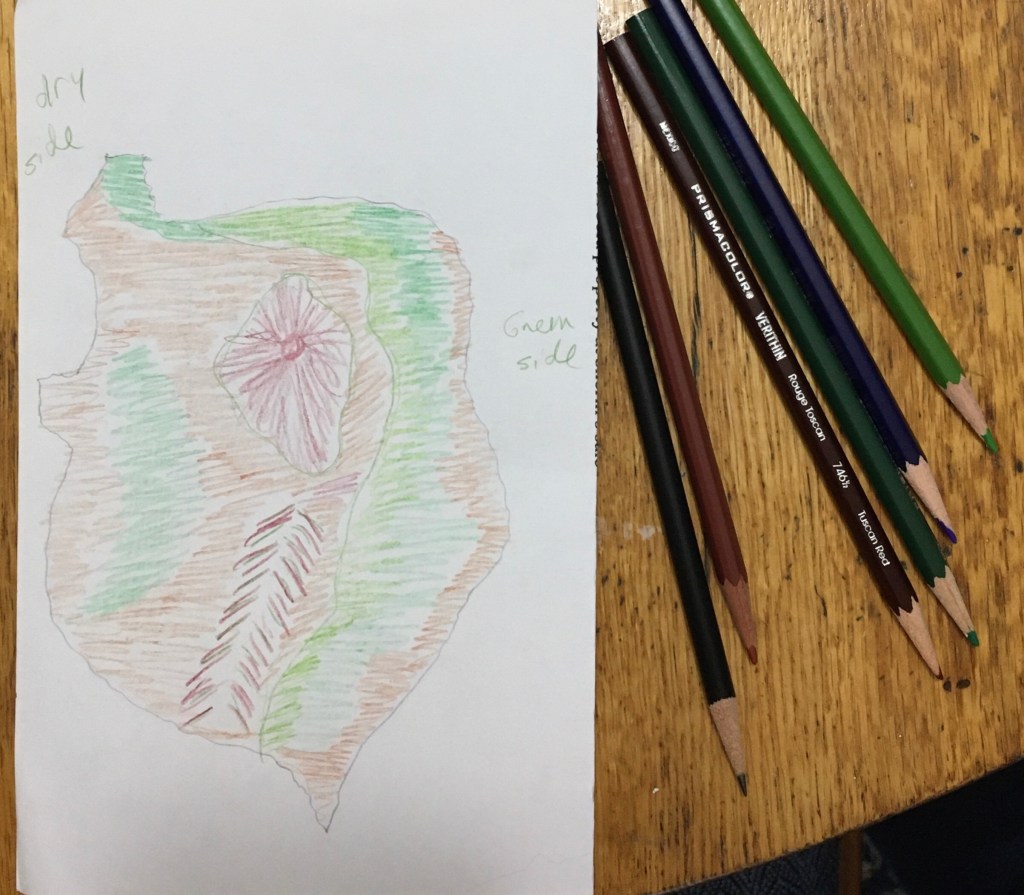
I spent a day looking at maps of all the islands I love. The Big Island of Hawaii. Tom Sawyer’s Island at Disneyland. Treasure Island from Robert Louis Stevenson. Tiny Gabriola Island in the Strait of Georgia. Neverland. Sketch, reconsider, sketch.
Pencils first….
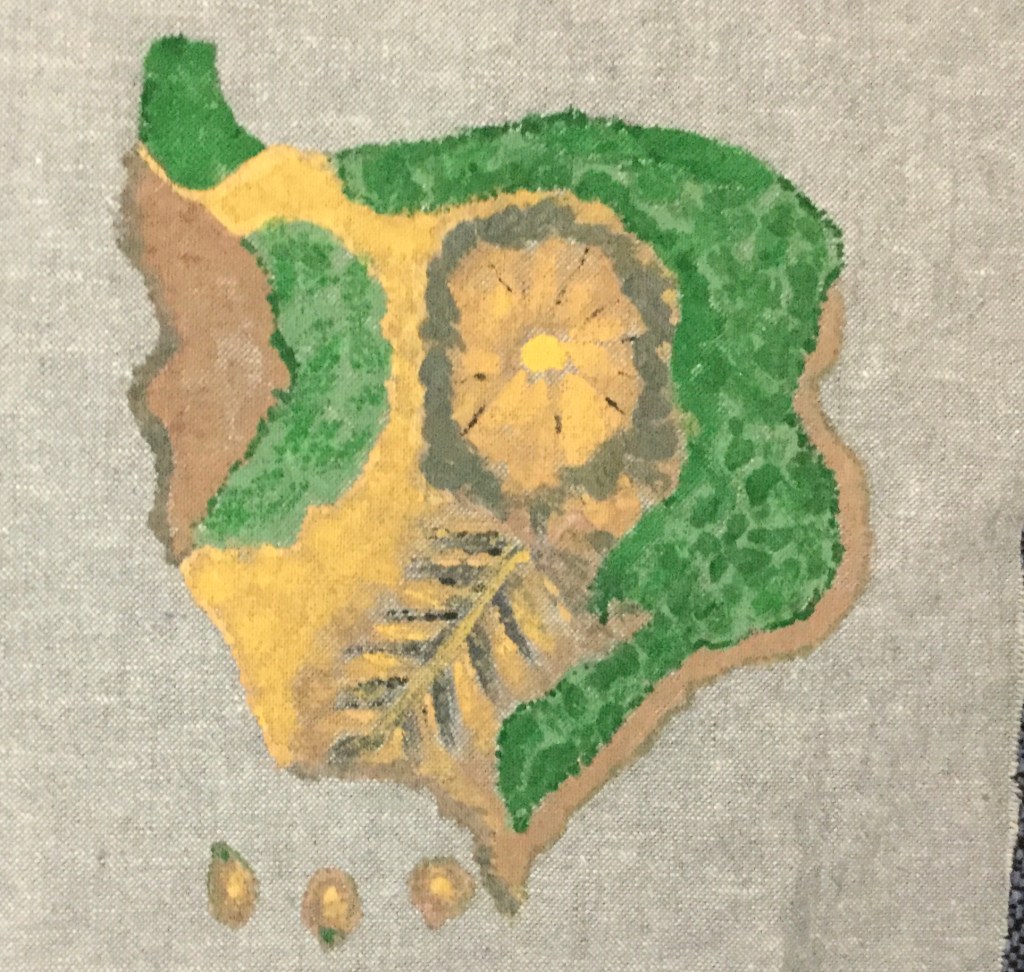
And finally I started painting my first fabric island. After smooth gouache and watercolors, the acrylic and muslin felt heavy and clumsy, but I kept at it.
The Big Island of Hawaii, as I have it so far…
I am still not totally happy with it, but I will get better if I just keep practicing. It seems a bit flat. Hmmmmm… Maybe I can add embroidery or even some beads. Maybe my friends will give me some good ideas.
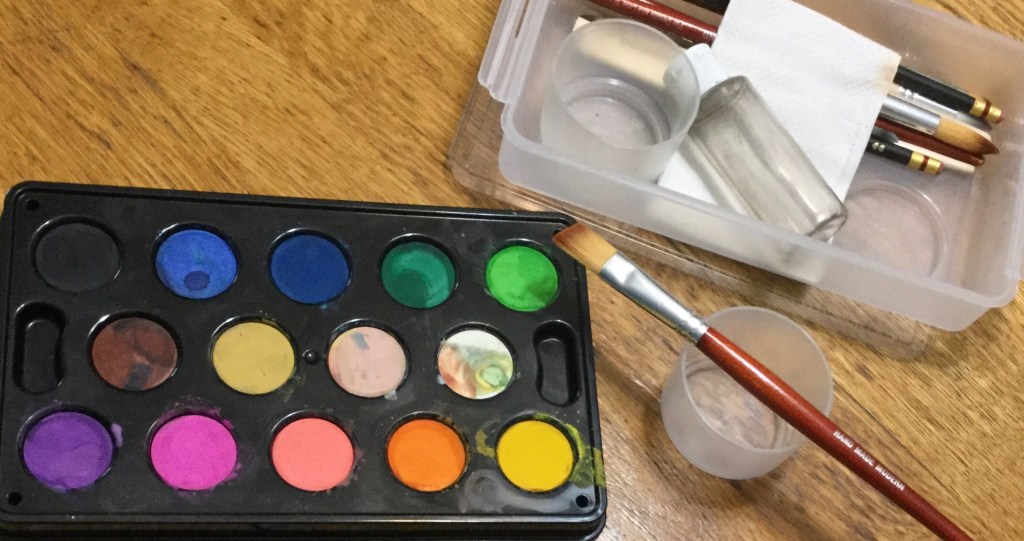
I have been telling you about painting with watercolors for a few months now. I have been using this little MALA set we found in one of the teeny tiny libraries years ago, and enjoying it very much.
My freebie paint set!
And, as it so often turns out lately, I was wrong…. just a little bit. Since I don’t know much about how watercolors acts or looks, I assumed that the matte finish and slightly chalky feel of my finished pictures was ‘just how watercolors work’ and my slightly muted colors were because I wasn’t applying them properly.
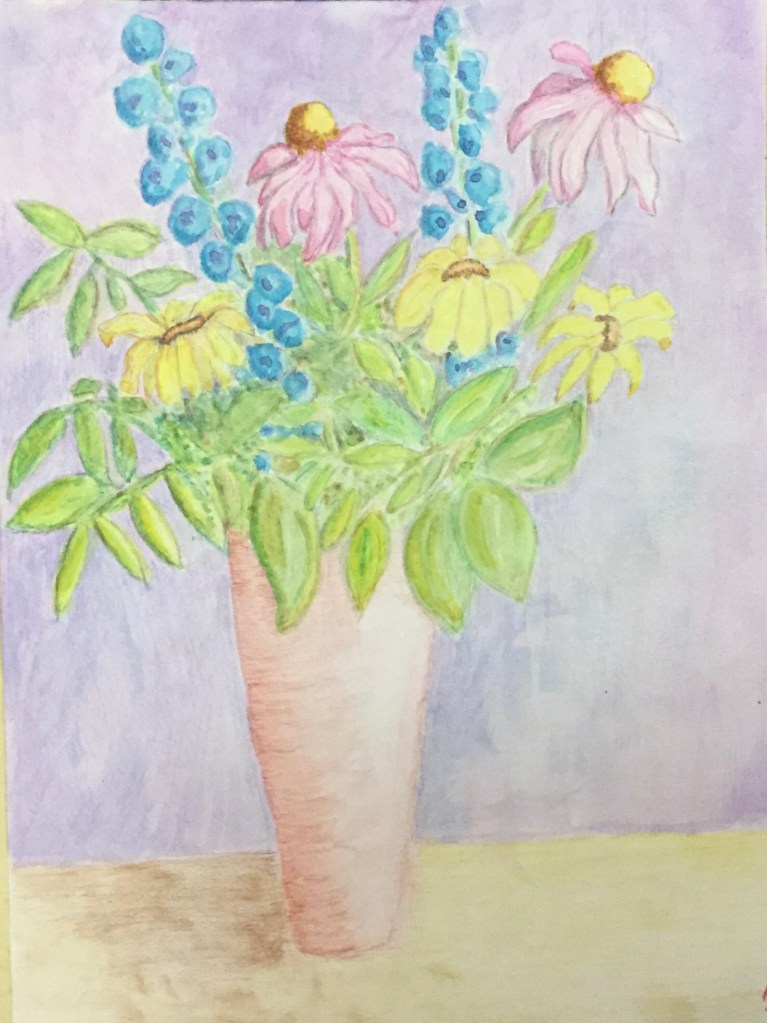
Pretty, but not what I was expecting…
Nope.
I have been using gouache! Gouache (you say it ‘go-wash’) is a watercolor that has ground up chalk in it, so of course it feels a little chalky and looks more matte, and less transparent, than regular watercolor.
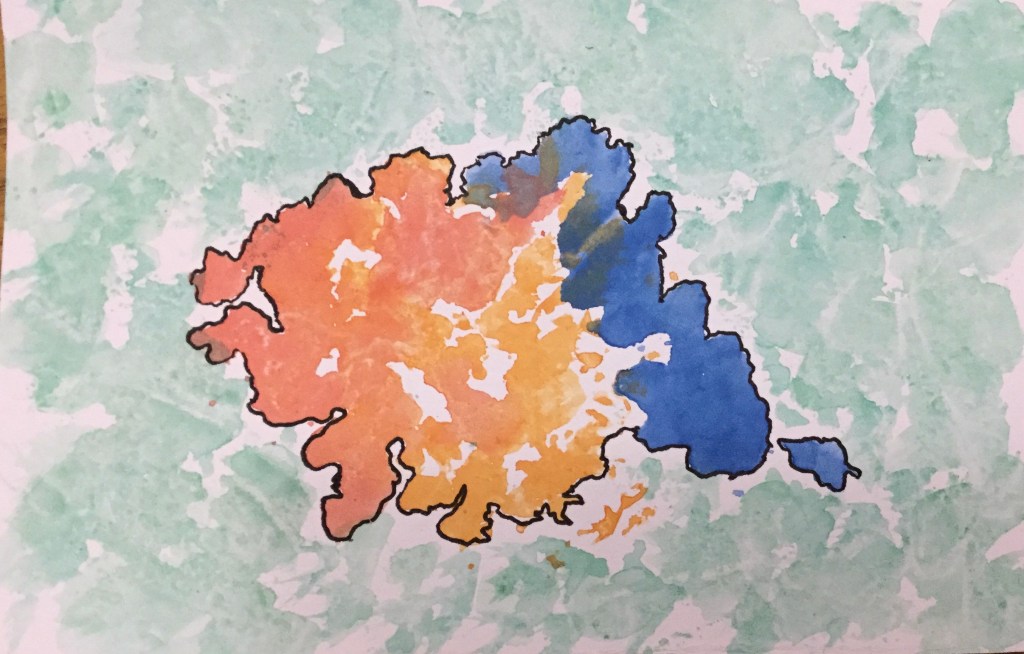
This realization came about when I re-worked of one of my fantasy islands from this…
To this….
“You shouldn’t have been able to cover that blue with the brown,” Auntie Bridgett said. “Watercolors are too translucent.” Her eyes lit up. “This is gouache!”
And suddenly, the chalky texture and soft colors of my flower vase made sense. My frustration with my non-shimmery dragonfly wings was explained. I was never going to get the transparency of watercolor using gouache.
I felt better, knowing it wasn’t ‘just me’ and that there were benefits of using gouache, not the least of which was, ‘Hey, it was free.’ But artist Auntie Bridgett, who has been very supportive of my painting, realized that she has a very nice watercolor set, and let me use it.
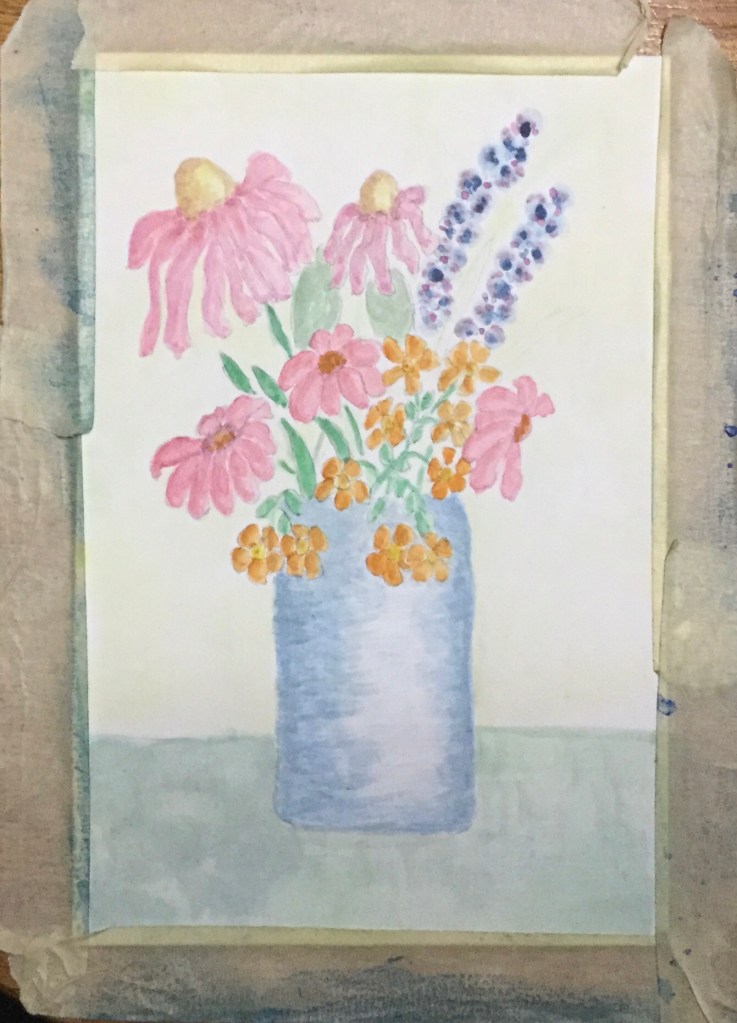
Starting to use actual watercolors!
This set has tubes, instead of cakes, of paint. The texture of the diluted paint is smoother and silkier. I really notice the transparency, even getting frustrated because I have gotten so used to the gouache! And it still has the “Hey, it was free” feature.
First real watercolor trial…
So now I am on a new learning curve and having fun with it. And while parts of me are in lockdown and stuck inside, other parts are just a happy seven year old with a new toy.
I was a teacher for thirty years. It was my job, my passion, my hobby. It became who I was.
Teachers talk about their “Teacher voice”. This is loud (but not yelling) way that teachers get thirty kids to listen to them. It can be stern, or disapproving. It is usually just matter-of- fact. But it is never FUN. It is never meant to make folks feel at ease or get them to laugh. It is an information delivery system.
Mine was good, too. I speak fluent Teacher.
My fellow Teacher- Speakers
Writers also talk about their Voice. It is their point of view, their style, their way of choosing words to make readers feel a certain way. It needs to be easy to read, entertaining, quirky. FUN.
Unfortunately for me, my Teacher voice seems to be getting in the way of my Writer voice. After months of studious revision, I still write with a very strong Teacher accent.
On the way to the Japanese Garden yesterday, Jasper asked me to remind him about Sacajawea, whose statue we passed. “But don’t say it like a teacher,” he said.
First, I determined not to be offended. This is a perfect “out of the mouths of babes” moment. I needed to learn from it.
Then I saw that if I couldn’t use my Teacher voice, I needed to use another voice, any other voice. You can’t speak without a Voice! So I borrowed a New York/ New Jersey gangster voice, jiggling my shoulders like James Cagney to help it along.
“Okay, see, there’s this President, see, Thomas Jefferson. Nice guy, writes well, even doh he owns slaves. He sends these two guys, Lewis and Clark, haulin’ clear across the country. Go! He says. These poor slobs had No Idea where they were going!” I went on to tell a shortened version of the story, just enough to make Jasper laugh and let him remember what he knew about Sacajawea.
Ironically, the main character of my story is a little girl who has become mute due to trauma. She has literally lost her voice.
How can I find my own voice to tell this story? How could I possibly write my story, in someone else’s voice?
As you know, I have been working on my children’s history story about Portland for a little over a year now. For the first six months I read about Portland history so I know how it became a city and what sort of interesting things happened here. The Oregon Historical Society and Belmont Library became my favorite hangouts.
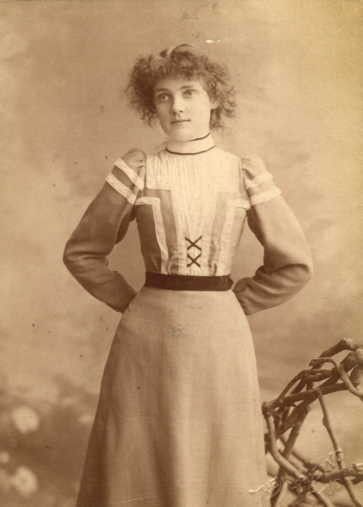
A Young Lady in 1903
I chose to put my story in the spring of 1903, when President Theodore Roosevelt came through Portland on a country-wide tour. There was a parade, a ceremony in what is now Washington Park, and a banquet. It was a very big deal and I think it would make a good backdrop for a mystery story. But as I told you, I don’t know much about mysteries.
So, I studied that, too. For a few weeks, I read Nancy Drew books and articles about mystery story plots, character development, and clues.
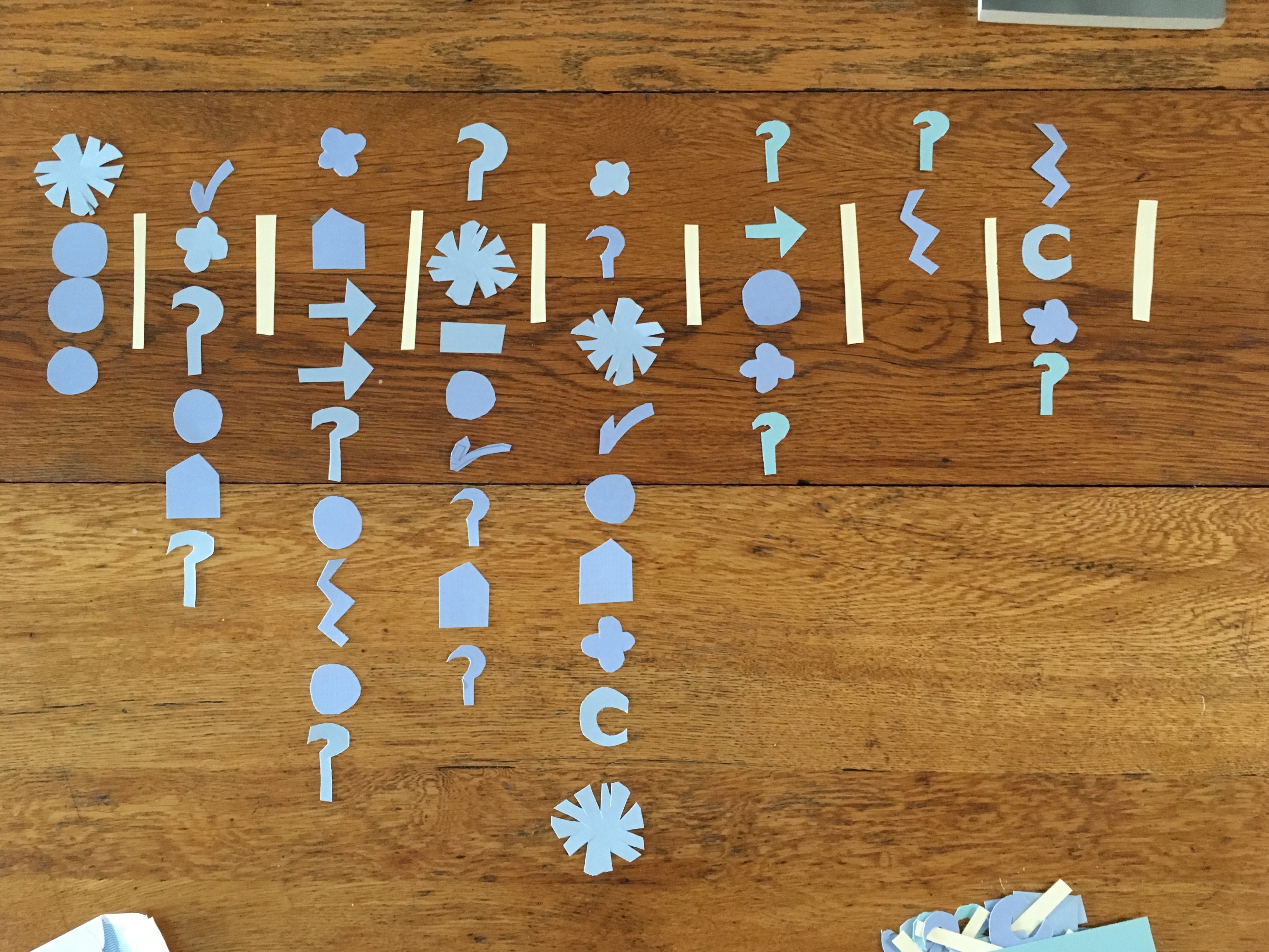
But as a teacher, I never really understand something until I need to teach it. So I pretended I was teaching someone about how to make a mystery story. I cut shapes out of paper to show everything that happened in the story: action, characters, description, distractions.
A new way of seeing a story
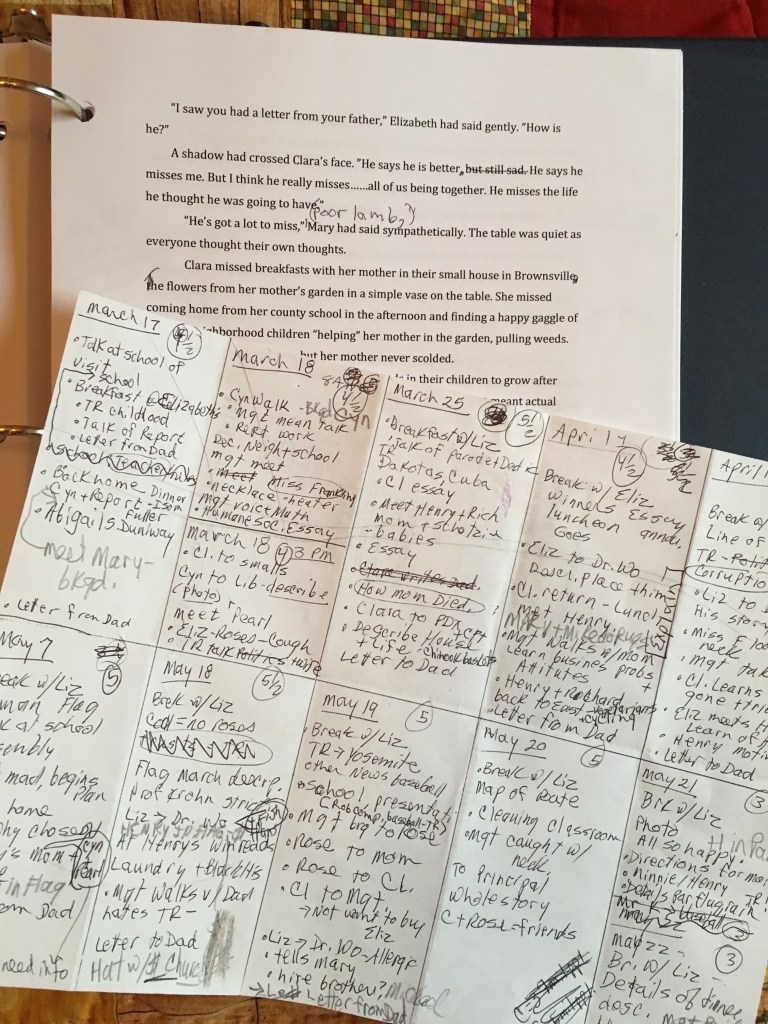
I practiced using these pieces to map out the first eight chapters of The Bungalow Mystery, #3 of the Nancy Drew books. I could see when action happened, when characters were introduced, how the chapters alternated between action and description, and how each chapter ended in a new mystery or dangerous situation.
This took some of the mystery out of writing my mystery! I am now working on my own story, using these paper pieces to make the characters move to solve the riddles of the story and come to a happy ending. If I don’t like the way it is going, I just move the pieces around! I feel organized, less confused, but flexible enough to create and re-create the story until it is right.
Of course, once I have this visual outline done, I still have to write the actual words….but that’s the fun part! I am happy to have found a way of working that works for me.
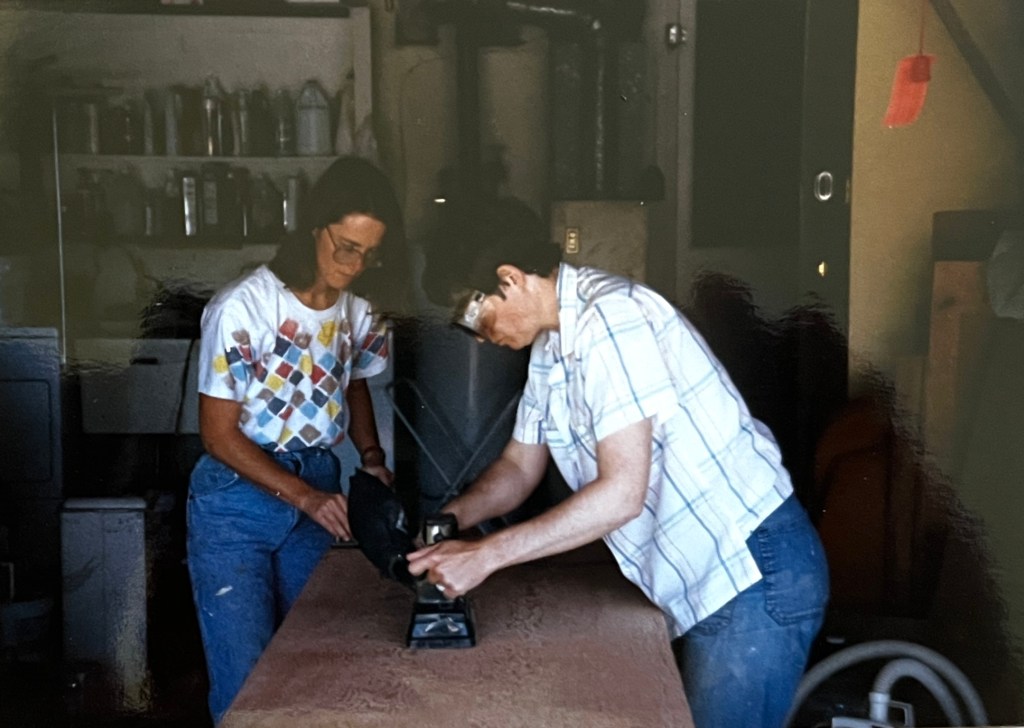
In 1990, when my teaching partner, Laurel Sherry-Armstrong and I moved from Hartnell College’s Child Development Center to University Park Elementary, we were happy to become part of an elementary school community. But we were sad to lose the lovely playhouse at the Center.
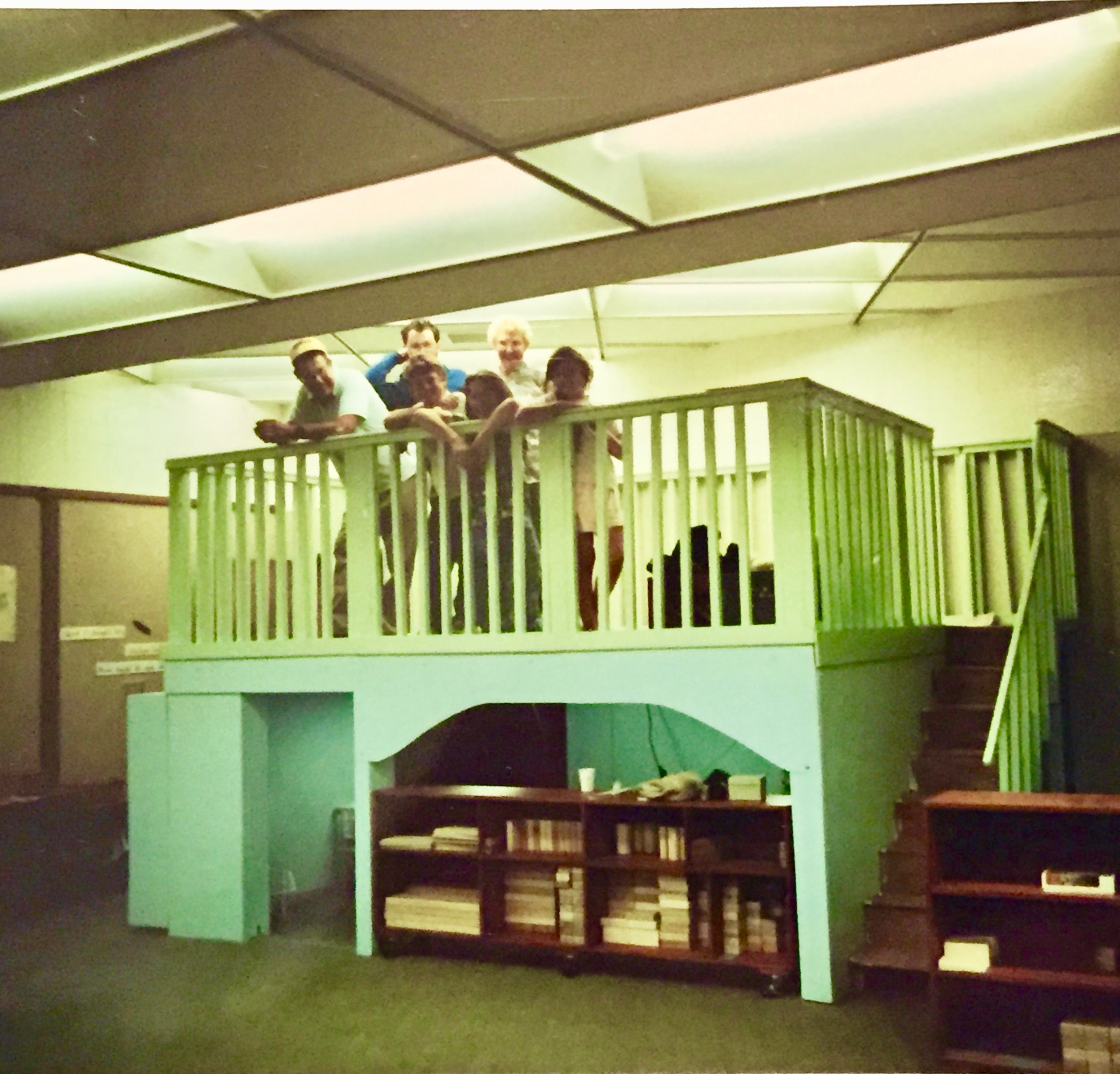
Best Playhouse ever, 1990
We mentioned this over dinner one night with my parents, who were visiting from Lompoc. My dad (your great grandpa Lowell) said that he could design a playhouse, and would even build it, if the District would allow us to put it into our new classroom. Weeks of drawing and discussion, proposing plans and changing them, became months of waiting for the District to get back to us.
Uncle David helping out
Finally, there was good news! They approved the planned two story playhouse, with stairs and a railing, to be built in room 13. Dad took the plans, built the house in pieces (walls, floor, railings, stairs), and drove it up to Salinas.
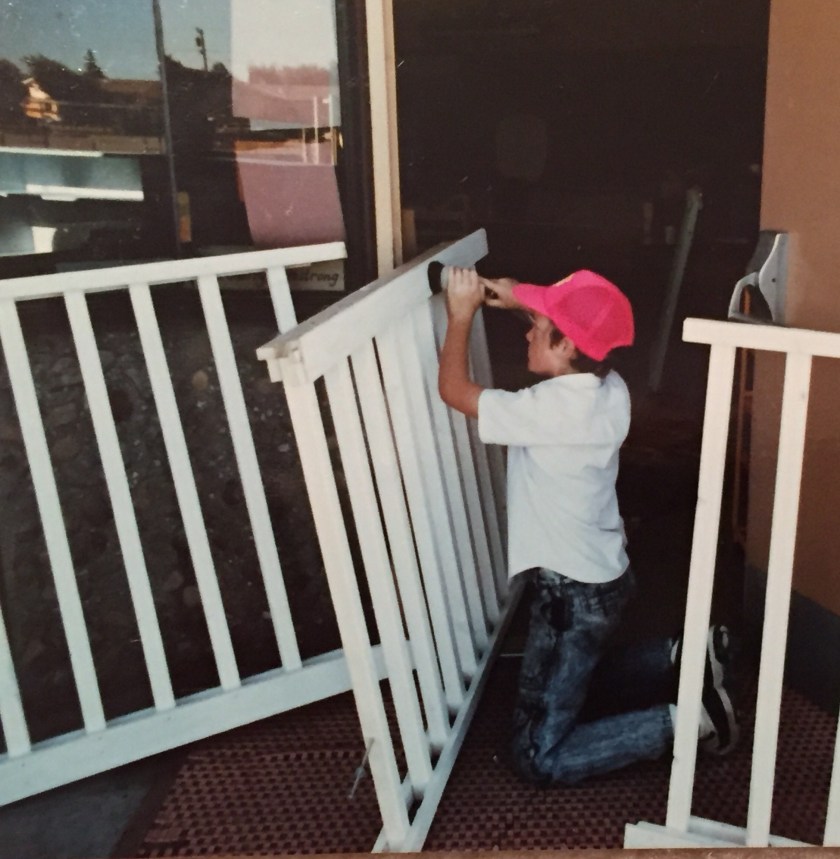
Painting the pieces
He and Great Grandma Billie, Grandpa Nelson and I, Uncle David and your Momma Katie (who were 10 and 8 at the time), Laurel and her husband George, and our friend Rick, all worked to paint the pieces. Then we put it together, laid carpet on the top floor, and even installed a bookcase and pile of pillows for reading on.
The kindergarten kids loved the playhouse. It was part kitchen, part pirate ship, part reading loft, and part cave. It was good for quiet times and silly conversations. It has been climbed on by, I guess, more than 700 kids over these 28 years.
And now, the kindergarten classes are moving, and the District hasn’t said that it will approve the playhouse for the new space or move it there. The teachers have no guarantee that it will even be on campus when they return for the next school year. Technically it belongs to me, but I only have two days left in Salinas and no way to pull it apart and move it anywhere.
This makes me very sad. There are so many things right with the playhouse, things that are missing in education these days. Imagination, thoughtful quiet time, and changes in perspective.
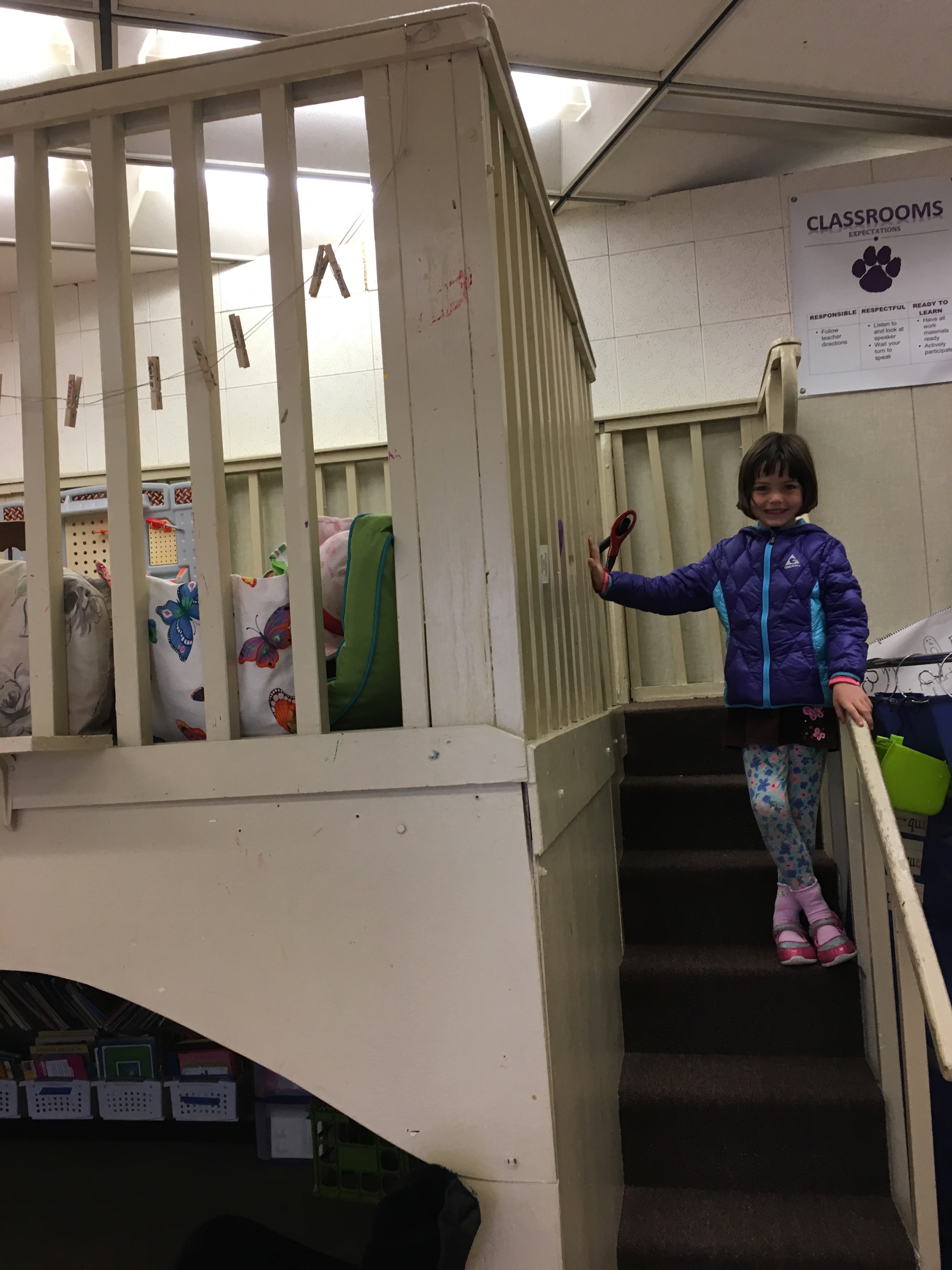
Fourth Generation
My only remedy was to get up extra early this morning, get you dressed, and take you up to play on the playhouse before it (maybe) goes away. You had so much fun! I looked at every inch of it, from the plaque Laurel put on after Great Grandpa Lowell died to the railing on the stairs, rubbed by hundreds of tiny hands.
When it was time for us to go, I cried a bit and said goodbye to yet another old friend.
Lowell G. Evans Memorial Playhouse Built Labor Day 1990 5-7-21 to 12-7-98
Yesterday I did a dumb thing. You know, the kind of thing that if you asked your Mom if you could do it, she would say,”That sounds like a really bad idea.”
It all happened just before school started, when I was taking artwork off the walls. We are getting the end of the year, and my classroom will be used by Kindergarten next year, so everything has to come down. I didn’t want to go hunting for the ladder, so I dragged a chair over to a bookcase and stood on that to be tall enough to reach. As I was pulling off the banner asking “Who? What Where? When? Why?” to remind students important points to cover in their writing, I stepped backwards…onto thin air.
I felt like a windmill. Arms flailing, trying to catch balance somewhere and failing. I ended up sitting down very hard on my bottom and left wrist, with my head just barely missing one of my students’ desk. Well, I thought, it certainly could have been worse.
Taking inventory, I checked to see what felt good and what hurt. My left wrist was hurt but I could move all my fingers, so I figured nothing was broken. My back and head were good. Just then, the bell rang and two students looked in and saw me sitting on the floor. They banged on the door to make sure I was all right. I explained what happened, calling it “a big stupid thing”.
During the day I managed to slip and fall against a desk, banging that same arm. Ouch! I went through the rest of the day carefully, using my left hand as little as possible. By the time I got home, it was swollen and very sore. It was useful as a paw or a stick, but I couldn’t grab anything with it. I was able to slowly chop onions to make pasta and meat sauce for dinner.
Auntie Olga got home and checked my wrist and arm, gently feeling it to make sure it wasn’t broken. She made me a lovely sling out of a scarf. It looked very fancy. She suggested an x-ray, but I decided not to go. I was tired and the thought of the emergency room seemed like another big stupid thing. I ate, read some Junie B. Jones to Liza, and went to bed.
Woke up this morning much better. Sore, but I could make a fist and hold things in my left hand. I got the sling on and headed off to school. Everyone asked about the sling, so I got to tell the story a dozen times. Children helped me with doors and carrying things. By the end of the day I was tired again, but less wounded.
I still napped after school, but, hey, I’m a Grandma, right? Looking forward to being even better tomorrow!
This is not a fun post. It is sad and scary. You may want to skip it. Fair warning.
Today I went to a teacher training, but we were not learning how to teach. Our wonderful trainer, Kelly Hendrix, vice principal at Mission Park School, was teaching us how to keep ourselves and our students alive in the event of an active shooter on campus. Let that sink in for a minute. We have fire and earthquake drills. In Portland there are even volcano drills.
Chart showing increasing body counts of shooting. Columbine is near the center of the chart, the Las Vegas shooting is on the far right.
But this….this idea that we must try to outsmart and outrun someone who has come specifically to kill us and our children…this is a whole new level of scary. Also scary is the fact that since most shootings last a total of 5 minutes, law enforcement folks will probably arrive after the shooter is done. We will be on our own for those terrifying moments, needing to think fast and be smart.
ALICE stands for alert, lock down, inform, counter, and evacuate, which are the steps (not necessarily in that order) that are encouraged in this training. Before, our directions have been limited to “lock the door, turn off the lights, get under the desks”. Then people noticed that in many mass shootings, there were a lot of dead people under desks. So, then what?
ALICE acknowledges that there are no easy answers and that every single situation, even room to room within a school, will be different. Hiding, if necessary, is best done behind a well-barricaded door, and children should be spread out in different parts of the room, not a dog pile, so they will be able to get up and move if it becomes possible to evacuate or necessary to fight.
Yes, fight. If you cannot get out of your room and the shooter is in there with you and your students, ALICE encourages you to know your resources and act fast. Things to throw, to distract a shooter and keep him from aiming. The kids can help by screaming like banshees or, my favorite technique, “swarming”, where everyone grabs a piece of the shooter and hangs on for dear life. Scary, yes, but better than sitting still and waiting to be shot. Besides, the image of 26 kinder-babies bringing down a psycho is very satisfying to my imagination.
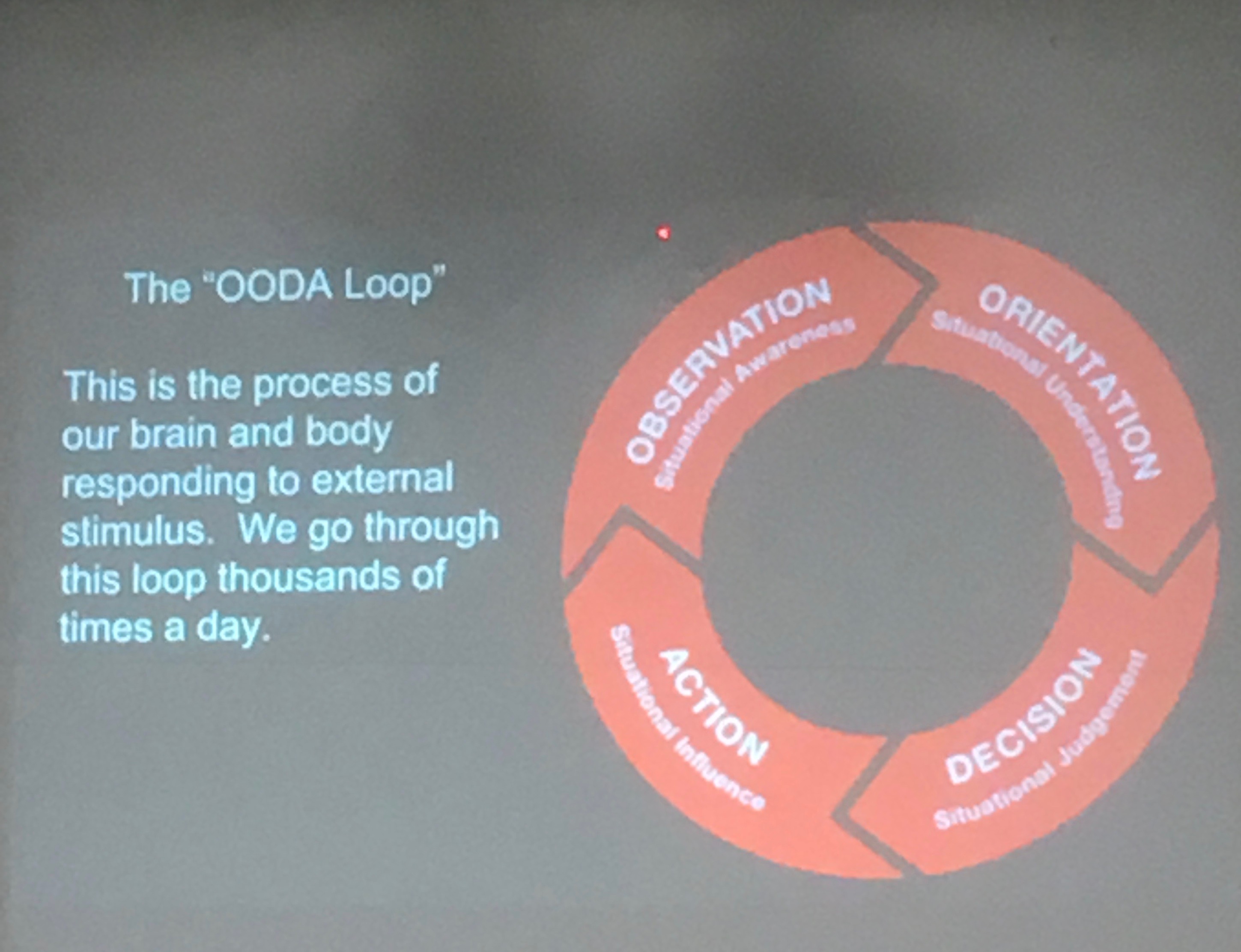
The OODA Loop shows the mental processes a shooter (or anyone) goes through to make a decision. Disrupt this, and you can slow a shooter down for a few critical seconds.
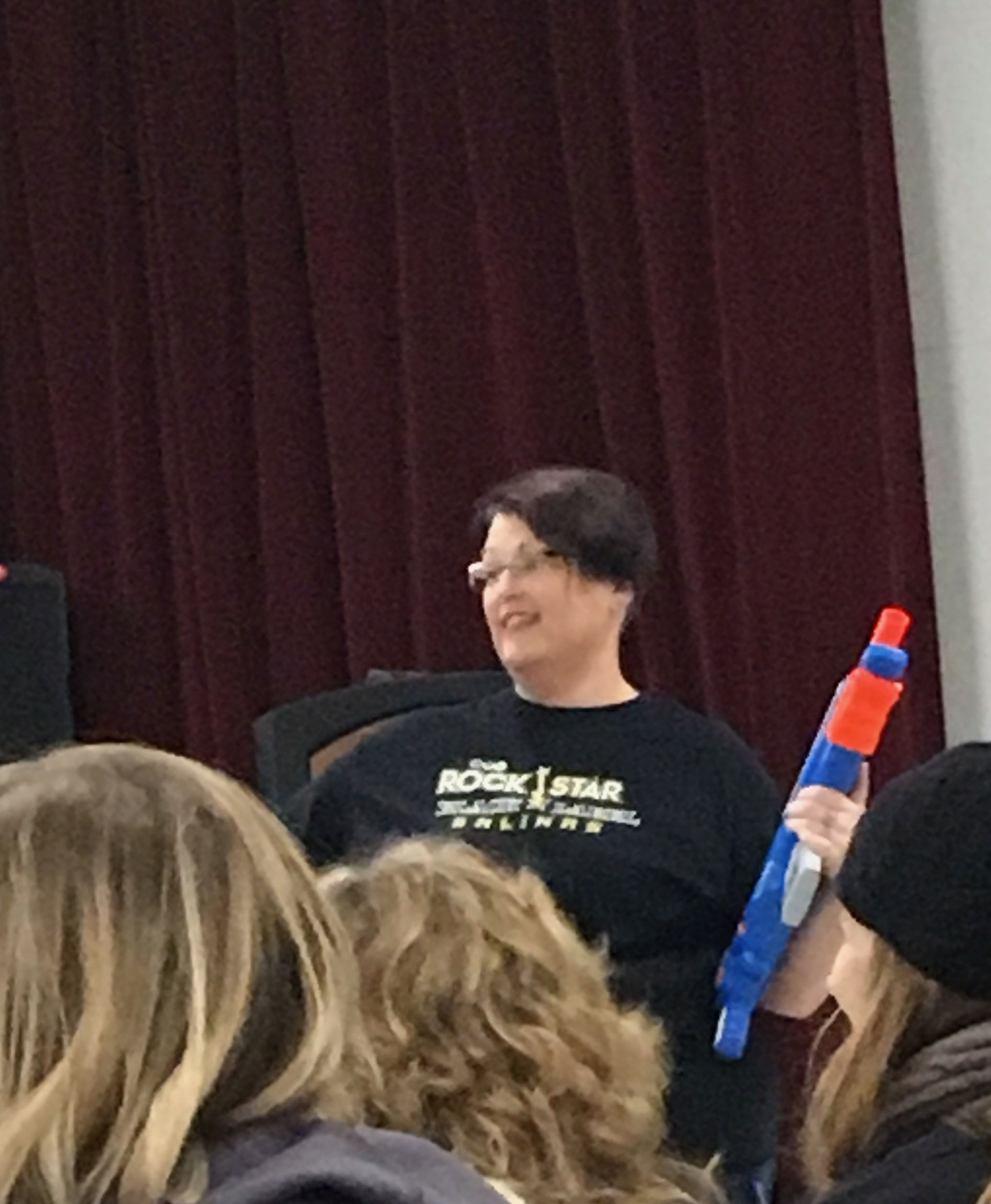
The last part of our training was acting out scenarios in which Kelly and her head custodian Gumaro, played the part of the shooters, armed with Nerf guns. We teachers played teachers and students and had beanbags and squishy balls with which to retaliate. Depending on where our class was when we became aware of the incident, some of us ran, confronted the shooter, or barricaded the door. One group was so well hidden we didn’t realize they were still in there! But even in our state of readiness, we had a few “casualties”.
Kelly Hendrix, our trainer
By the end of the morning we were all exhausted, hyper-adrenalized (if that’s even a word) and a bit sadder and wiser. I feel it was the most important training I have received in 30 years of teaching, because all our work goes nowhere if our students are dead.
And that’s the reality of it. Sorry for the sad story.



















 Dear Liza