Our small ZOOm art group got together again this week, and I made some good progress on the fabric and paint thingee.
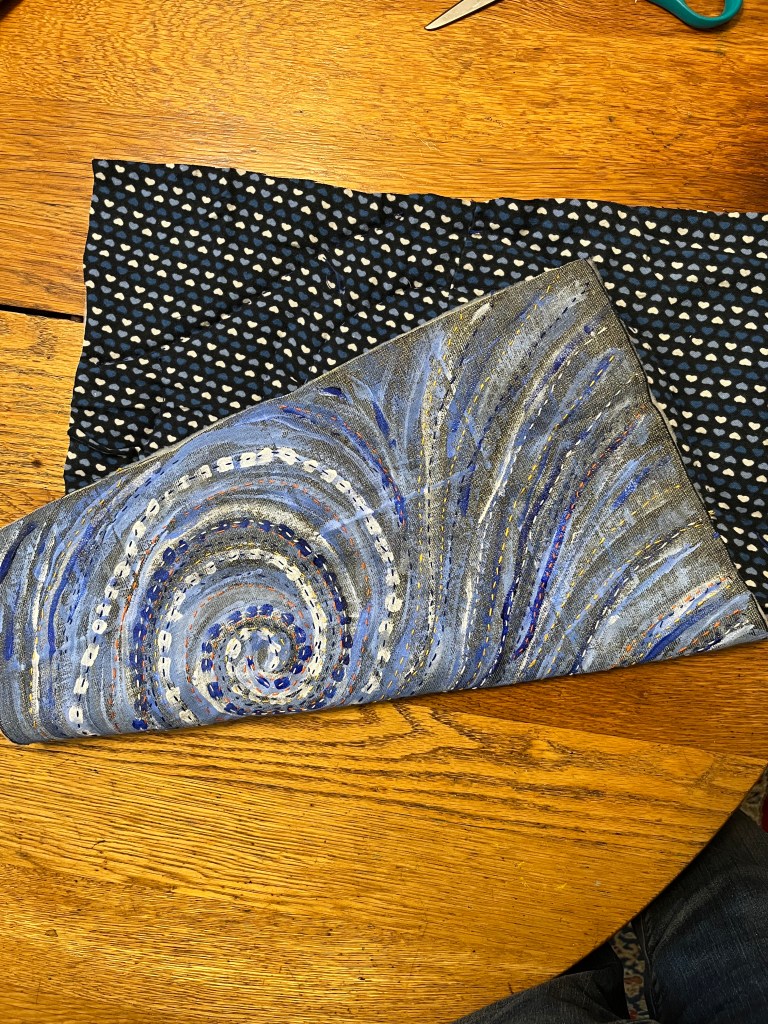
This almost-square piece of grey-and-silver fabric got painted with swirls, and then stitched with blue, white and oranges to follow the swirls.
Once I felt there were enough swirls, I found some quilt batting and some nice patterned fabric for the lining. This fabric, which I am very fond of, is up-cycled from a pair of pajamas.
I decided to use the same embroidery thread and quilt along the painted and embroidered lines, just enough to hold all the layers together. I love how textured and nubbly it is!
Now I just need to sew the side seams and put in a zipper to make a useful, beautiful padded sack.
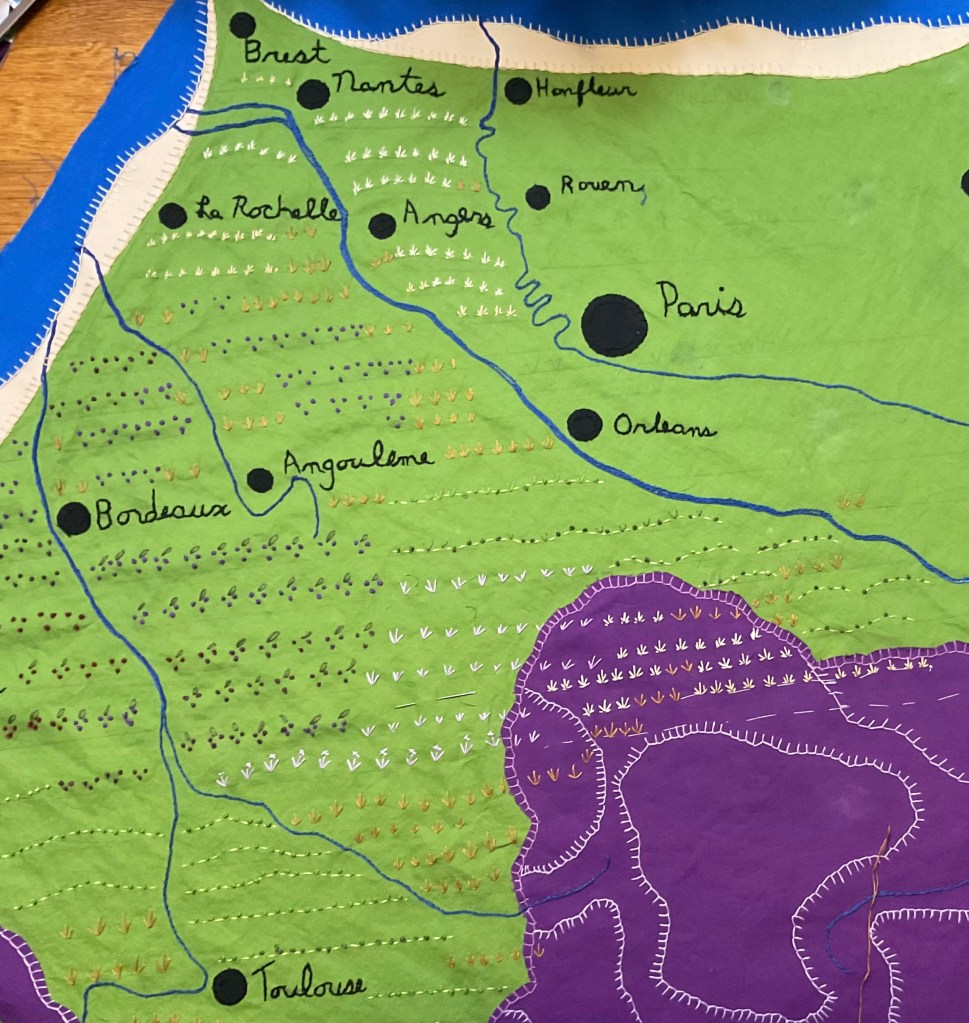
As I stitch more on my map of France, adding dozens of icons for row crops, vineyards and wheat fields, I feel like I’m looking backward and forward at the same time.
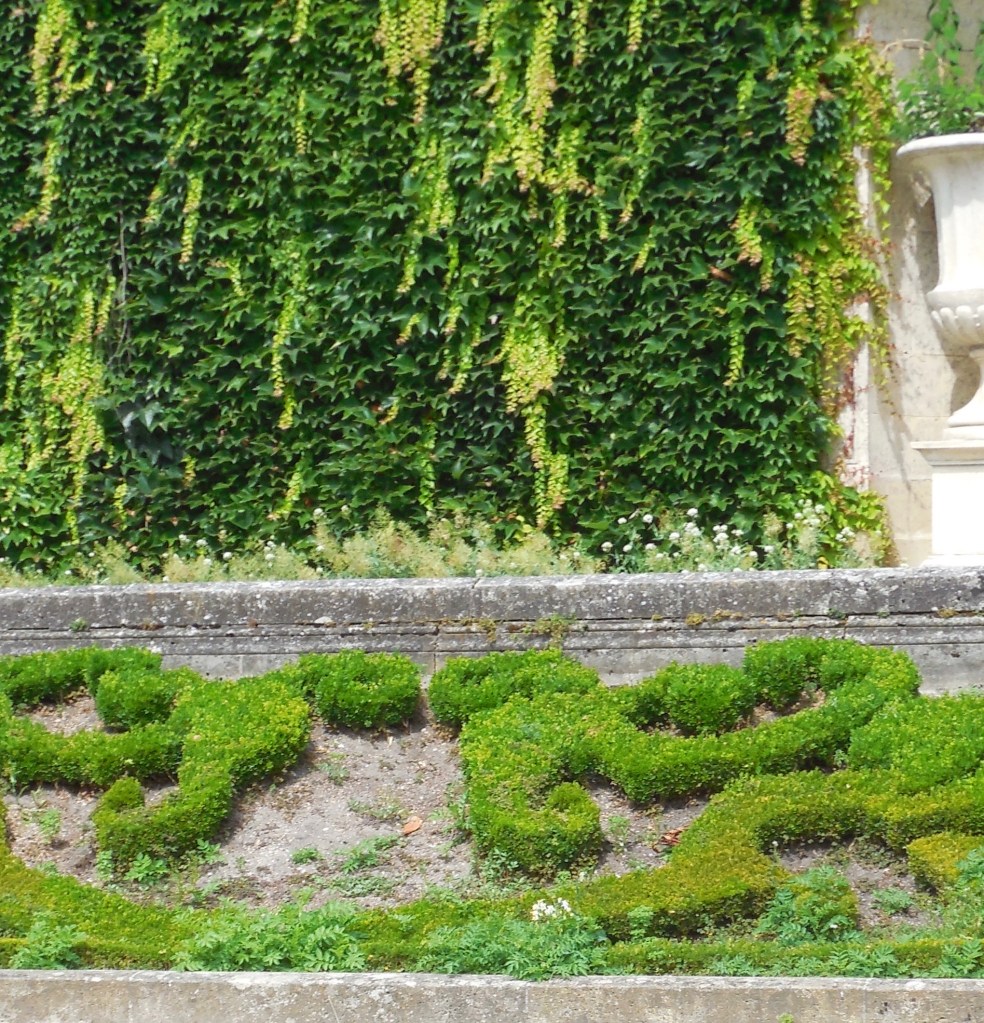
I am remembering the shining wheat fields and castle gardens in the countryside, where our GPS stopped working and we got delightfully lost.
I am remembering the awe of walking along the Seine and seeing history standing before me.
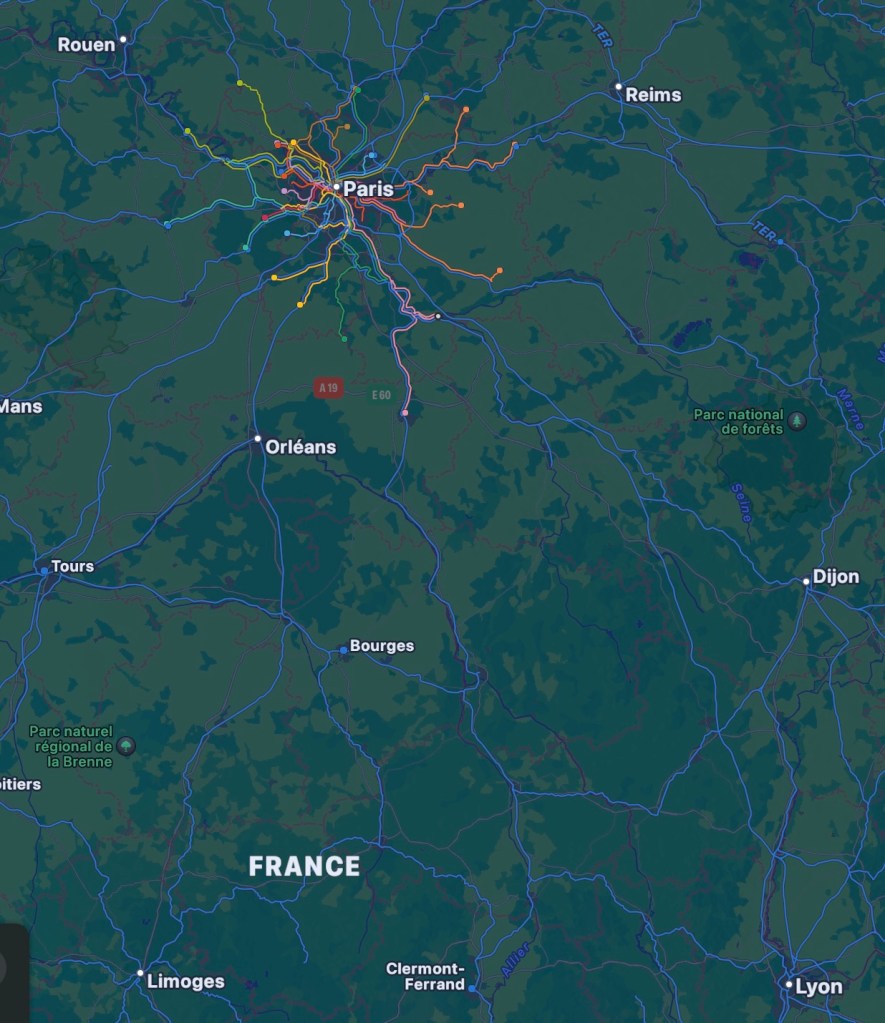
And, looking at maps and train lines, I am planning our next journey, from Paris to Lyon, then winding around to Orléans and up to Rouen. What will we see on our way? How will it let me see the country differently?
Screenshot
Honestly, I never thought embroidery could make me philosophical. But here we are.
Now that I am ready to put the land-use icons on my map of France, I am getting a little worried. There are going to be hundreds of these little rascals!
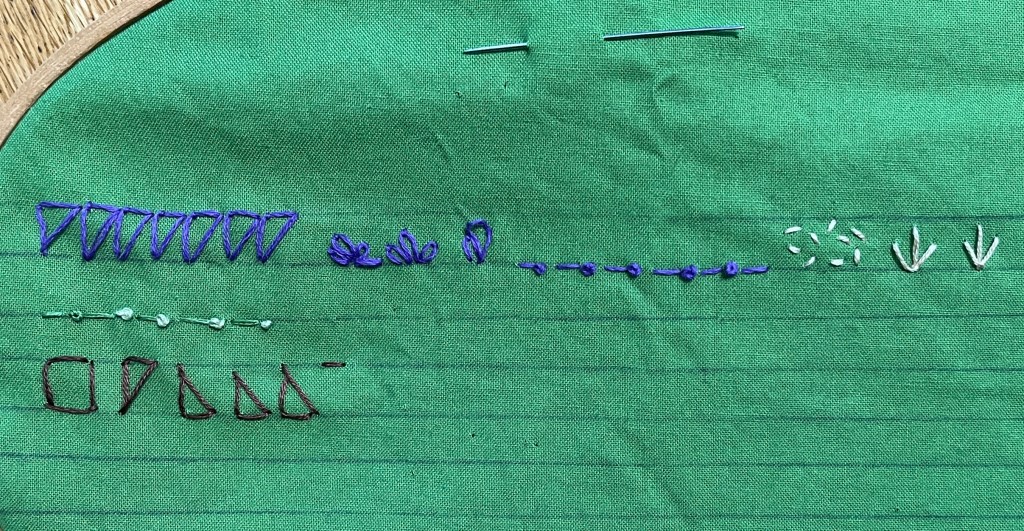
I want each icon to be easy to sew, of equal size, and to look vaguely like what it represents… a row of crops, a tree, or a vineyard.
Watching videos of embroidery, I noticed the importance of straight lines, so I practiced on some.
I am happy with some of these, but the squares and triangles were not right. I did more experimenting.
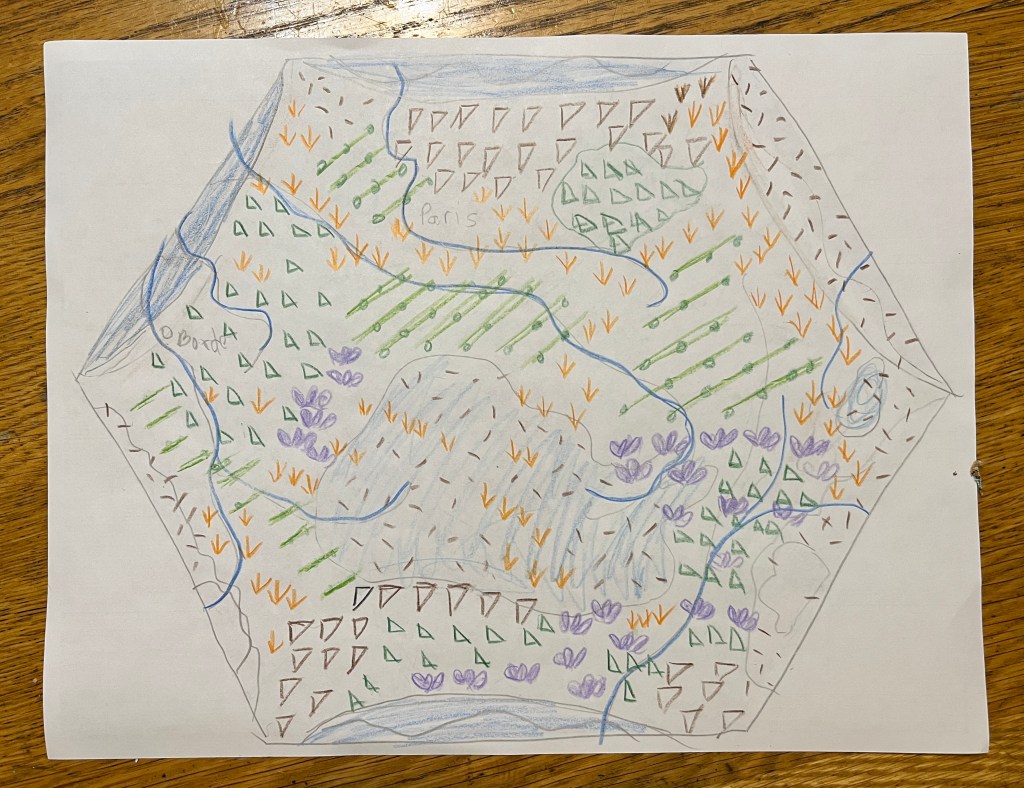
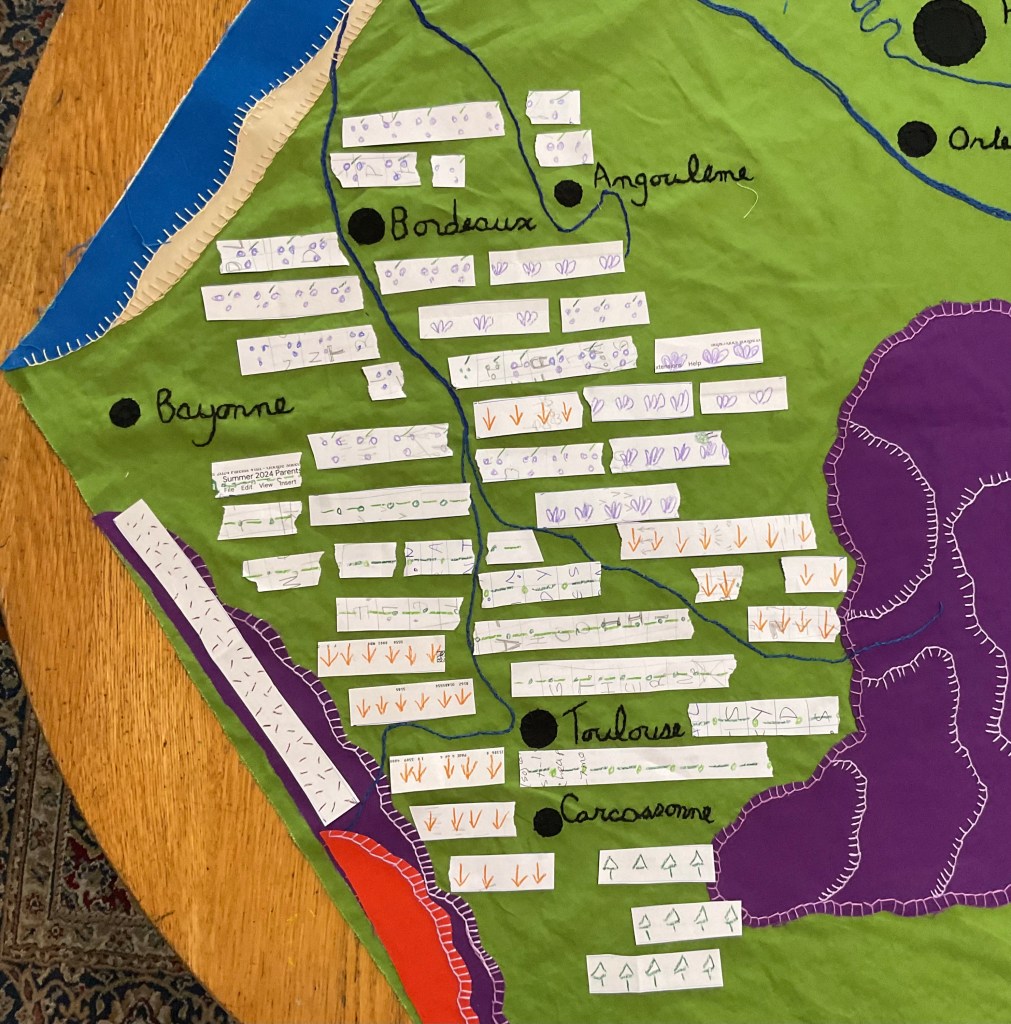
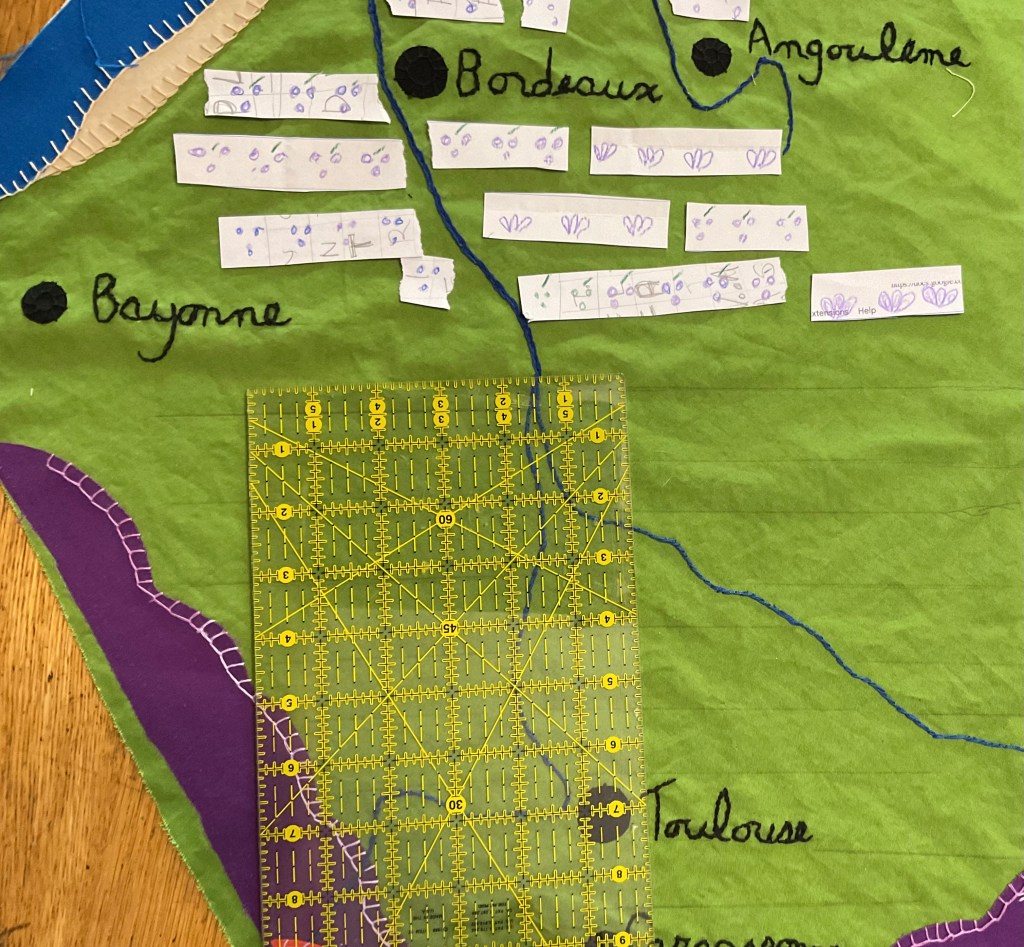
I also had to work out the right scale for the icons. Those first ones were 1 centimeter high, which I realized, since the whole map is about a meter wide, is TINY. So I tried some at 2 centimeters, which made more sense. I drew the 2 cm. icons on wider strips and laid them down according to the land-use maps I’ve been studying. I started with the south western part of the country
I took this picture to remind me what went where, then used my clear ruler to get the guide lines all straight.
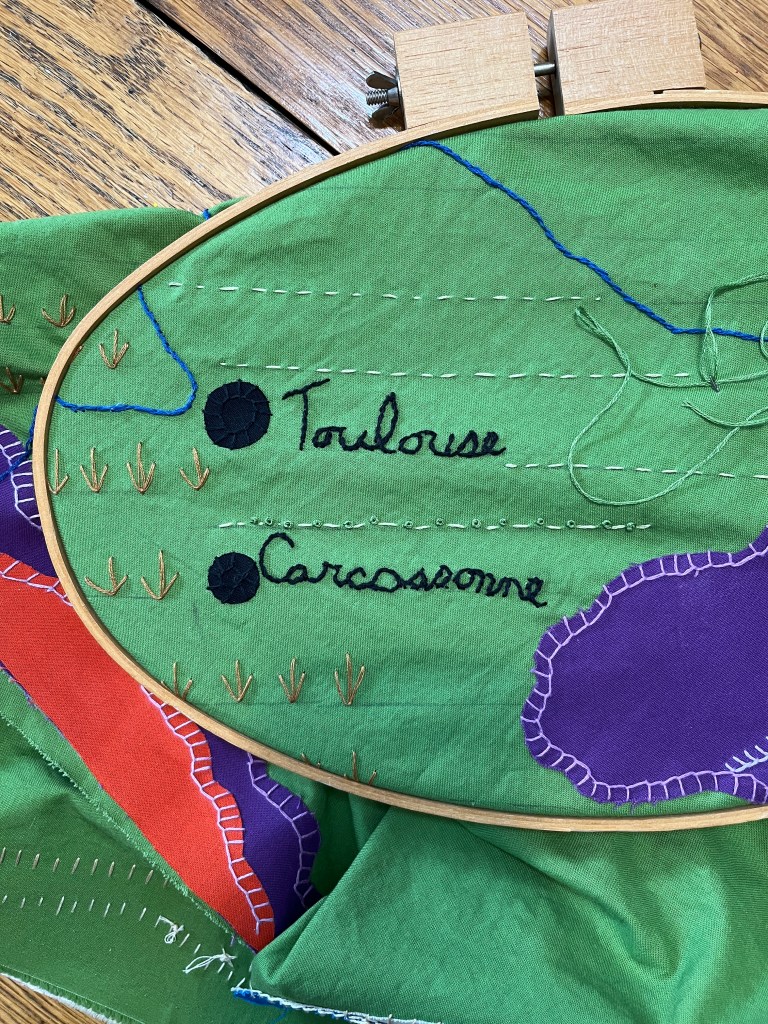
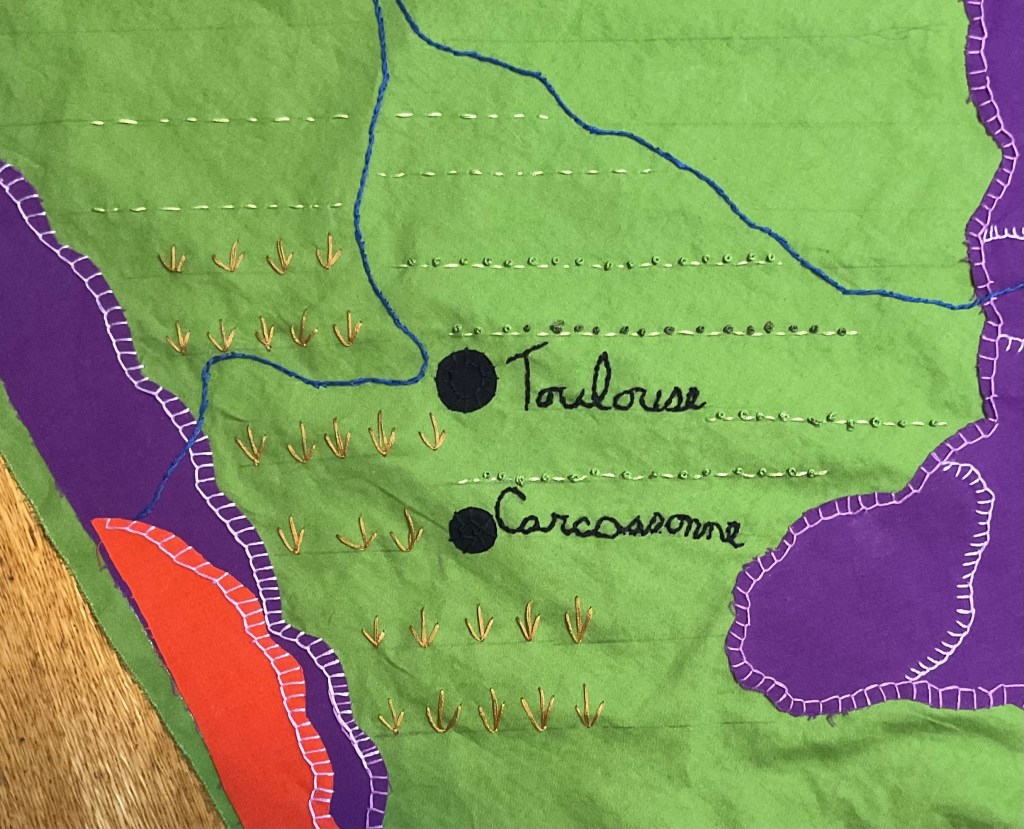
And now, I have started sewing the icons! These are for wheat fields and row crops.There are still a couple hundred yet to go, so it will be a good long time.
It was my intention to be very methodical about this quilt. First the land forms, then the cities, then the rivers, and so on. But that wasn’t working for me.
Embroidering the names of the cities is extremely fiddley, and hard to do for very long without getting a little crazy. There was lots of squinting and mumbling.
So I started alternating. A few cities, then some easy, sweeping lines on the mountains, then a few more cities. Then start on the Loire!
Then a walk in the park to stay balanced and happy.
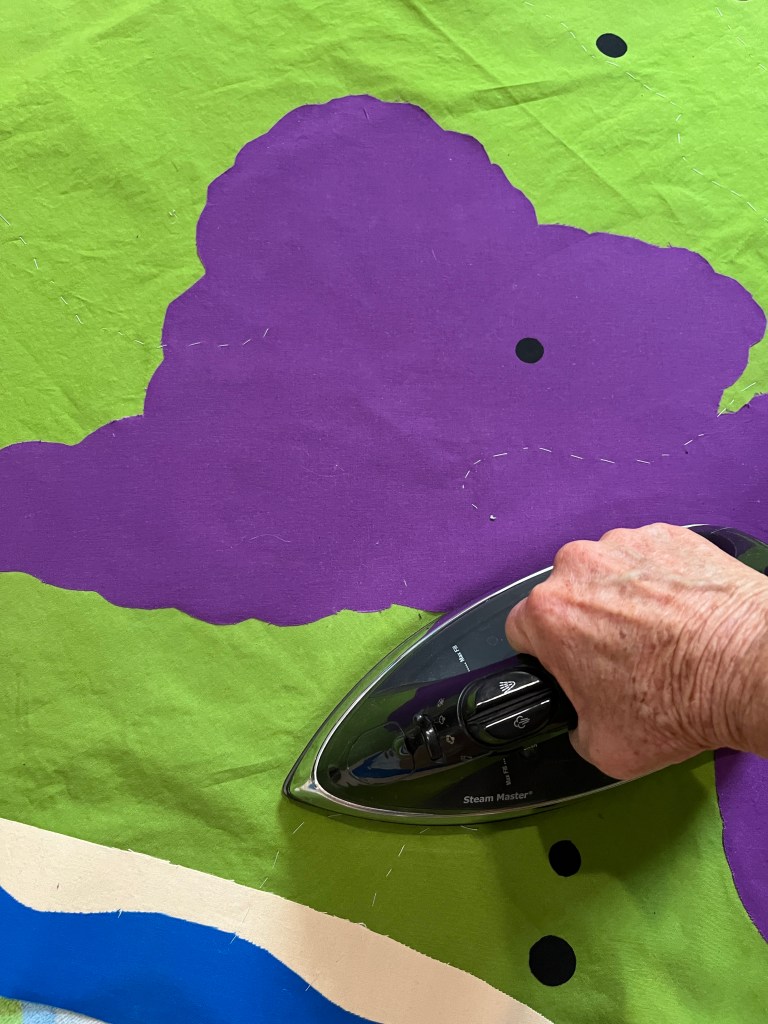
To put the cities in my French map quilt, I used the same Heat N’Bond fusible interface that I had used to attach the Massif Central and the shorelines.
I traced three different sized circles to show different sized cities. The cap of a vitamin bottle made Paris, a wine cork made the medium sized cities like Nantes, and the cap of a chapstick tube made smaller towns, like Angouleme.
I cut all the circles out during the Olympic beach volleyball matches, which made it much less monotonous. Each one was peeled, then placed and pressed into place.
I realized, once they were all down, that Paris was a bit too far east and north. For a few days, I tried to convince myself that it was fine, and I was going to leave it where it was.
But every time I looked at it, the error bugged me. So I decided to move Paris… which meant I had to move the Seine, the Loire, and all the cities along both rivers.
There were bad words. I’m still in the process of removing and replacing the dots, and you can see where some of the adhesive is still there.
I managed to get “Paris”properly named, so at least I have a point of reference going forward.
I am embroidering each name in a cursive script, much like my own handwriting.
That’s going to take some time, too, but I am happy I corrected the error while it was still possible.
In search of fabric for my France map quilt, I took the # 75 bus to the #72 to Bolt Fabric the other day. It’s a quick trip, and nice to see new neighborhoods.
Bolt didn’t disappoint! I found the palette I had chosen in solid cottons, which will be good for appliqué-ing and embroidering as the project moves along. I got the fabric home and washed it.
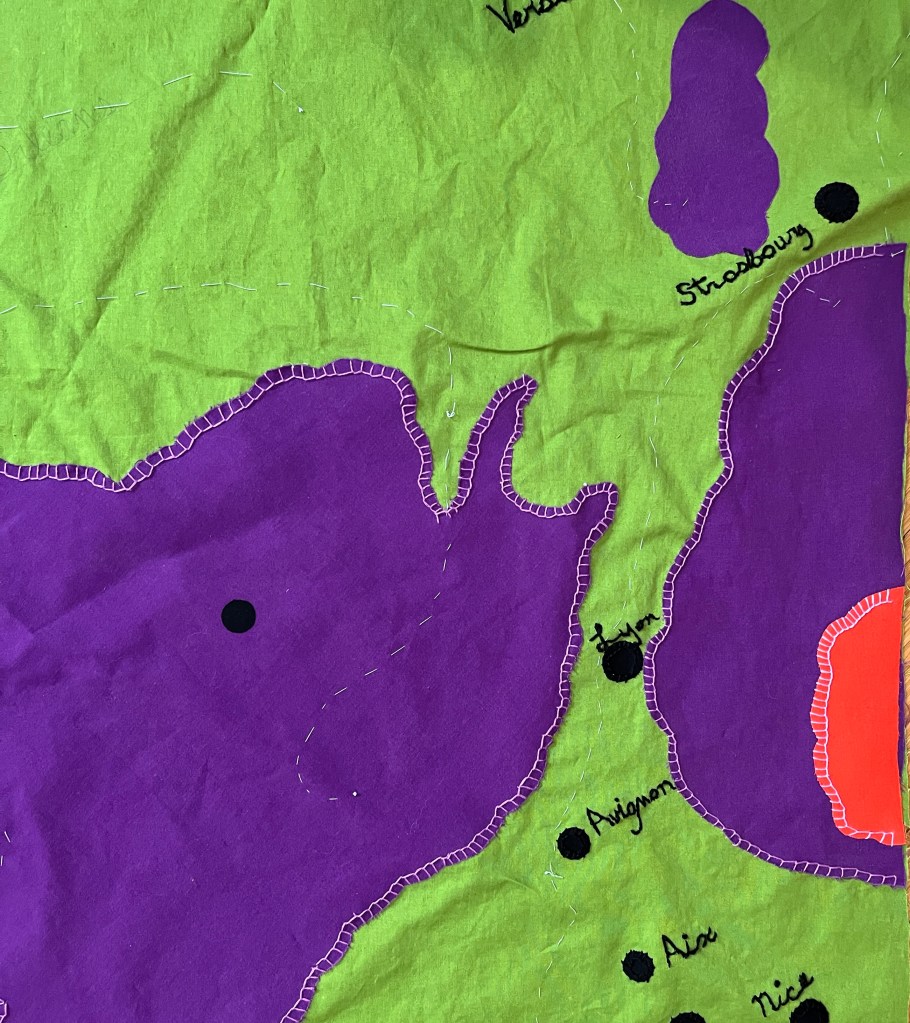
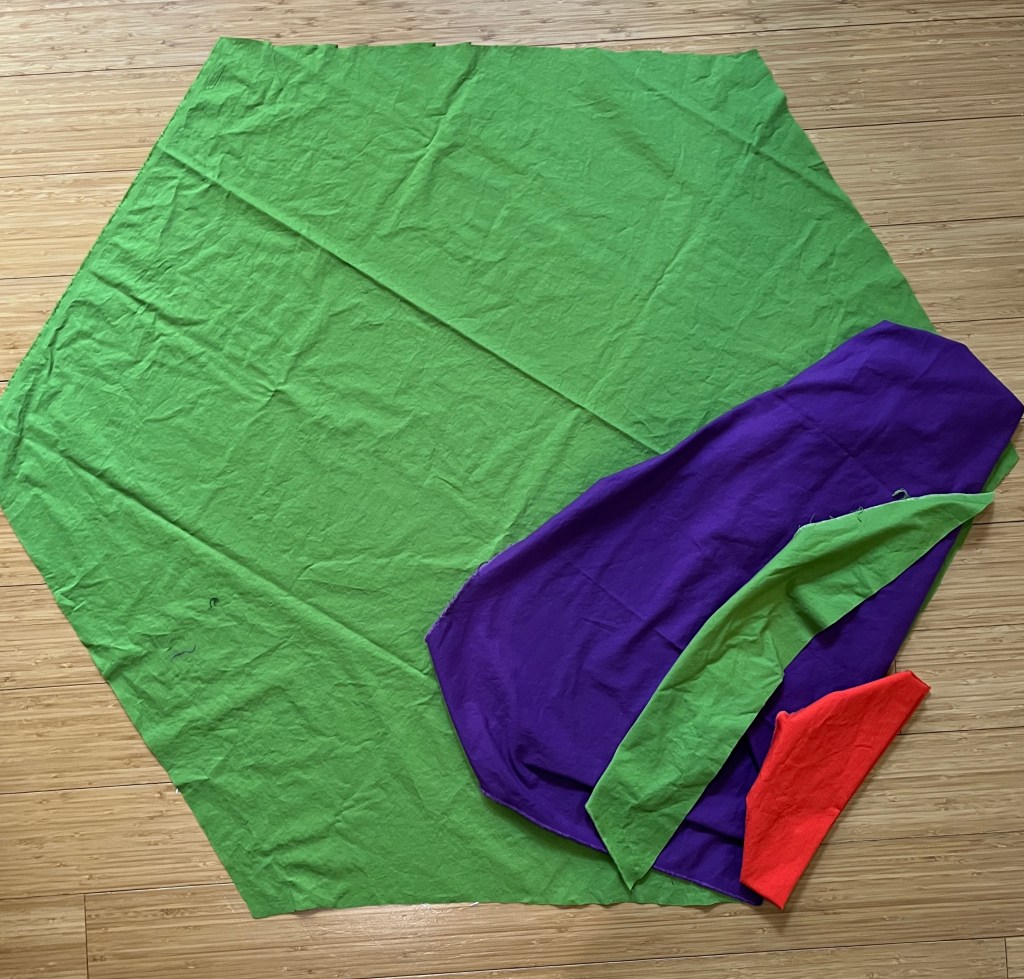
And now I need to decide on the style of the map. The main body will be green, the lower mountains purple, and the peaks of the Alps and Pyrenees will be red. Coastlines will be a soft peach. Am I sure? Maybe.
With my five colors, it will not be a ‘realistic’ map. It will be modern, abstract, more …. stylized. But what style?
I’m wrestling with that, in one of my favorite stages of creation, the “creative problem”.
My goal at this point is to let each stage sit long enough, and look at it often enough, so I don’t get ahead of myself.
So far the only cutting I’ve done is to make the basic green hexagon shape. The rest will come, I’m sure.
I love learning new things, and this week I have been all about Slow Stiching. This is a new name for combining old hand sewing techniques like embroidery and quilting, and I am loving it.
I have got a project set up to do on my flight to Denmark, but I want to make sure I know the ins and outs before I start it at 30,000 feet.
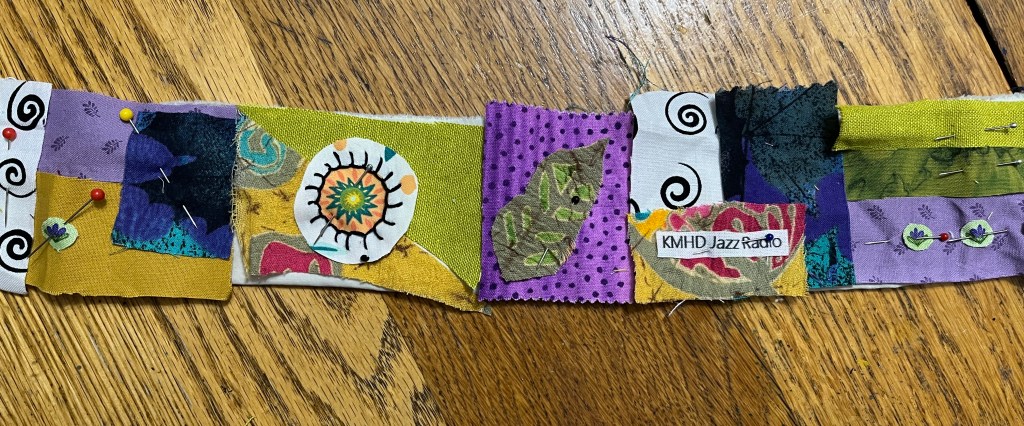
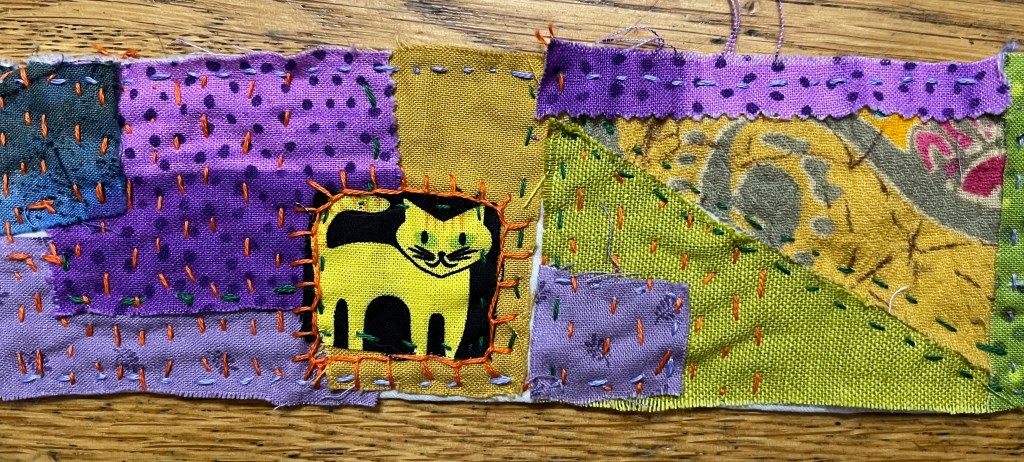
So I am practicing! I am making a 30 inch long, 3 inch wide strip, quilted, appliquéd and embroidered. I am not sure what I will use it for, but something will come to me. Wall decoration? Head band? Ridiculously long book mark?
Anyway, I am enjoying the act of embroidering, playing with colors and patterns, and feeling the textures grow under my fingers. There may also be buttons, beads, and other goodies as I go along.
I am learning how this sort of project works. A few things I have learned:
*** Keep about half an inch of overlap so there are no gaps between patches.
*** Use a single strand of thread of a light color to sew patches down if you plan on adding more layers of stitching, so it doesn’t distract from the patch.
This is how it is looking so far, on the front….
And on the back.
Maybe I’ll bring this one along with me, and we’ll figure out what to do with it!
Back in March, I got some books about Sister Corita Kent for my birthday. As you might suspect, Corita was a Catholic nun. She was also an artist and teacher at the progressive (as far as Catholic institutions go) Immaculate Heart College in Los Angeles back in the 1960s.
I will not attempt a detailed biography here. There are dozens in print and online, by folks who have done their research.
What I want to talk about is how some of Corita’s “Ten Rules’ have affected me and my art.
Number 4. Consider everything an experiment.
I know Crazy Quilts are an OLD thing, but mine is a NEW thing, at least to me. Combining piecing, embroidery, beading and quilting in one totally original creation big enough for two people to snuggle under was a seven month expeiment. It worked out pretty well.
Number 6. There are no mistakes. There is no win and no fail.
This is comforting to me, after years in the classroom where I dreaded making mistakes in front of my students. Knowing I can learn from everything makes me braver.
Number 7. The only rule is the work. It is people who do all the work all the time that figure things out.
For the past few years, with help from Auntie Bridgett and Ruthie Inman, I have been reading, thinking and experimenting with art. The stitches in my Crazy Quilt were an experiment. Laying down layers of collage, then tissue, then ink. Three dimensional constructions covered in paper mosaics… all experiments. I like some better than others, but I learned from them all.
And, as Sister Corita promised, I am figuring things out.
As summer is winding down, the activities are ramping up! Sunday was a busy, exhausting, happy, musical day. First our friends John, Jennifer, Amy and Phil came by for lunch. We got caught up on everyone’s news, adventures, children and grandchildren. It was wonderful.
After lunch, I asked our friends to sign my tablecloth. They did, with John (the tall handsome fellow on the left) giving me a real challenge. His self-portrait sure makes things interesting!
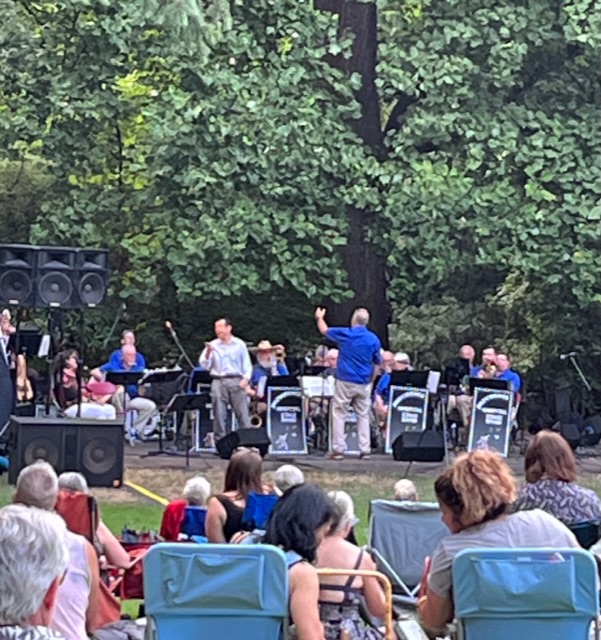
When all the shenanigans were done, our guests headed off and we packed some leftovers and went to Laurelhurst Park for some music.
The Providence Stage Band is a very talented group of doctors from our local hospital, and they were performing a concert. We love their Big Band and Jazz era music, and the vocals were classic. “Ain’t that a Kick in the Head?” and “Queen Bee”, “Too Darn Hot” and other songs from the 40s and 50s bounced among the Douglas Firs and picnickers.
As usual, though, the real joy was watching the people! Youngsters dancing by the stage made their own show and got just as much applause as the band.
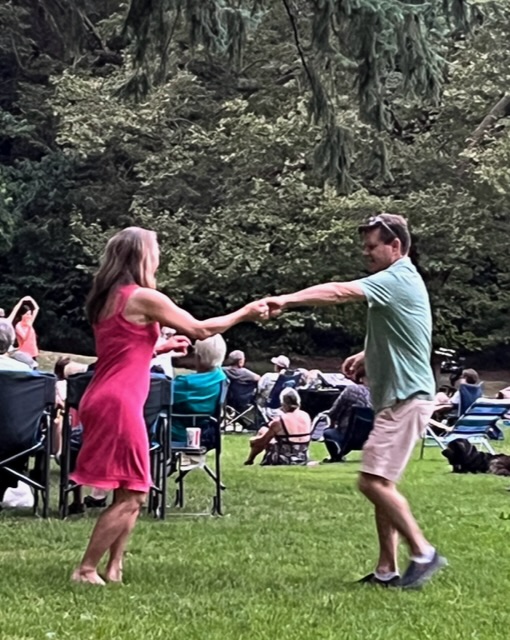
Couples dancing under the trees had romance, music, and conversation.
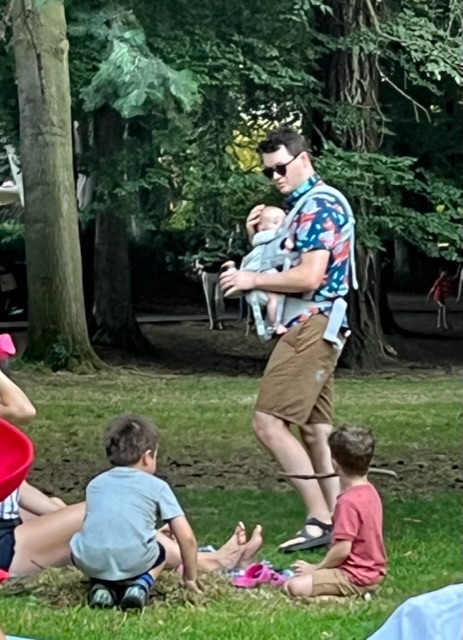
There were Dads carrying infants while supervising young stick-collectors.
And of course, everyone brought their dogs!
The air got cooler as the sun went down behind the trees, and the band ended with “In the Mood”, my favorite Big Band piece of all time. We packed up the chairs and walked the three blocks back home, worn to very happy nubbins by the day.
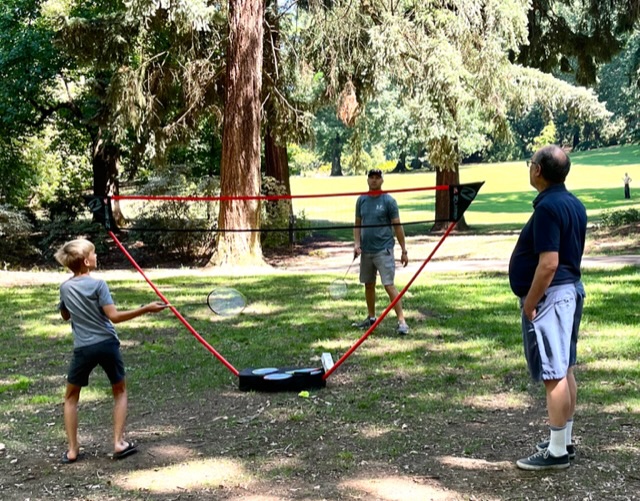
On the family’s second day in Portland, we met up at our house, packed up a picnic, and walked up to Laurelhurst Park. We had seven people and so much equipment, I felt like part of the Lewis and Clark Expedition. Food, drinks, blankets and badminton all got carried by the crew.
We set up to eat in Picnic Area A, which usually hosts weddings or birthday parties, but it was a weekday and we had it all to ourselves.
It had a nice flat space for badminton practice.
After lunch and badminton, we packed up the gear and headed to the part of the park where the swings are. Everyone got into it!
By this time I was about worn out, so Bridgett and family went off to visit The Grotto while I konked out for a bit. Then I made supper for when they got back.
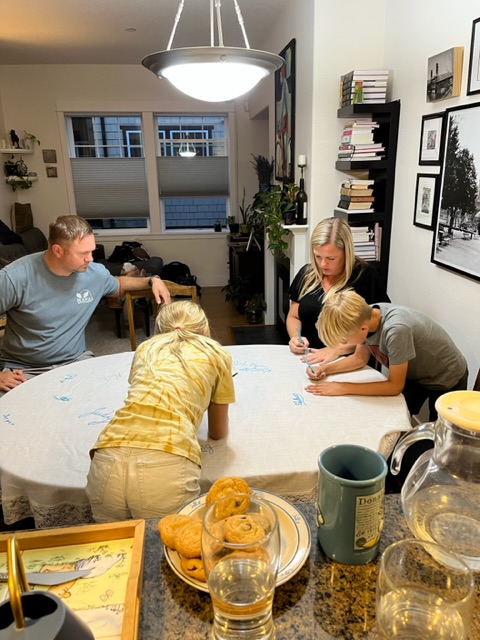
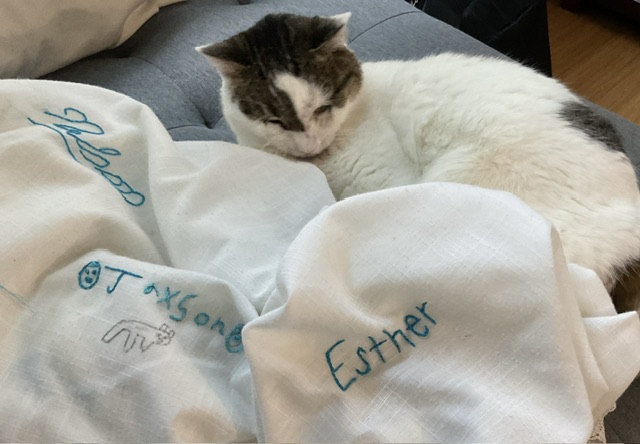
When supper was done and the table cleaned off, I got everyone to sign my tablecloth as part of my ongoing ‘memory through art’ project. It is a way of remembering all the lovely people who have eaten around my table here in Portland.
And today, I started embroidering the names so they become permanent.

















 Dear Liza