Swarming to OMSI

Dear Liza,

We went out to OMSI the other night for a Science Pub, a program that we have gone to before, but usually at The Kennedy School. Like other pubs, you can have beer or wine, sodas, snacks, and learn stuff!


The big show currently at the Oregon Museum of Science and Industry is about Dinosaurs, but we walked right past them (after saying a polite Hello from a safe distance, of course) and into the Empirical Theater.

Urban beekeeper Mandy Shaw was there to talk about her love of, and work with, bees. We are all interested in the buzzy, pollinating honey-makers and Auntie Bridgett’s main character, Auntie Beeswax, is a beekeeper, so we wanted to learn everything we could.

And we did! In Mandy’s hour long talk (complete with great video and even audio recordings of different bee activities) we learned that male bees don’t mate with their own Queen, but with Queens from other hives, at a place called The Drone Zone. This was a complete surprise, and now I wonder where our local Drone Zones are!

We also learned that if a hive makes too many Queens, the spares are killed by the bees swarming her in what is called a Murder Ball, or “Cuddle of Death”, where their body heat literally cooks her. Gruesome, but necessary. This Cuddle of Death is also used to protect the hive from invaders such as Yellow Jackets and Wasps.
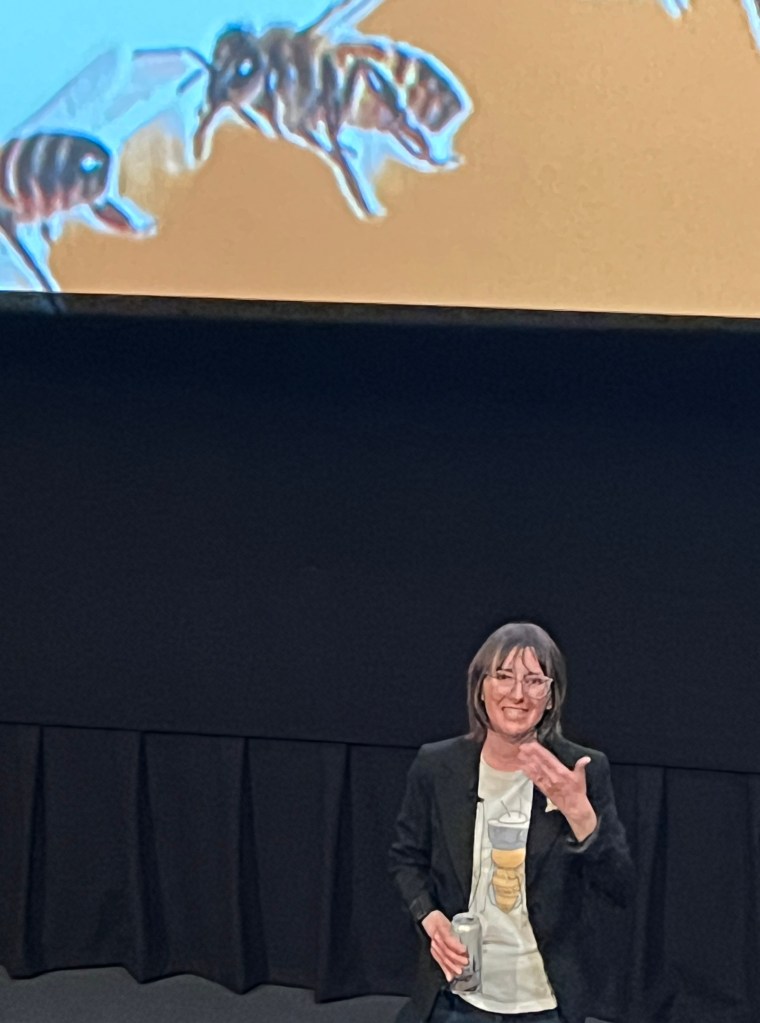
Mandy obviously loves and admires bees, and told us about honeycomb ‘memory’, Mason Bees, and how bees build their own honeycomb in a process called “festooning”.

It would take another two dozen blogs to tell you all I learned, and there are folks on YouTube, podcasts and elsewhere who will give you better information. So, go learn! My brain is still processing!

Love,

Grandma Judy

Pumpkin Gender

Dear Liza,

I learned something at the garden yesterday!

I was bemoaning the fact that so many of my beautiful pumpkin blossoms weren’t turning into pumpkins, and my garden-mates Morgan and Abby set me straight. It turns out, every squash plant (pumpkins, zucchinis, acorn squash, and such) will produce BOTH male and female flowers.

The male flowers will never mature into squash. Their only job is to pollinize, that is, fertilize, the female flowers. Once the bees are done with them, they just shrivel up. They are useful, however, for fancy ‘stuffed squash blossom’ dishes, where you put rice and meat into the flower and then tie it up and bake it. Yum!

These are spent male flowers

The female flowers, once their blossoms are pollinated, will fatten up and become a squash. Ain’t life interesting?

Yellow male flower on the bottom, green female blossom-turned-pumpkin above….

I didn’t know any of this! I love that I am still learning things about gardening.

Love,

Grandma Judy

Still Growing, Part 2

Dear Liza,

Last summer, a few months after the Covid shutdown, I started painting with an online group organized by Ruth Inman. It made sense that we should start painting with flowers…. who doesn’t like flowers?

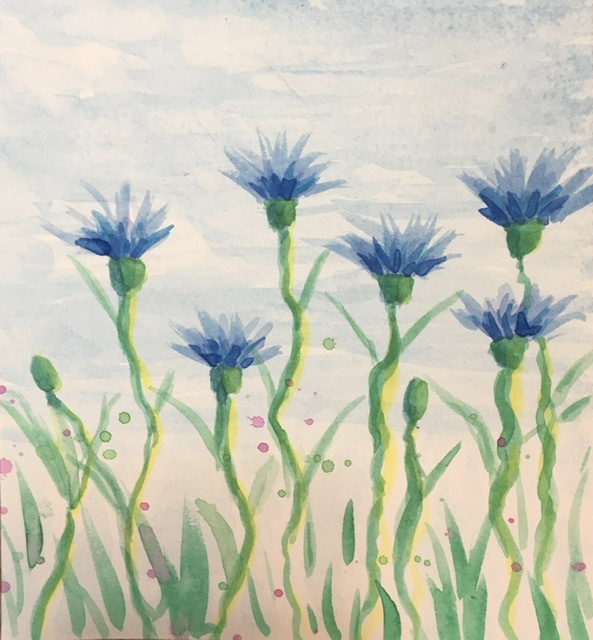
Step by step watercolor Cornflowers

My skills weren’t very good, and I was scared of making mistakes, but being with an old friend put me at ease. The tremor in my hand got in the way a bit, but I’d just power through, realizing that the wiggly lines could be just part of the picture. Flowers don’t have straight lines, anyway.


Wacky candy wrapper collage

As the year passed, Ruth would give us challenges to use different materials, like candy wrappers or other recycled papers. These let me realize that ART didn’t have to mean making a perfect painting every time. The making, the process, was the main thing. If other people liked it when you were done, that was a bonus. But it was not the main goal.

Fun with Acrylics

Realizing that, I got more confident. I also came to understand that different media work in different ways. Watercolors always show through, so planning is crucial. Acrylics are more forgiving and will cover up mistakes. Collage needs a careful hand but is amazingly freeing. And all of these can be used in the same piece, if you like!


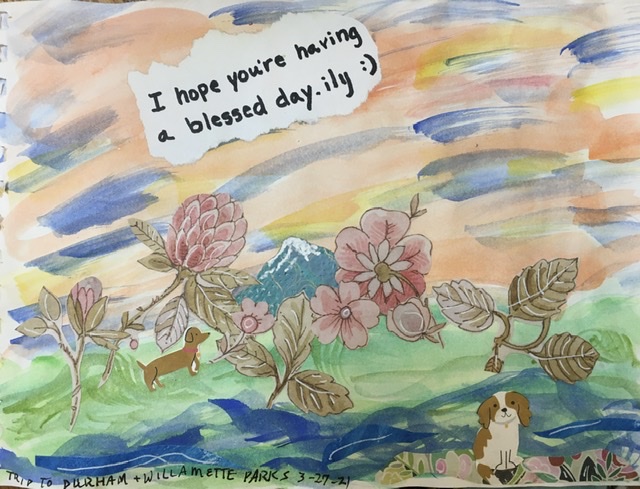
This is my new favorite, a remembering of a drive along the Willamette. As I sat on a bench looking at Mt. Hood far away across the river, I planned out how I would construct it. Watercolors for the sky and ground, THEN the distant mountain (out of a bit of Kleenex box), THEN the flowers/ trees in front of it, then the river and dogs. I found the note in the sky folded up in our picnic table, and wanted to include it.

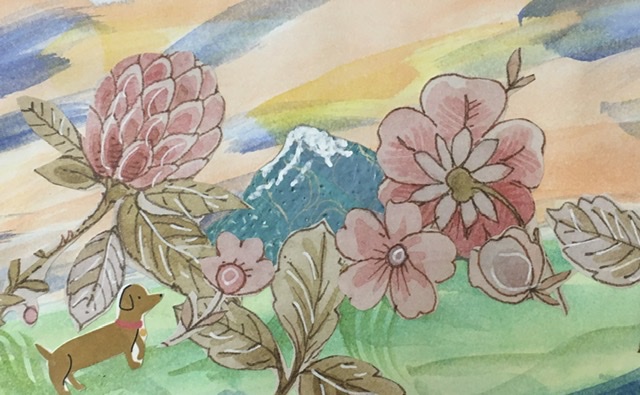
Close up!

I built up from the background to the foreground, and was pleased with how it turned out. The snow on the mountain is a tiny bit of Posca marker.

I’ve learned a lot this year. Mostly, I learned that I am still learning, which is a good thing.

Love,

Grandma Judy