When I travel, I walk miles every day and take way too many photographs. And since I know I won’t remember everything, I write and draw and collage into my travel journal. Here is the page that shows our train ride journey from Charles de Gaul Airport to Lyon.
I try to write with accuracy about where we go and what we see, and how I feel about it. But my art …. Is somewhat less accurate.
And that’s okay! Sometimes I work from my photos, trying to make things look just right…
.
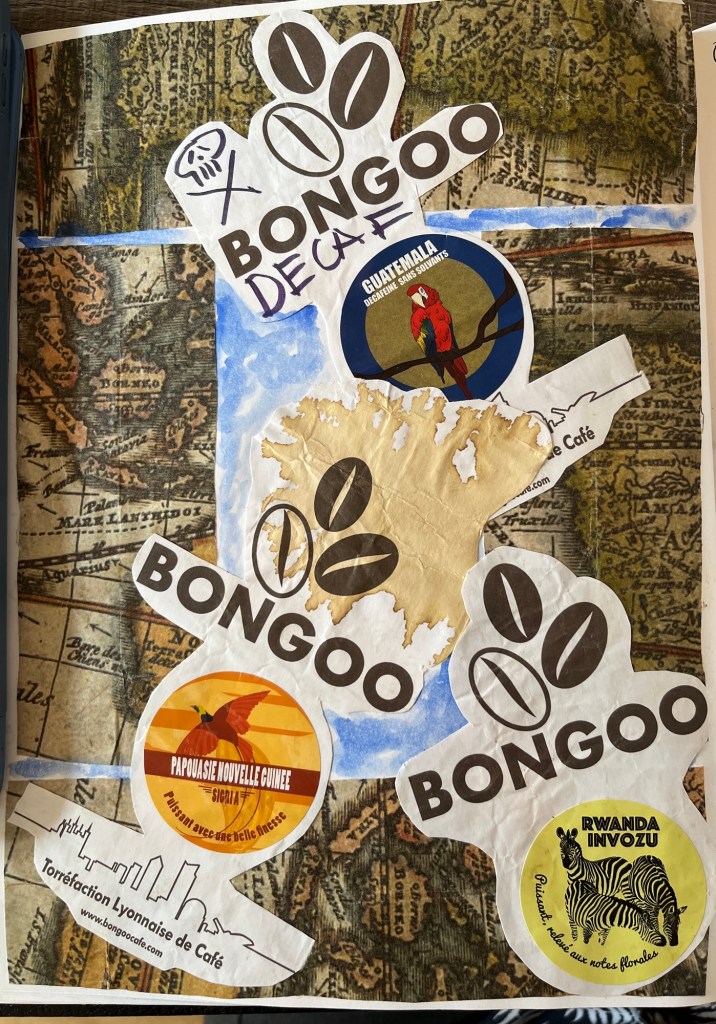
And sometimes it’s more of an impressionist collage sort of thing, like this page filled with coffee bags.
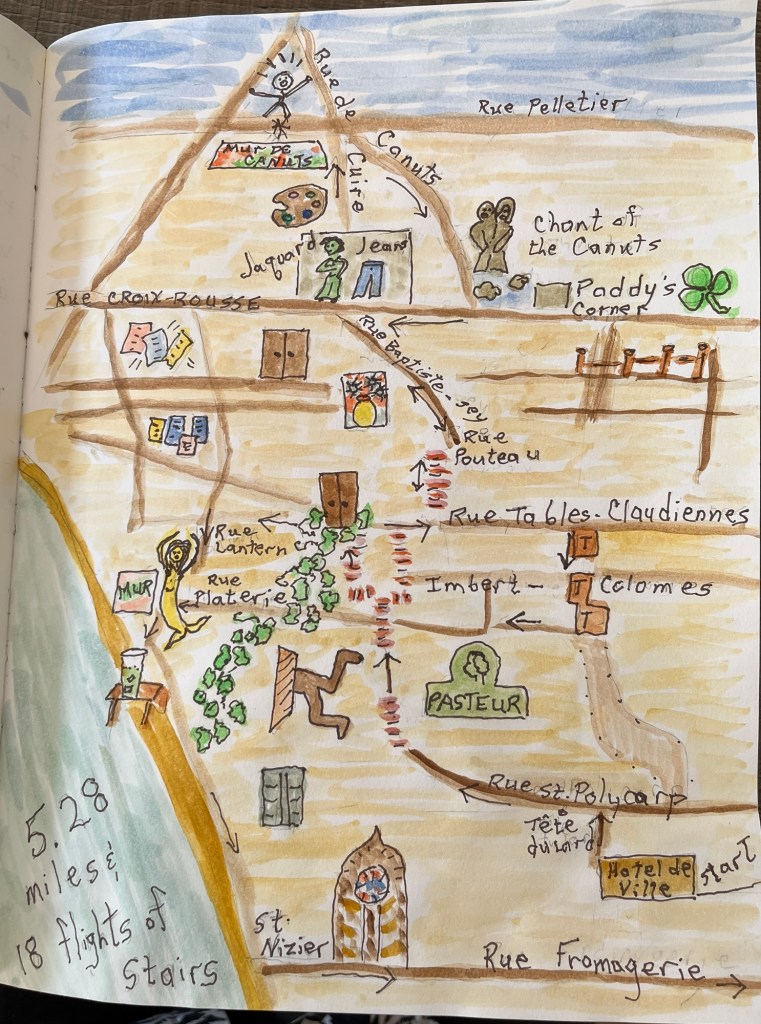
And MAPS!! I love maps, and they help me make sense of what I saw and where I was. Our long hike up the Croix-Rousse neighborhood ended up looking like a board game.
And then I feel the need to sketch some more. It’s my book, after all, isn’t it?
The problem (is it a problem? Or an opportunity?) is that my Journal is filling up fast. I will need another in a week or so. Do I get the same size? This one is 8.5 by 11 inches, and I like having the big pages to play with. Since I don’t carry it with me, it’s not really cumbersome.
I’m sure Bridgett will help me find an art store that will help me solve my dilemma.
We have been so active during the day here in Lyon that we are worn out by evening, and make an early night of it. But this past weekend was the European Night of the Museums, and every museum was open, free, from 6:30 until 10:30.
You know we had to get some of that!
But first, it was a pretty, sunny day, and a walk was called for. Auntie Bridgett and I wanted a short stretch of the legs before resting up for the long evening, so we explored some new corners of Parc de la Tête d’Or.
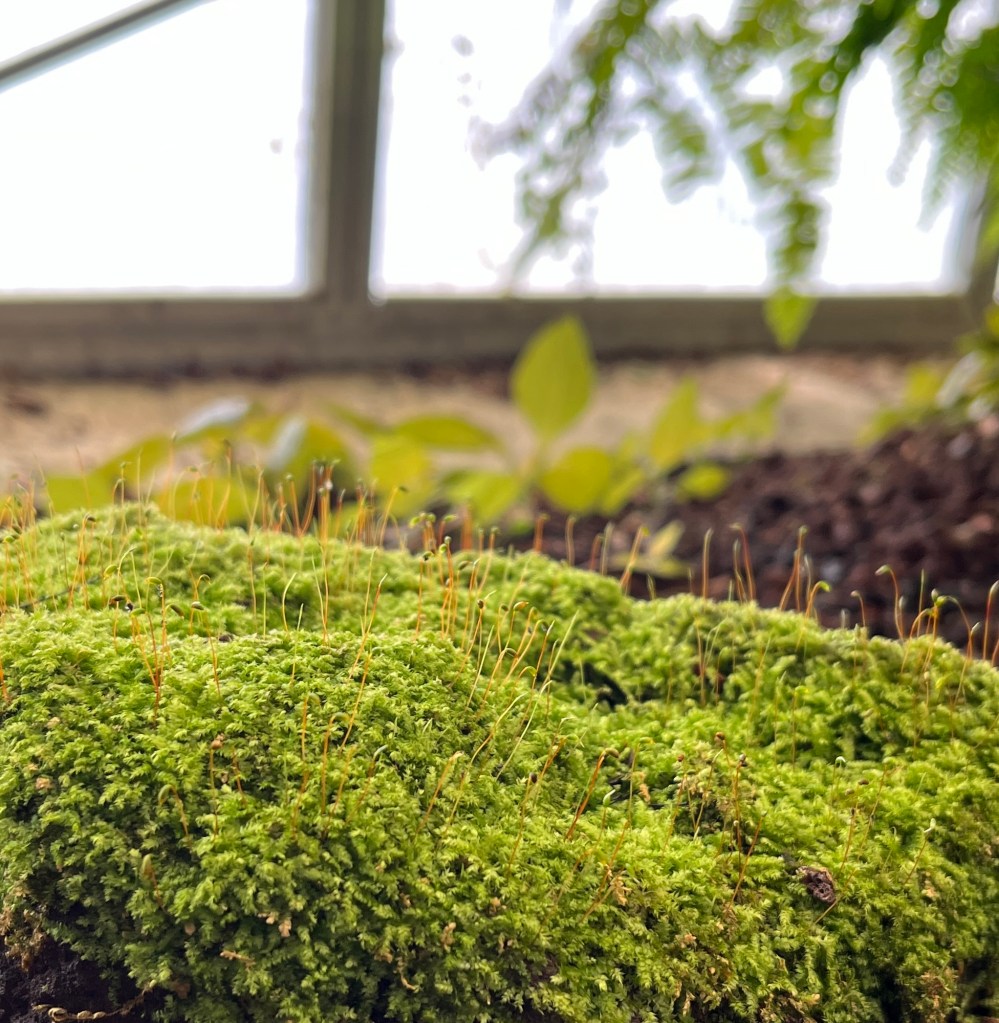
This small, humid greenhouse had incredible jungle growth.
Huge leaves, bright blooms and bizarre shapes were hanging and sprouting all over! it was amazing.
Once evening came, we took the A line metro to Place Bellecour and walked to a place Grandpa Nelson had seen, Café Française.
It looked nice, but their terrace was crowded, smoky, and we sat for 30 minutes without seeing a waiter. We like leisurely French service, but this was ridiculous.
So we headed a few streets off the main drag and found Aperothéque, with fewer people, a cool interior, and waiters who acknowledged our presence. Their food was good, too.
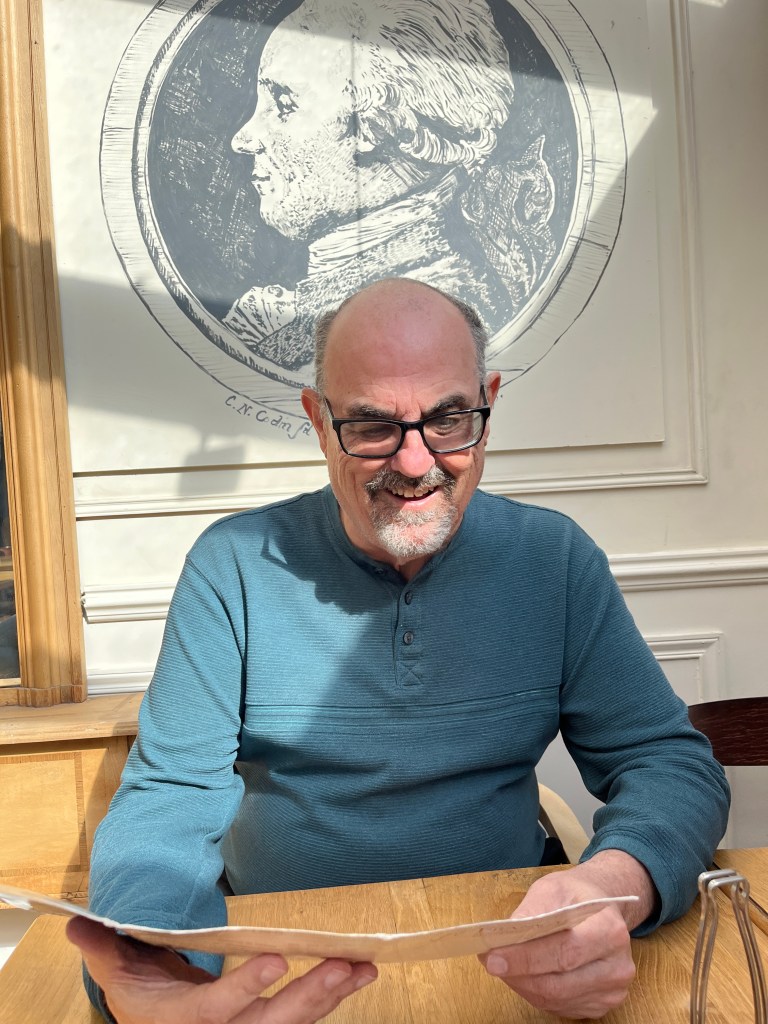
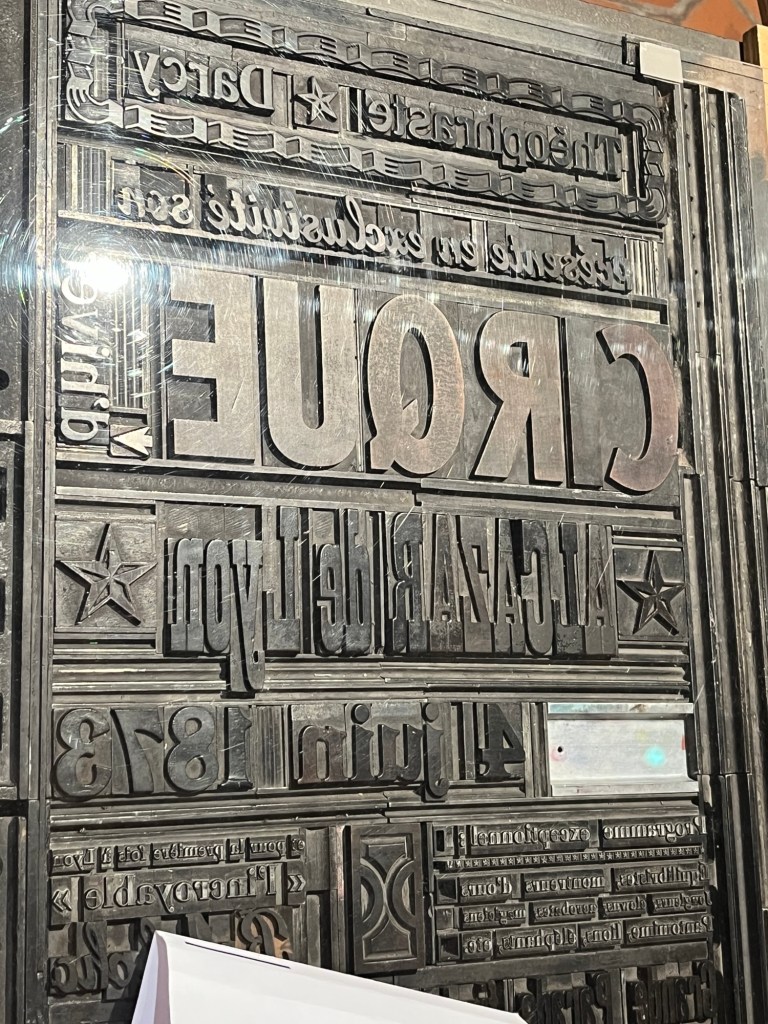
And finally, to the main attraction! We started with the Museum of Printing, which was full but pleasantly orderly. Housed in a Renaissance mansion that used to be Lyon’s City Hall, the museum tracks developments in printing from carved wood blocks to moveable type and its effect on religious reform, to multi-colored computer printing. It was reading-intensive, but well done and fascinating.
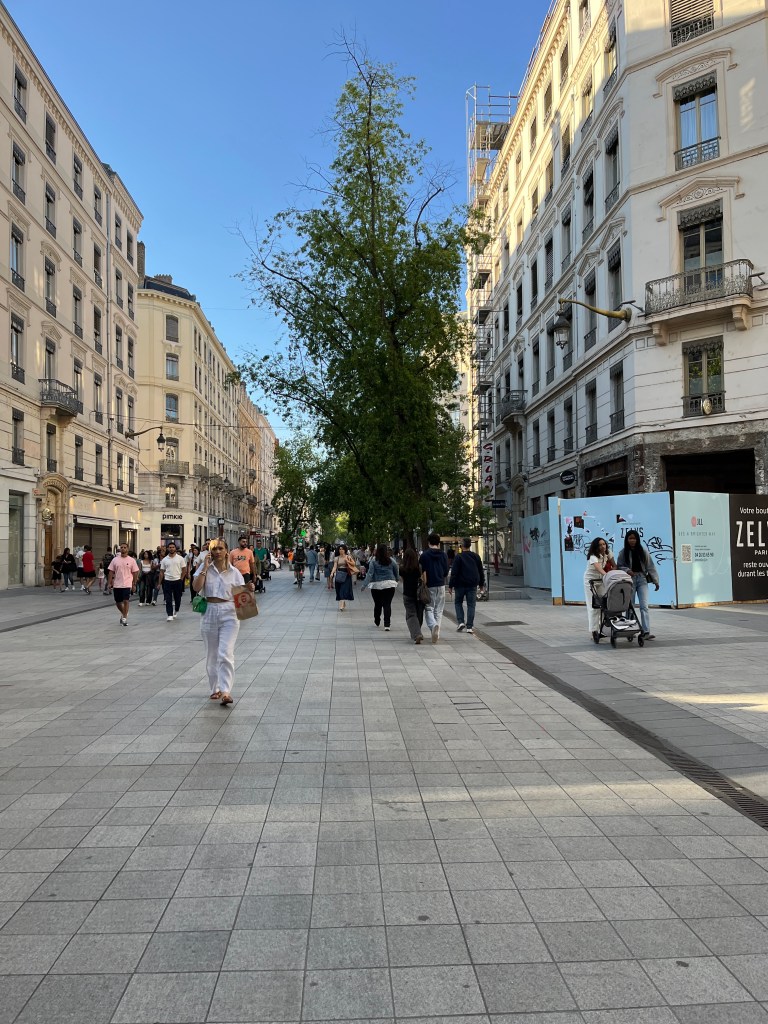
We were feeling a bit foot sore, but a delightful walk through bustling pedestrian streets got us to the Fine Arts Museum.
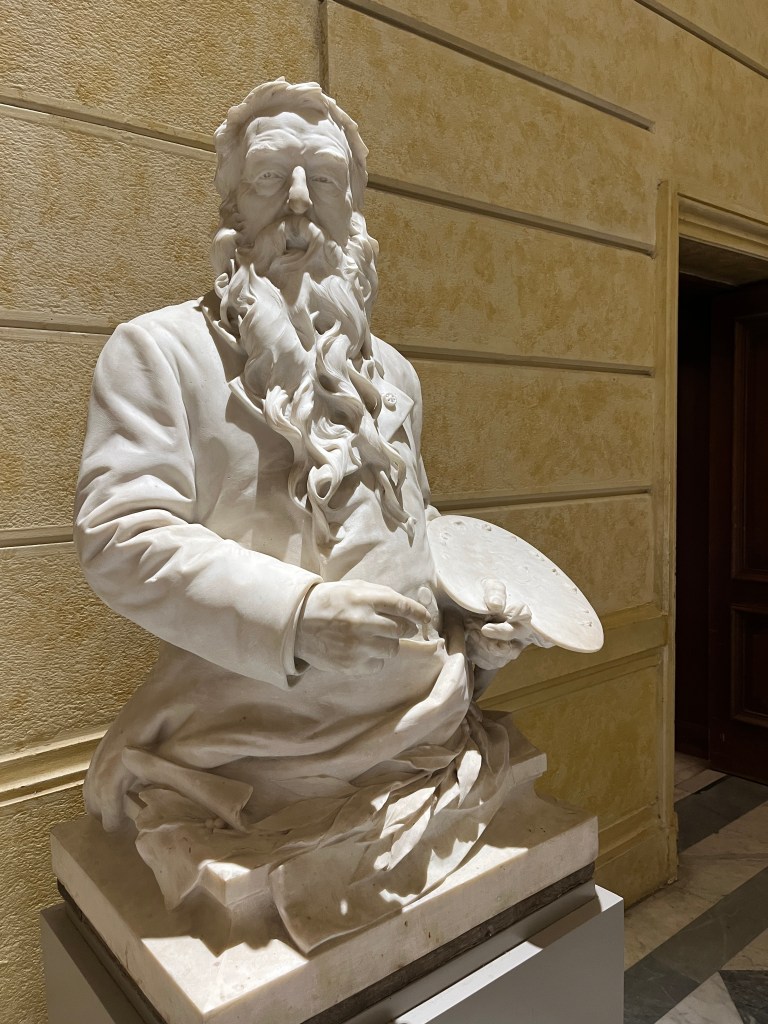
I didn’t take many pictures inside the Museum, because there were so many people coming and going so quickly, I felt like I just needed to hold on! Here is a lovely marble bust of August Rodin, looking as concerned about the crush as I was! We didn’t stay long.
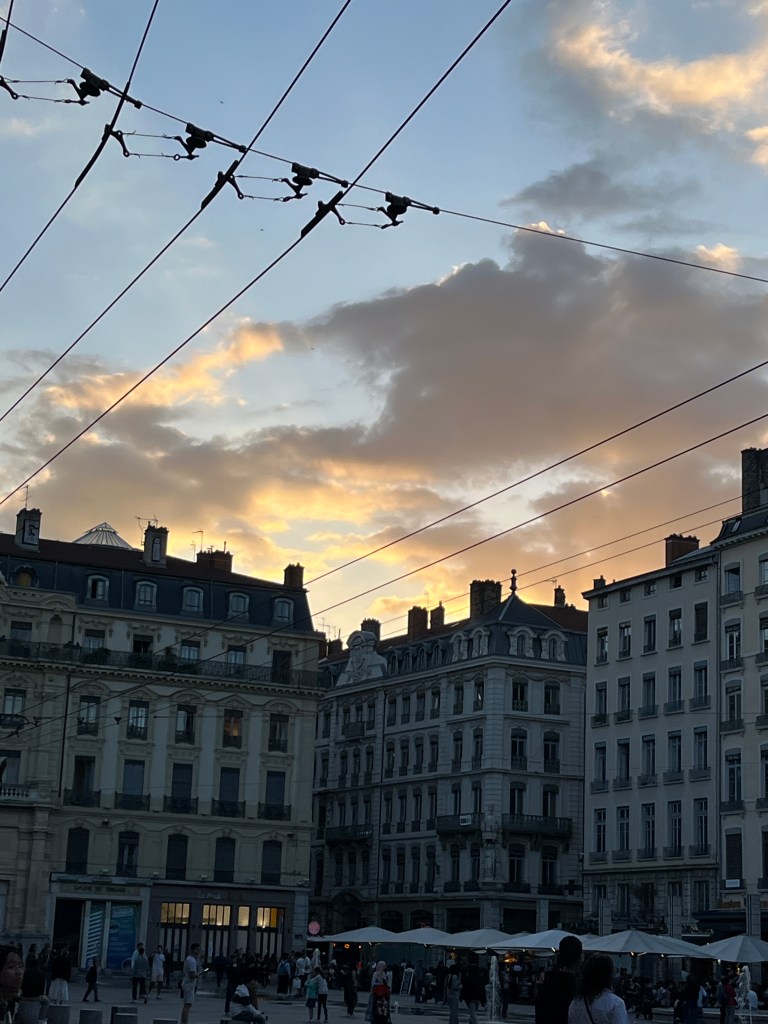
Once we found peace and space outside in the Place Terreaux, we saw our first sunset in Lyon and made our way back across the bridge and home.
Once they got settled in, the Roman Empire was in Lyon for a long time. For 368 years, from 43 AD to 411 AD, the Roman Empire built and ran Lyon, which was then called Lugdunum.
It’s no wonder, when the Empire fell and the Roman army left, that a lot of stuff was left laying around.
Great piles of that stuff has been collected by folks who came later, from Medieval farmers to modern archeologists, and put into this wonderful, modern Musée at Lyon.
The museum itself is a wonder. Built right into the back wall of the cliff that houses the amphitheater, it spirals down, leaving only the entrance and a few windows to give it away. Artifacts are arranged by era and type, so we can see the progression in ceramics, jewelry making, and glass work.
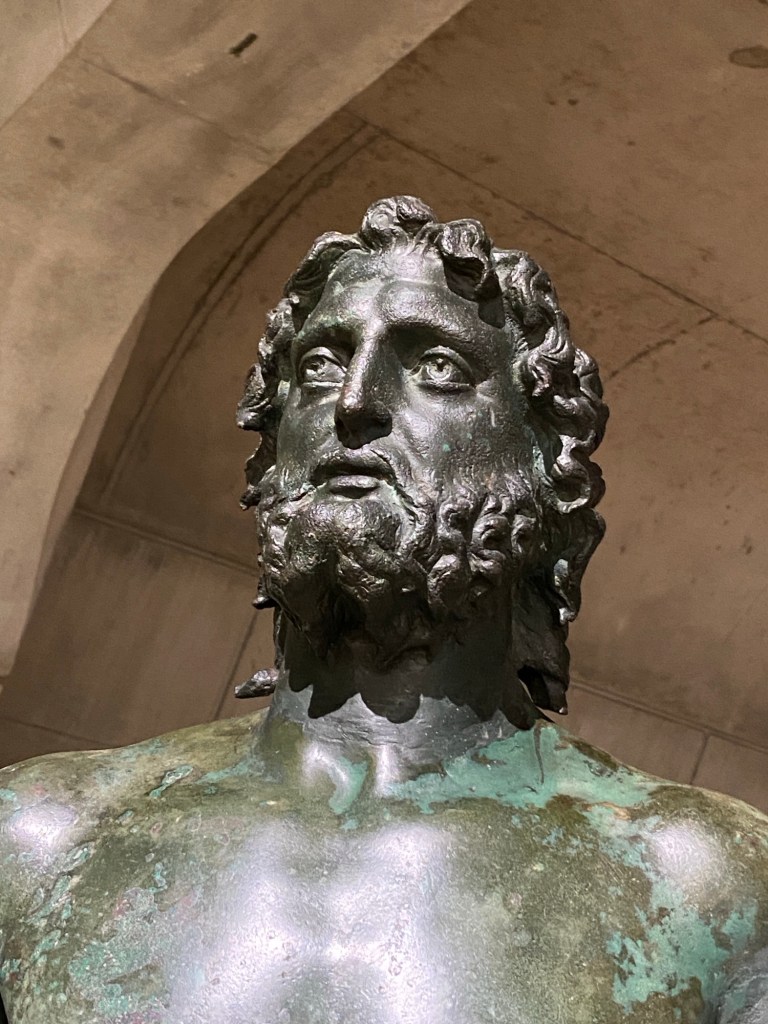
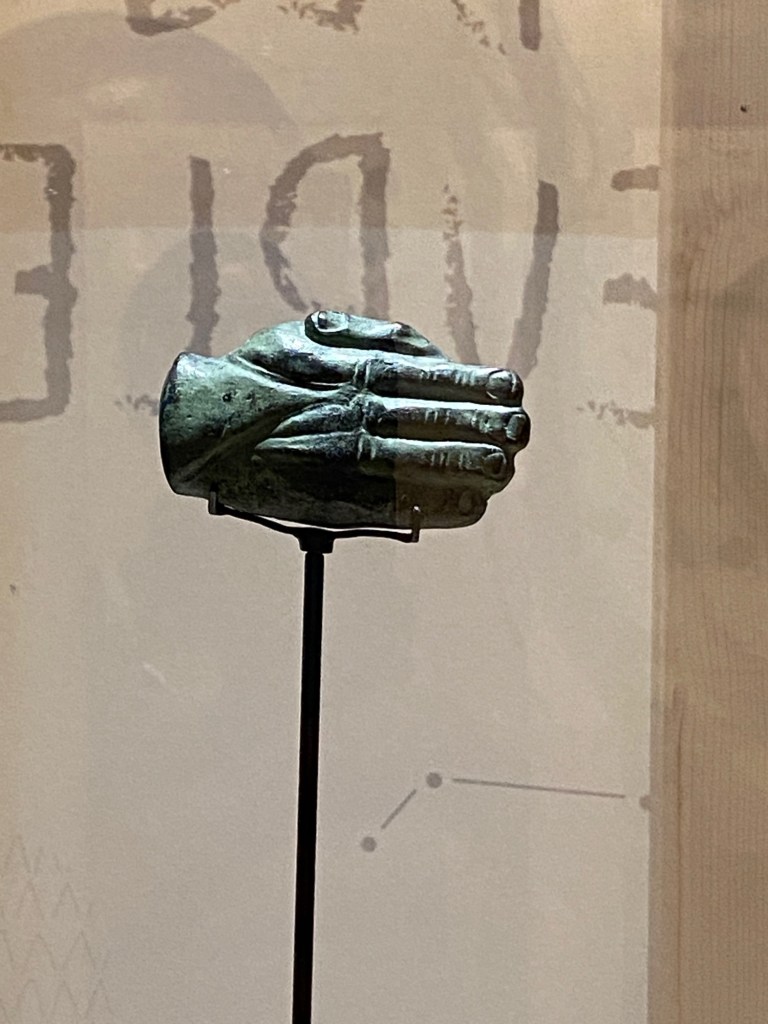
We get to see the variety of religious articles, from tiny pocket divinities to greater than life sized statues that Romans looked to for comfort and protection.
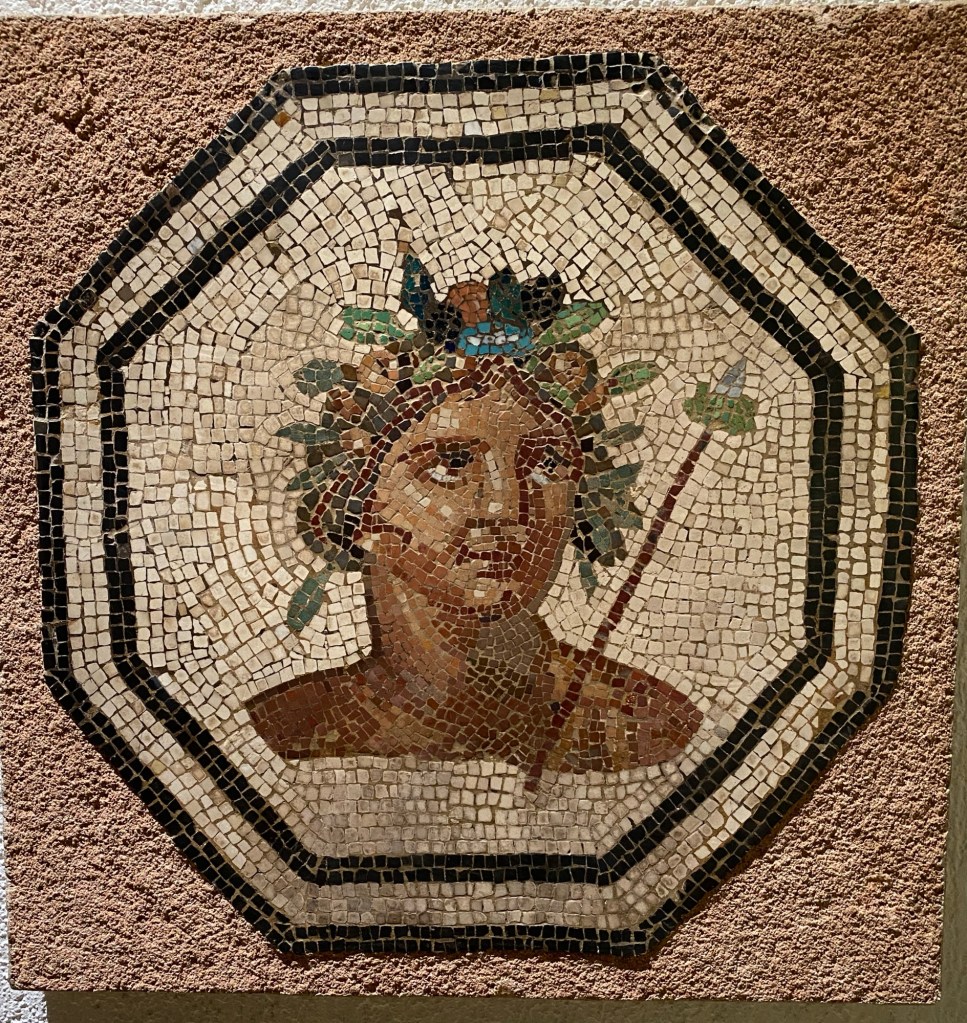
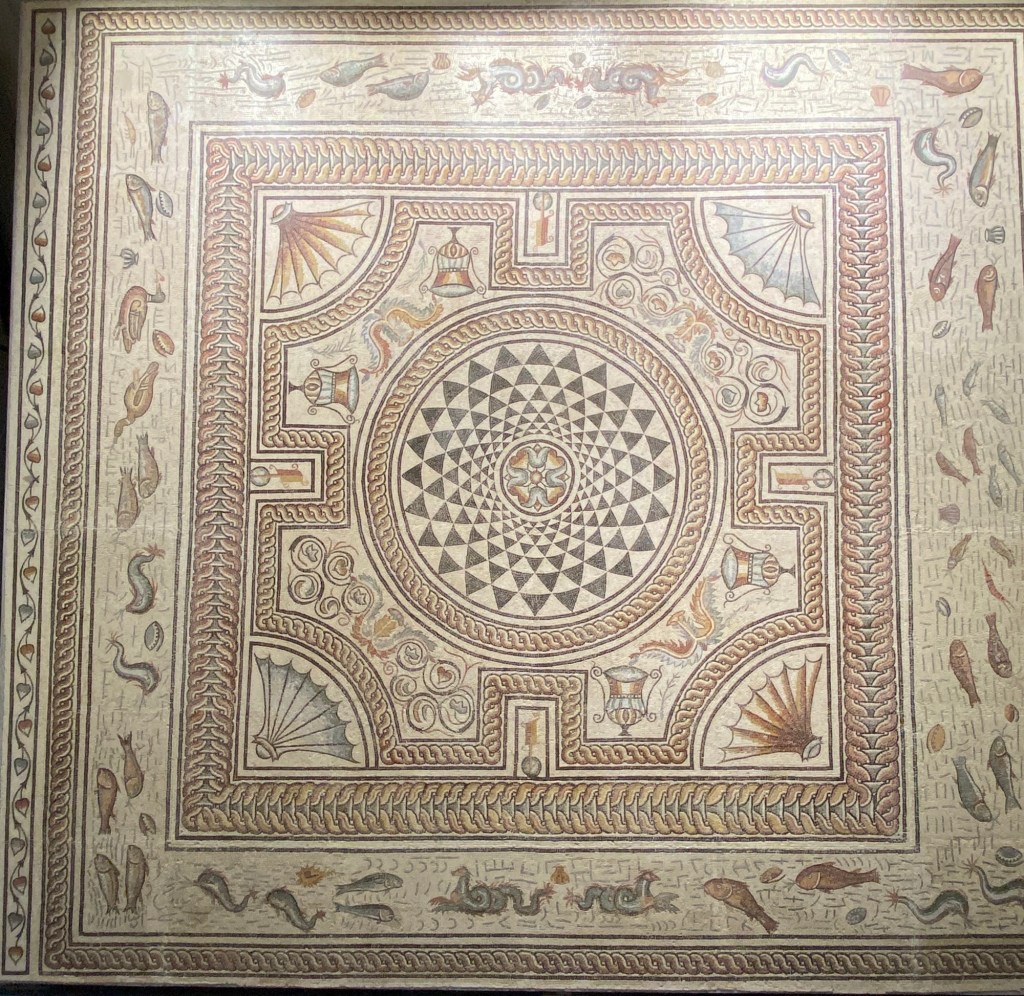
And the floors. I told you there would be floors, didn’t I? Many of the houses of Lyon, once they were properly excavated, were found to have these magnificent mosaic floors.
I actually got emotional, sitting right there, touching a floor that Roman moms played with their babies on, that dogs ran across, that people hugged and cried and celebrated on. These weren’t characters in a stone fresco. They were humans, making their way through life.
We kept spiraling our way down, learning about how people moved around the Empire, from Turkey and Spain, Germany and Iraq, to make the Empire diverse and powerful.
And when we reached the end, we were at the bottom of the Amphitheater, and just walked across the stage and down the road into town. From the ancient everyday world to the modern everyday world.
When we get to any city, of course we find the art museum. In France, these are called Les Musées des Beaux-Arts. So the other day, we set out for an arty adventure.
The Musée in Lyon is on the Presqu’île, the peninsula that is formed where the Rhône River and the Saône River both run south for a bit before converging. We crossed the Rhône on the Pont Morand and walked right into the middle of the city!
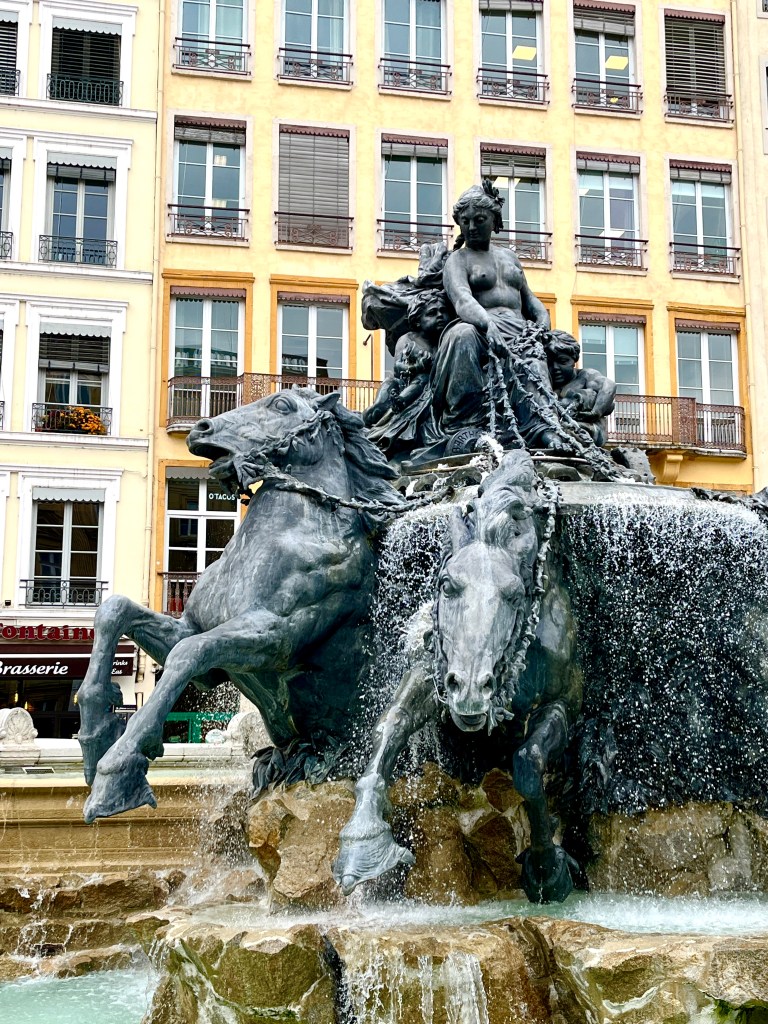
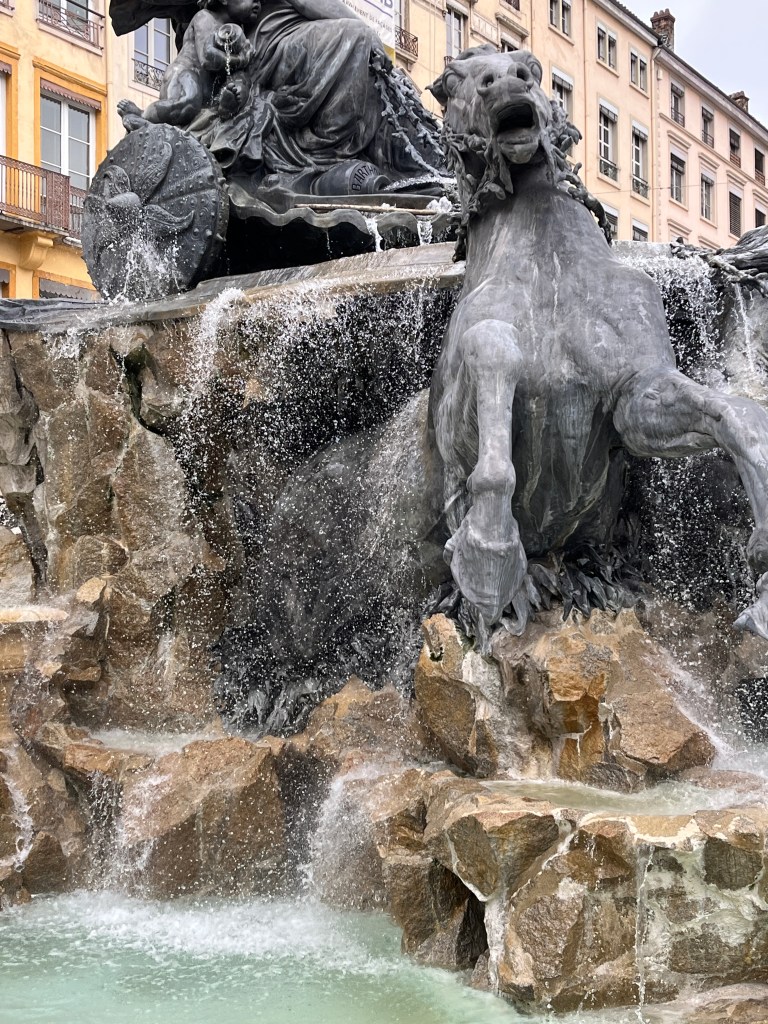
Le Musée is on a wide plaza called Le Place Terreaux, which also has the Hotel de Ville, or City Hall. The first thing that catches your eye is this magnificent, roaring, complicated fountain. Sculpted by August Bertholdi (who also did the Statue of Liberty), it shows France as a woman, riding a chariot pulled by four wild, energetic horses.
The horses represent the four great rivers of France, the Rhône, the Loire, Seine, and the Garrone, with France controlling them in a gushing, turbulent flood. We walked around and around, amazed at the details.
The building that houses the Musée is hundreds of years old and is as beautiful as the art inside. The first staircase is topped with statues that represent the Beatitudes ( “Blessed are they that …” verses from Luke in the New Testament), and were so interesting that it took us twenty minutes to get past them!
I won’t try and tell you about all the art, just let you know that their oldest item is from an early Egyptian dynasty thousands of years ago, and their newest is some crazy ceramics from the early 2000s.
Of course, I loved the paintings, but the variety of sculpture really knocked me out. This tall fairy like person, called Abandoned Psyche, was beautiful, sad and sweet.
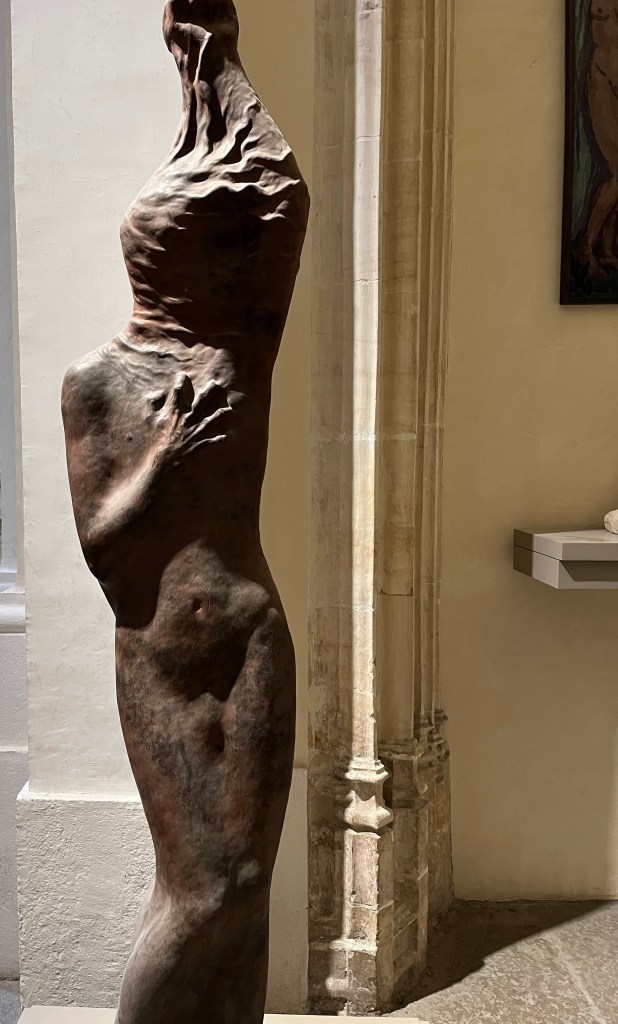
This wind-swept figure is called Power of the Will and shows how we all feel sometimes, just standing as straight as we can in the winds of circumstances.
And on our way out, I found the one sculpture I would take home if I could. This slightly larger than life sized dog, resting sweetly, waiting for whatever adventure comes next. I can imagine he would be very satisfying to pet, after a long crazy day.
Once we had breakfast, we were ready for adventure. Grandpa Nelson had seen that the local zoo (you know he loves zoos) was at the parc just a few blocks north of us. The guidebook we had about Lyon didn’t mention it, but it looked interesting, so we wandered over.
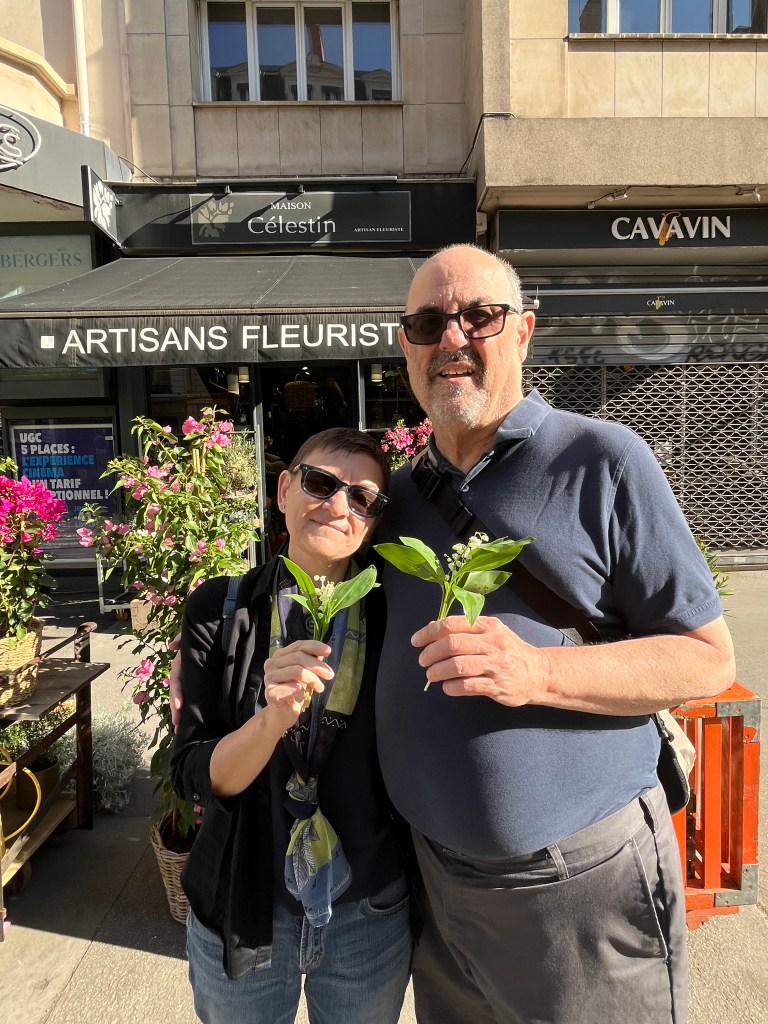
On the way, we discovered lots of folks out selling these little bunches of flowers, called Muguettes de bois, for May Day. I bought one each for Grandpa and Bridgett, and we figured two tiny bouquets were enough to keep track of at a big park.
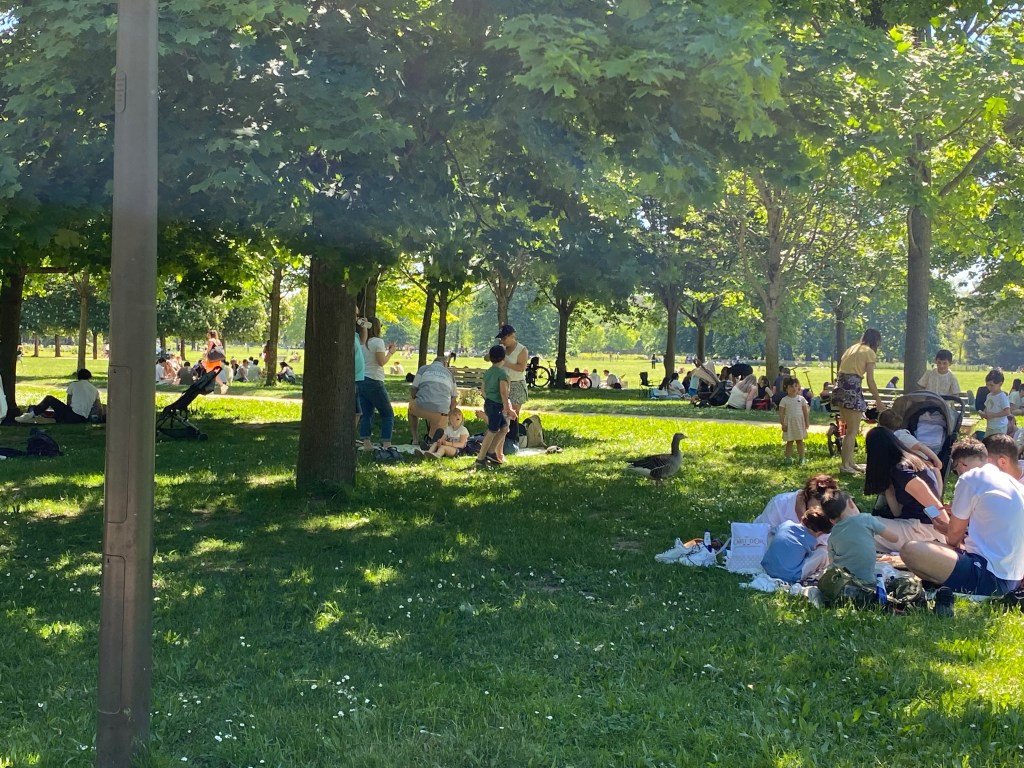
Since the First of May is a national holiday in France, lots and lots of people were heading to the park… families, toddlers on scoot bikes, small groups of friends… all carrying baskets, bags, even small take-away boxes from local restaurants, and blankets. I wondered what part of the park the picnic grounds were in.
It turns out, the whole park is a picnic area! It was different than in the States… no tables, barbecues, or stacked up cases of beer. No radios or other artificial music, just friends and families eating and relaxing together.
Every family on the move seemed to have a soccer ball they were slowly kicking along, scooters, or bikes. I loved how even with hundreds of people gathering, it was peaceful and quiet… less hollering parents or wailing children.
We walked through some greenhouses that protect exotic plants from Lyo ‘s cold winters, andSoon found the Zoo! Again, there were differences … the enclosures were greener, more overgrown, less tidy and raked. In other words, more like a natural habitat. Also, animals that are compatible were enclosed together. It was nice to see them hanging out!
We kept wandering and found the cafe at precisely the time I was getting hungry ( funny how that works). The cafe was right on the small lake, sheltered by Plane trees that have been here, doing just this job, for a hundred years or more.
There was also a goose who seemed to be posing for pictures on this set of steps! People would come by, their children would have a moment with the goose, and then they would part ways. It was wonderful.
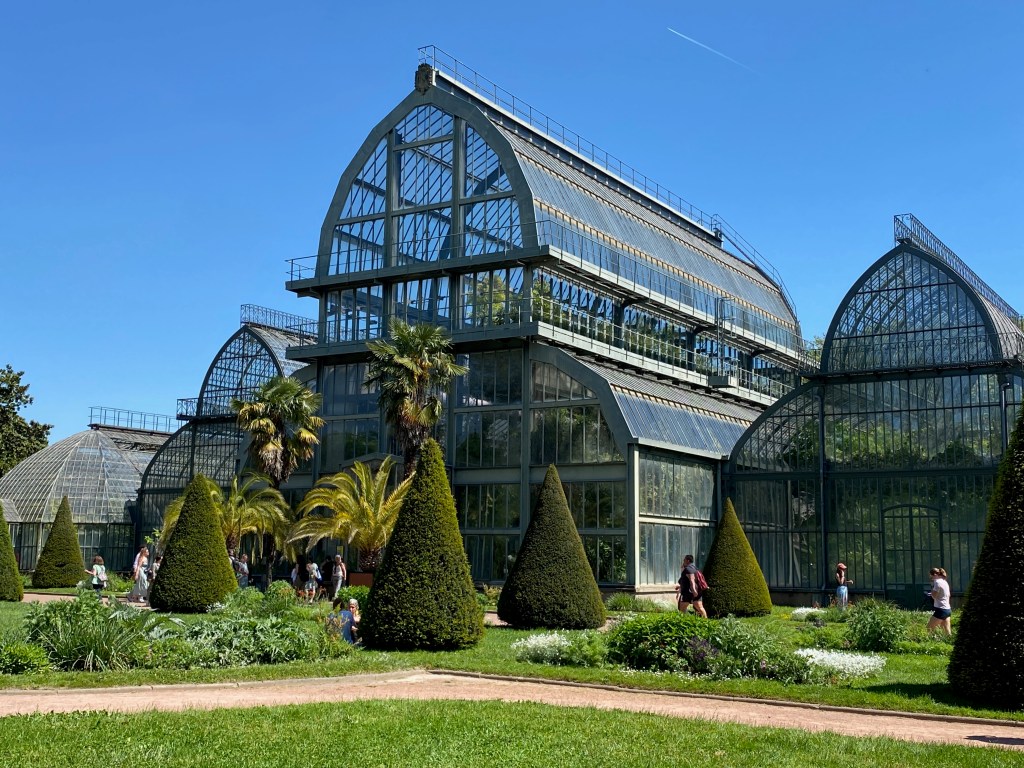
Continuing through the park we saw Victorian greenhouses for the tropical plants, which varied in temperature from a bit sultry to absolutely sauna-like. We didn’t stay long, or we would have been poached!
And just about the time we were running out of energy, we had walked our way around the park and back to the entrance. Back through the neighborhood and to our apartment on Rue Cuvier.
Le Parc de la Tête d’Or is a jewel, and shame on the guidebook for leaving it out!
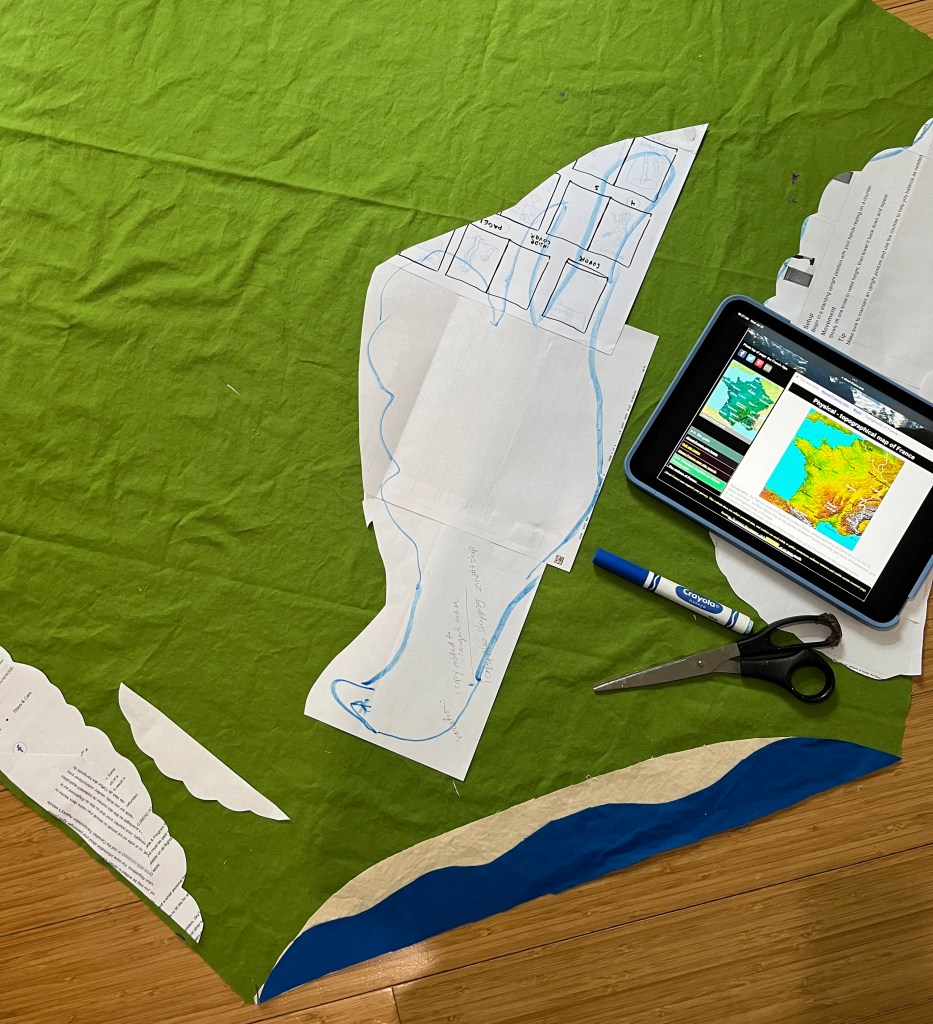
Yes, I have made progress! Once I got the shorelines figured out, everything starting making sense.
I kept looking at my patterns for the Grand Massif, the Alps, and the Pyrenees, and they were just …. Clunky. They made the whole eastern side of the country look like a mountain range, which just isn’t the case.
As you can see….
So I pulled up different topographical maps of France to see how I might make them better. Certainly more accurate, and maybe just a little prettier.
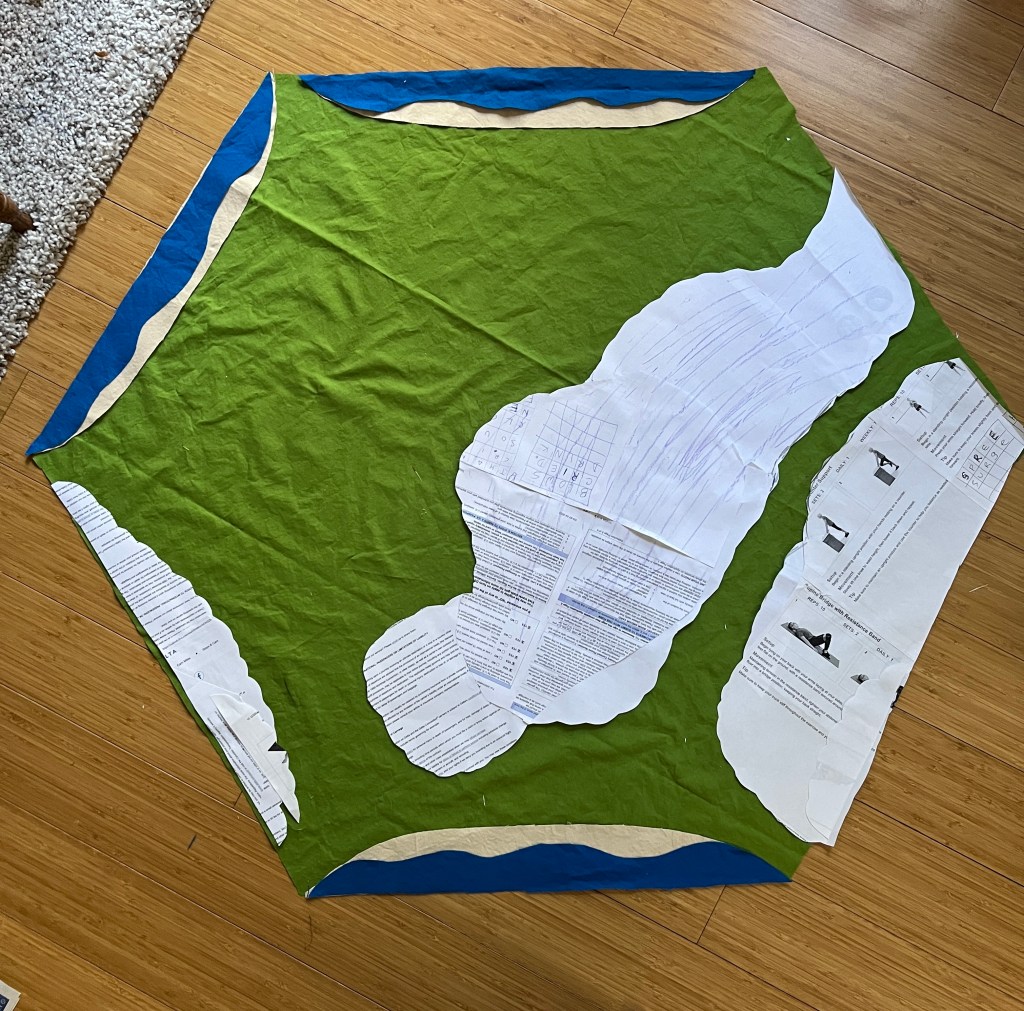
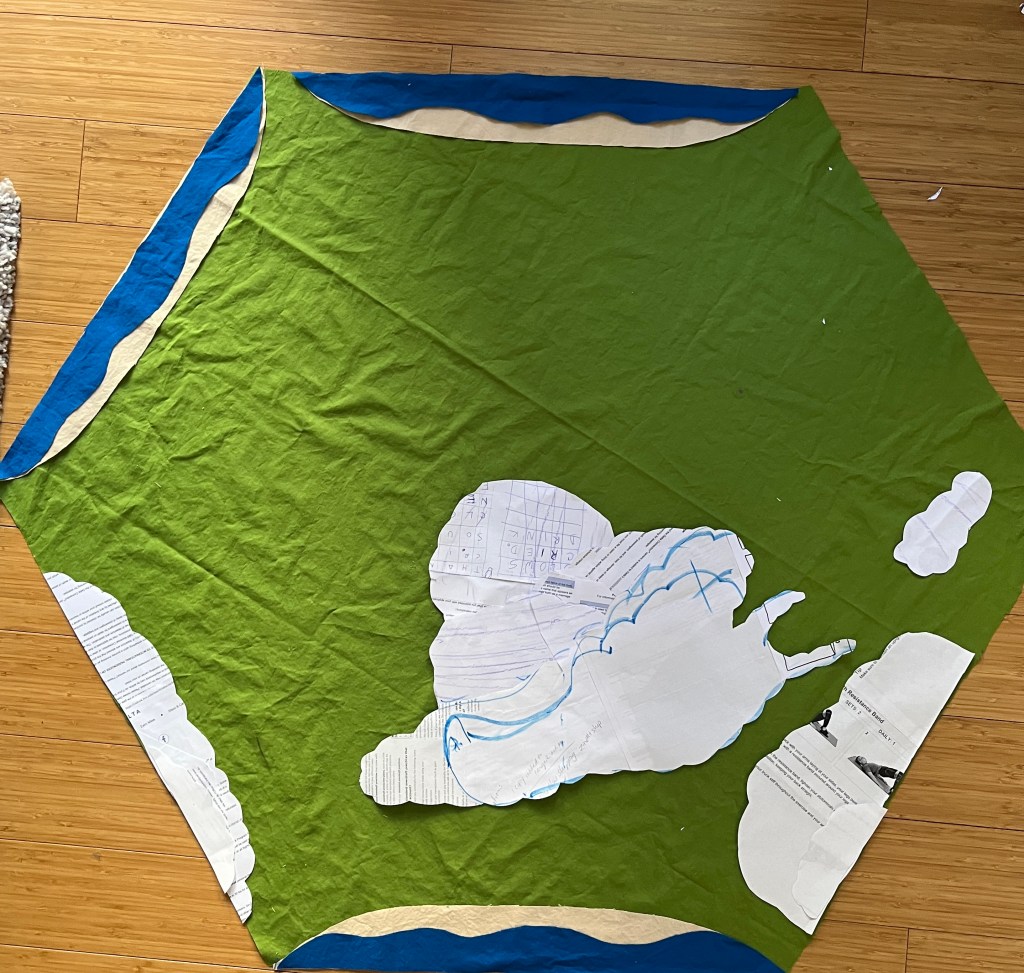
My process isn’t artistic, or even scientific. I glue sheets of scrap paper together and start cutting, staring and trimming until I get a shape I like.
This took a good part of the morning, because there is a lot of cutting, placing, staring, and walking away for a while. During the walking away parts I vacuumed, went shopping, and watched the Olympic Triathlon on YouTube.
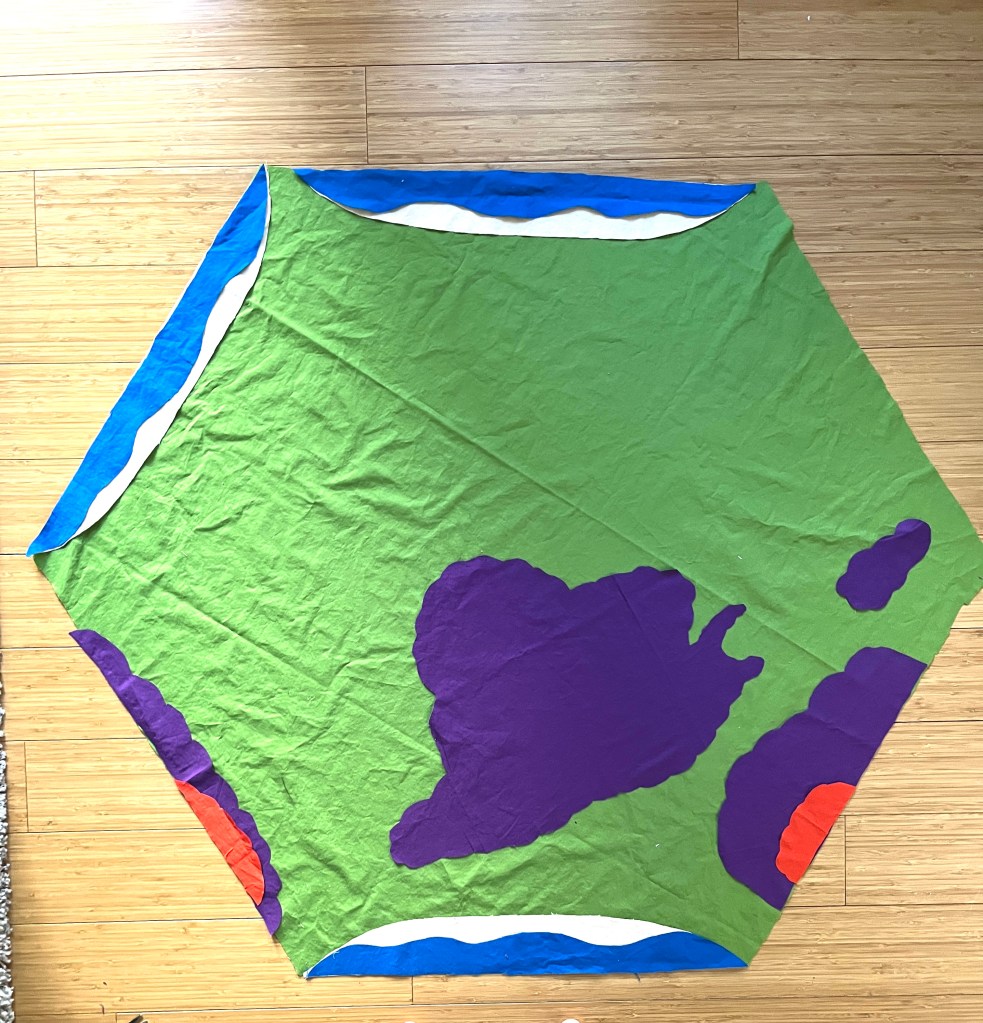
And when I got a pattern that was closer to the shape of the Massif, I laughed out loud. Un Escargot!!! That is, a snail.
I like that a lot. Escargot are one of the classic French dishes. Snails are also raised all over France for it, and it is one of Auntie Bridgett’s indulgences when we visit there.
So I chuckled and pinned the patterns down, carefully trimming the lumpy shapes out of the purple fabric. The highest peaks of the Pyrenees and the Alps will be shown in red.
Et voilà! The big shapes are taken care of.
But there is one more detail hanging over my head.
I have this half yard of black fabric that I haven’t used yet. It is part of the color palette, and I think it will give the map some depth and drama. I intended it to be mountains, but it looked like a big black hole. I think it would be better as a detail, a curve or a line rather than a blob.
So now I get to stare at this for a while, and figure out what comes next.
Our stay in Denmark is coming to an end, but there are still adventures to be had.
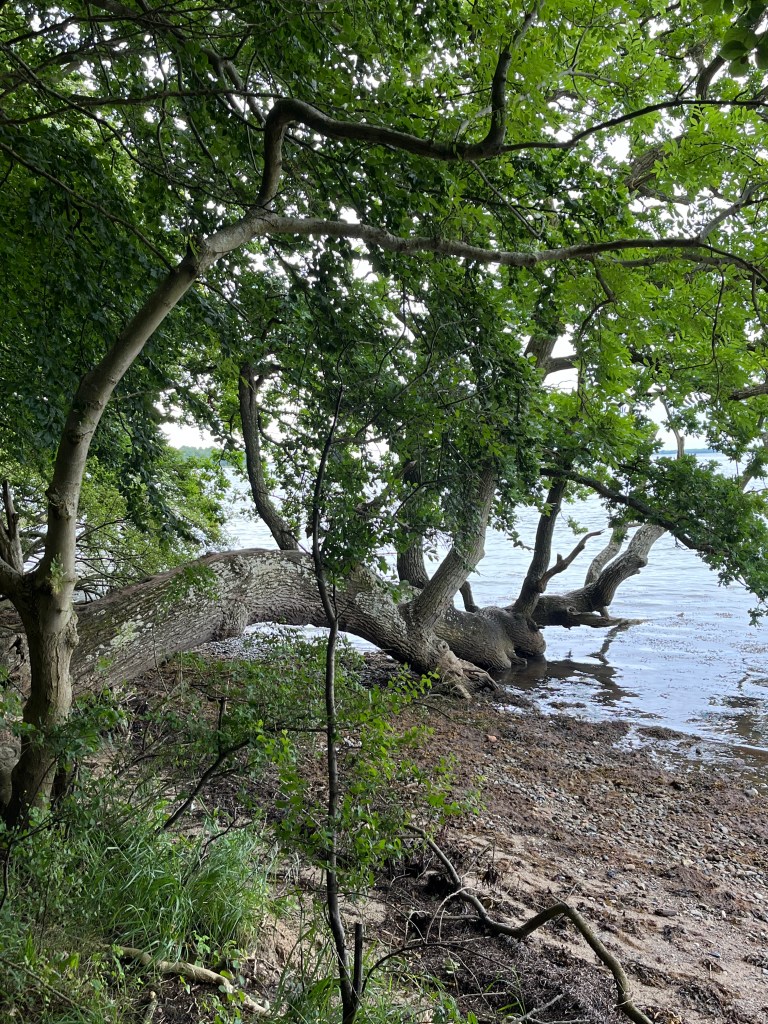
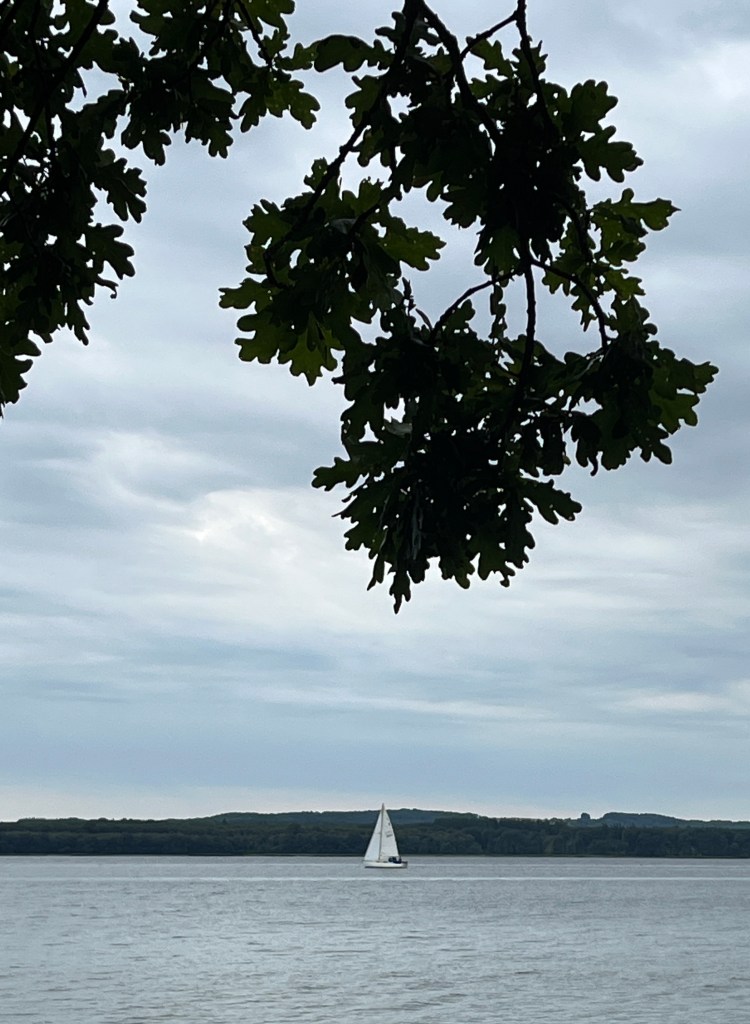
Liza’s favorite walk, for example, is along a particular stretch of the Horsens fjord called Elbaek Skov. It has an unusual sort of forest that could only exist in the protected environment of a fjord.
The huge trees that grow at the very edge of the water lean way out, looking for open sunlight. And since the waves in the fjord are almost nonexistent, the trees are not damaged or eroded, but just keep leaning and growing.
Like so any of the beautiful places in Denmark, this area amazingly accessible. A small parking lot leads to a gravelled path, which runs parallel to the shore. Without the sound of crashing waves you would expect, the feeling of peace and tranquility seeps slowly into your bones and when you are done walking, you feel better than you did when you went in.
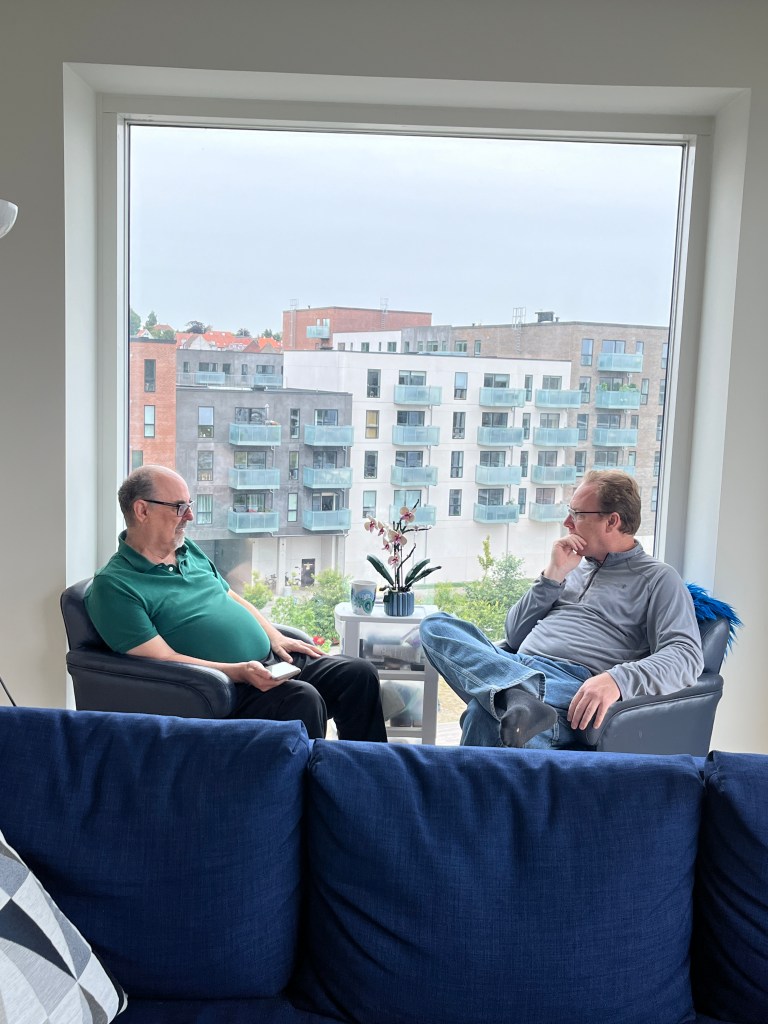
We walked until we were halfway tired (as my Dad would say), then headed back home for lunch and more chat.
I know I have to go home soon, but I am sure going to miss these lovely people and this pretty country.
We have started our three day road trip across Denmark! There is so much to see.
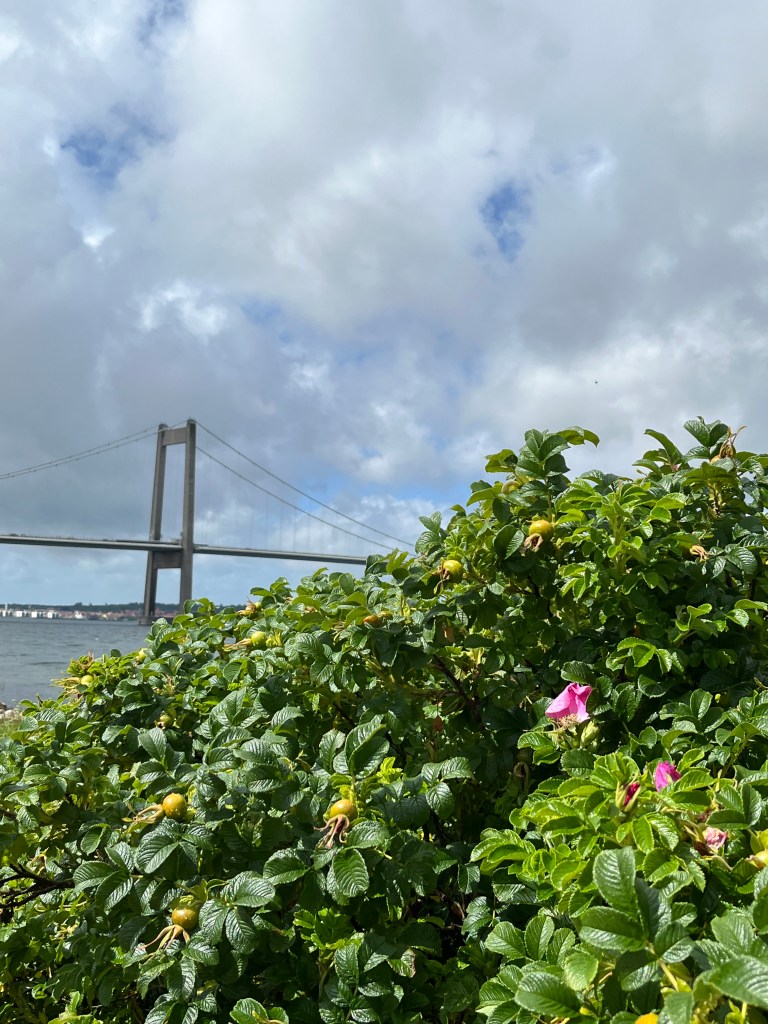
We started our drive in the pouring rain, heading south from Horsens. We crossed over from the peninsula of Jylland to the island of Fyn over the Lillebro, or Little Bridge. As you can see, it is only little compared to the Storbro, or Big Bridge, which we will see later on our journey.
The weather went from rainy to blustery, with amazing clouds and a good stiff breeze.
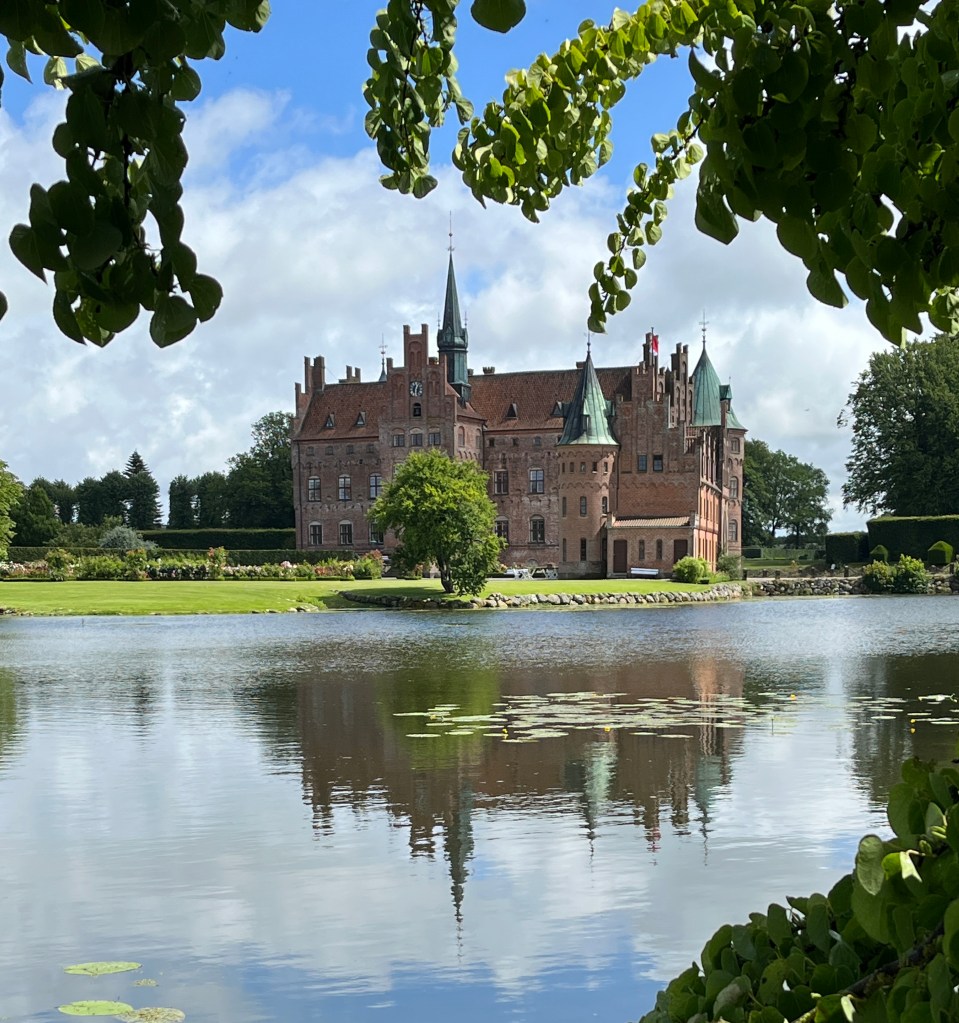
We found the castle of Egeskov, which Auntie Olga calls “The Castle-iest Castle in Denmark.” She is so right! Surrounded by a lake-like moat, lovely gardens, a maze, and lots of land, it has been named Europe’s best preserved Renaissance water castle. It has stood here since 1554 and is currently owned by the latest in a long line of sons, Michael Ahlefeldt-Laurvig-Bille, but operated by the Danish government as a historic landmark.
Inside are generations of historic dresses, furnishings, weapons, and portraits. There are toys and kitchen tools displayed in the attic. It is a huge amount of stuff. Imagine if your house still had your great great grandma’s dishes, and all the rest of her stuff. Plus your stuff. Oy.
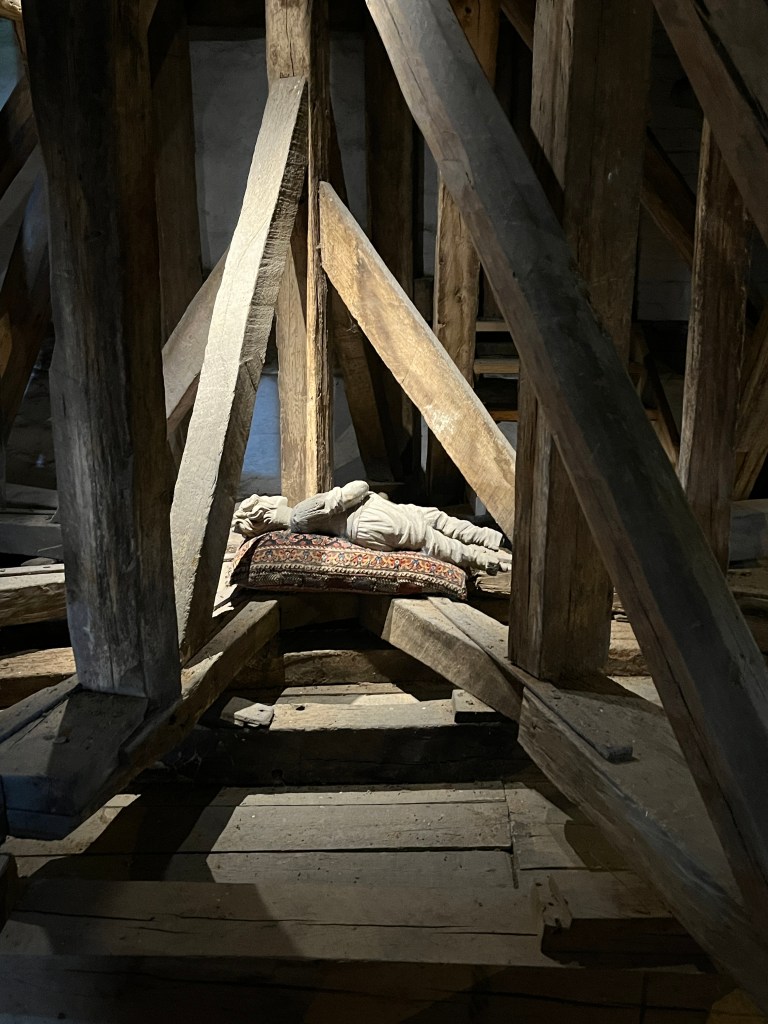
There is also a said-to-be- haunted doll in the attic which no one moved for a few hundred years, for fear the castle will fall down if they did. They all seem to be over it now, but the doll is still there.
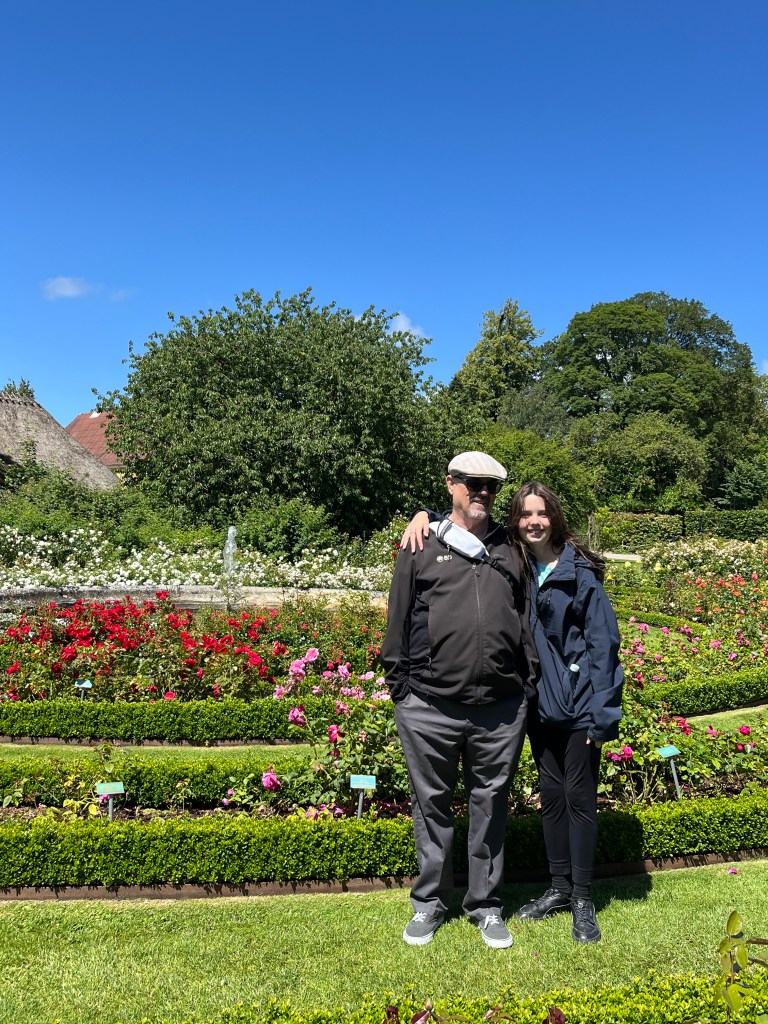
Out in the grounds, we wandered the rose garden, maze, and water garden.
Everything was a photo opportunity! So I took lots. I love watching Uncle David explain things to Liza. Most of what I learned about the mechanical world came from my dad, so I value this sort of learning.
But there is MORE to Egeskov, and that will need to wait for tomorrow.
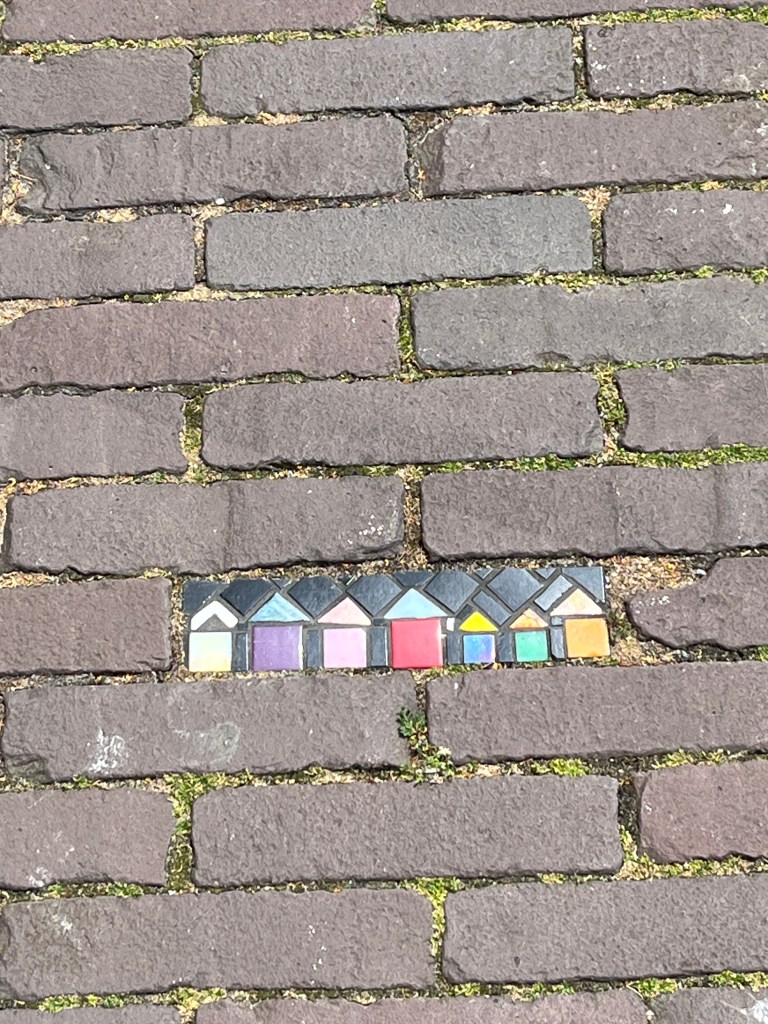
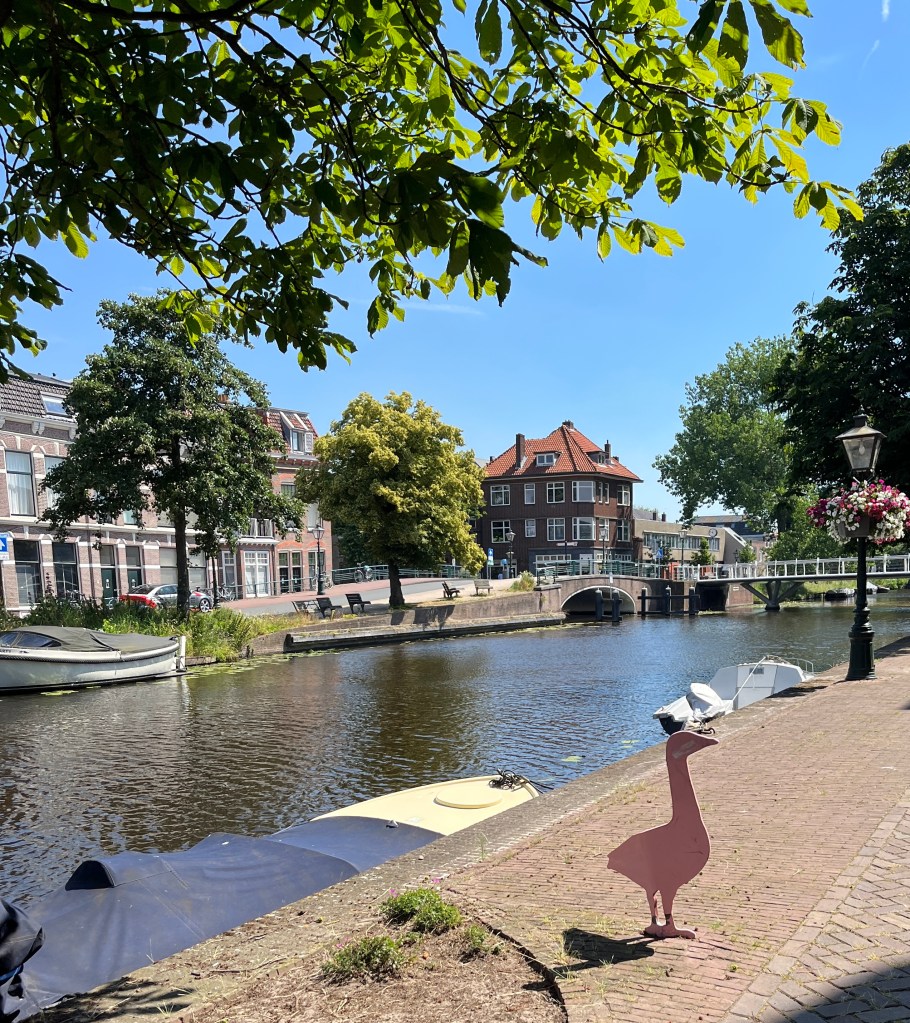
Walking through Leiden, we kept coming across wonderful quirks that reminded me of Portland. First, there were these little mosaics, each the size of one paving brick, in places around the city.
There were enough that I stopped taking pictures of them, yet never so close together as to be boring.
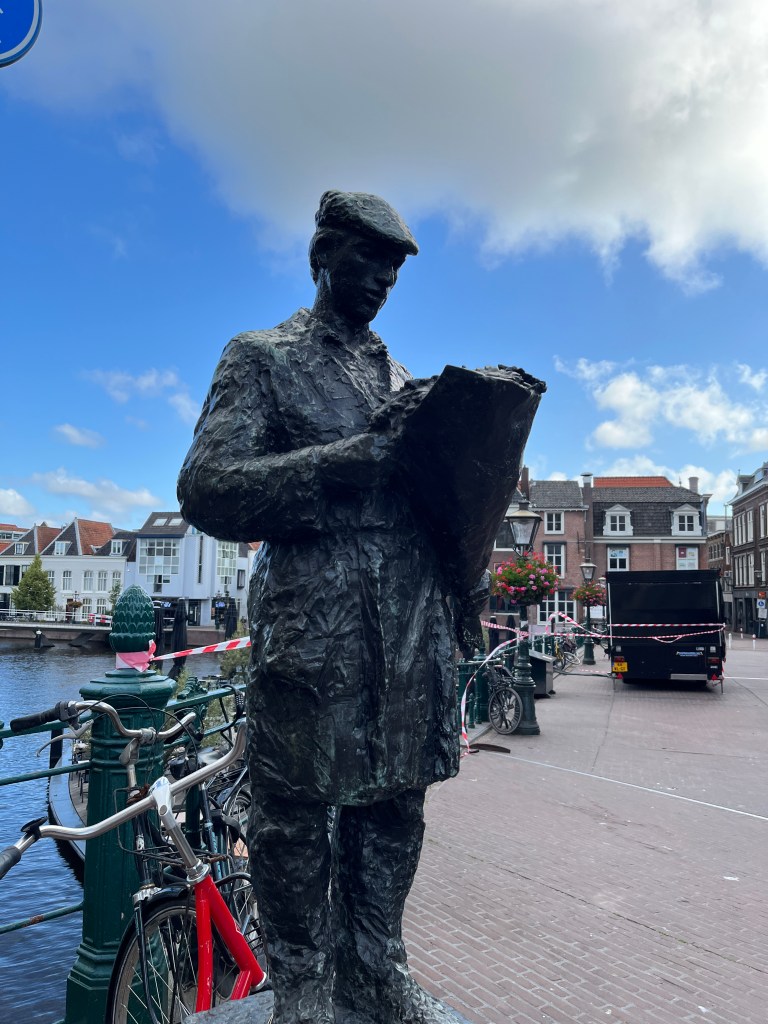
There was also a lot of public art, mostly in the form of bronze statues; a series of young men selling things, like flowers, fish, and fabric. I suppose this was a celebration of Leiden’s history as a market town.
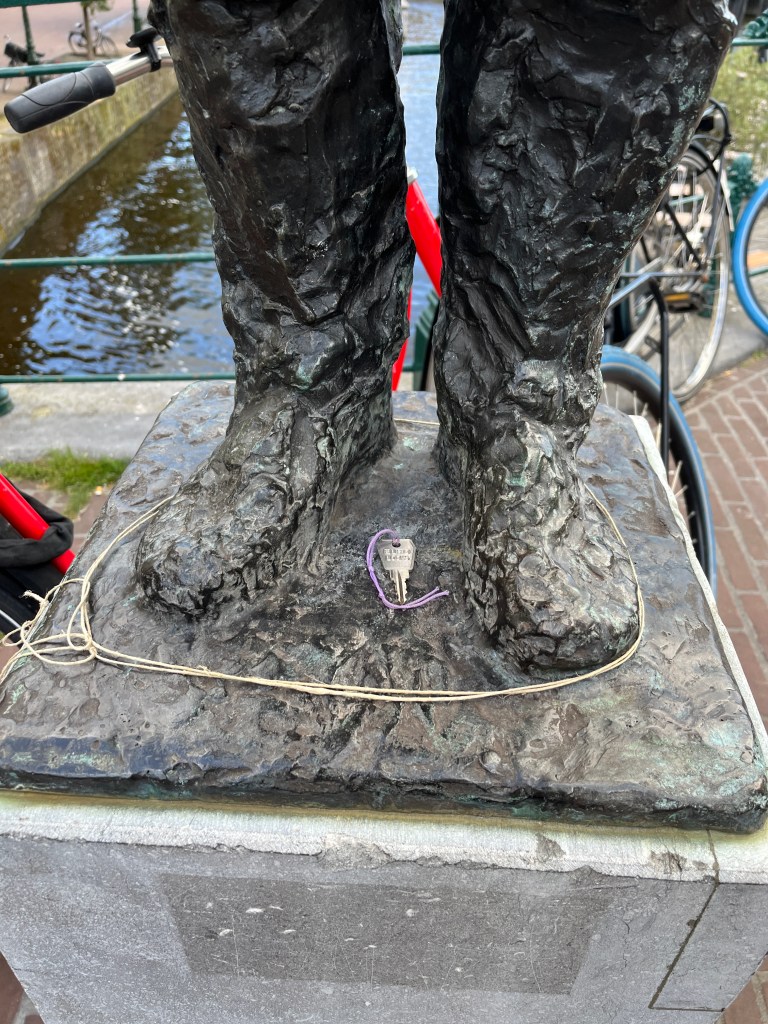
Some of the statues are also draped with string, and one had a key placed at his feet! I wonder what the hidden message was, and for whom.
Some things, we may never know.
Another bronze statue, near the main entrance to the University, was designed to encourage public voices of dissent. This podium, with a little riser behind it, has “Protest” and other words carved on the front. Student challenges to the status quo is celebrated. Hooray for young ideas!
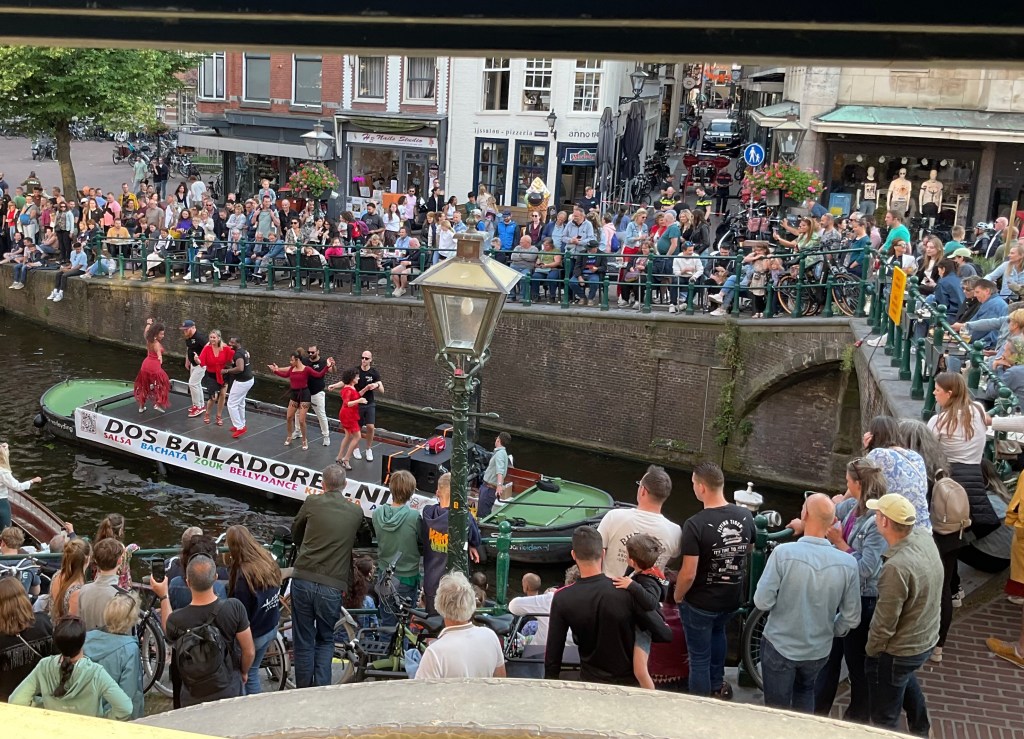
Finally, we happened to be in town for the annual Parade of Boats. It was described by our waitress as a yearly party where “drunk people in boats make a show for drunk people on land.”
A few dozen groups like dance classes, choirs, clubs, or just groups of friends, rode through the city’s canals in decorated boats, playing music and entertaining the crowd. It was clear that many of the paraders, as well as many of the audience, had had a few drinks. But, as far as I could tell, no harm done. Our hotel room on the second floor gave us a front row seat.
And it was a magnificent party!
Well, that’s all I’m going to tell you about Leiden for now. Tomorrow is our flight to Billund!
After the usual disorientation of an overseas flight and time adjustment, we are in Leiden, the Netherlands, and seeing all sorts of lovely things.
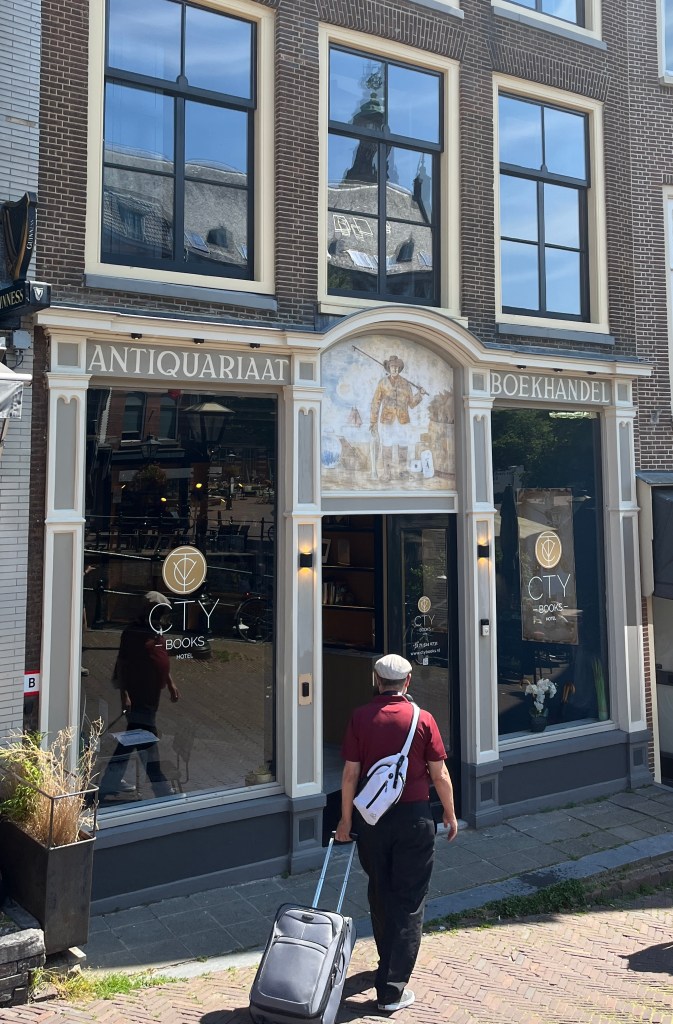
We are staying at a hotel called CTY Books, which is a modern place built inside a really old book sellers (from the 1700s). In a perfect blending of new and old, it has super nifty electronic locks but traditional Dutch stairs; AC for the hot days but is perched on a centuries-old canal.
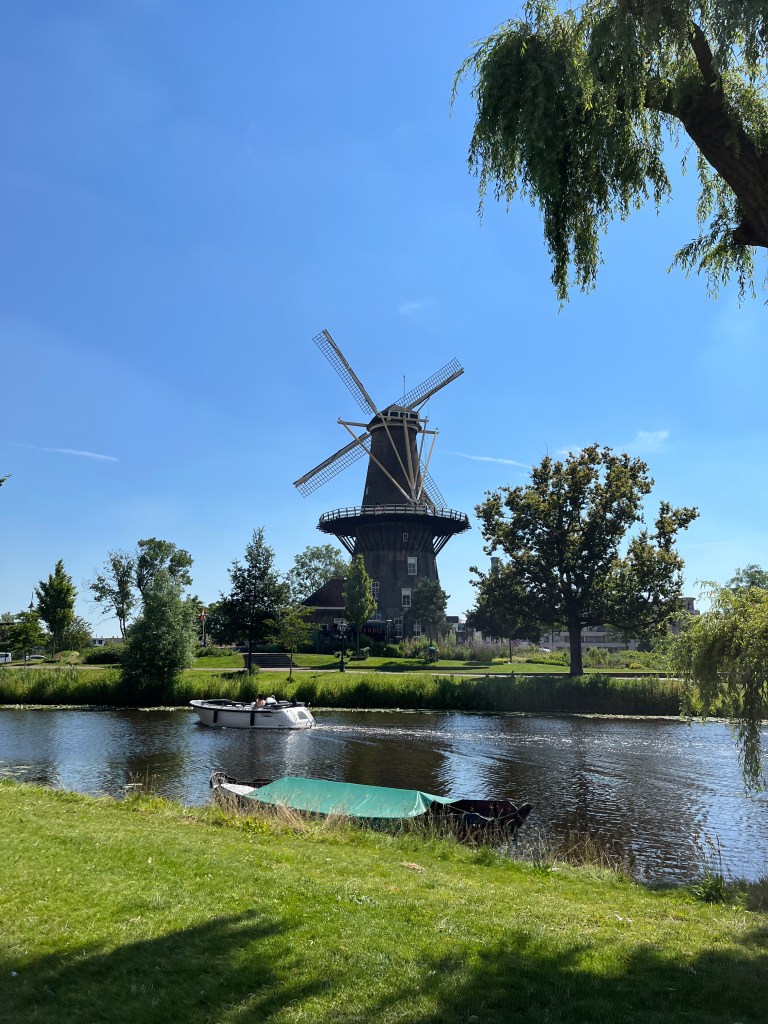
The parts of Leiden we have seen are busy, modern city businesses that work in a very canal laced geography. This giant windmill sits beside a canal on the way from the train station.
Canals are common in The Netherlands because the land is low and swampy, so for centuries the people have dug canals to drain the water away. The canals also make for nice transport, to and from the sea as well as around town.
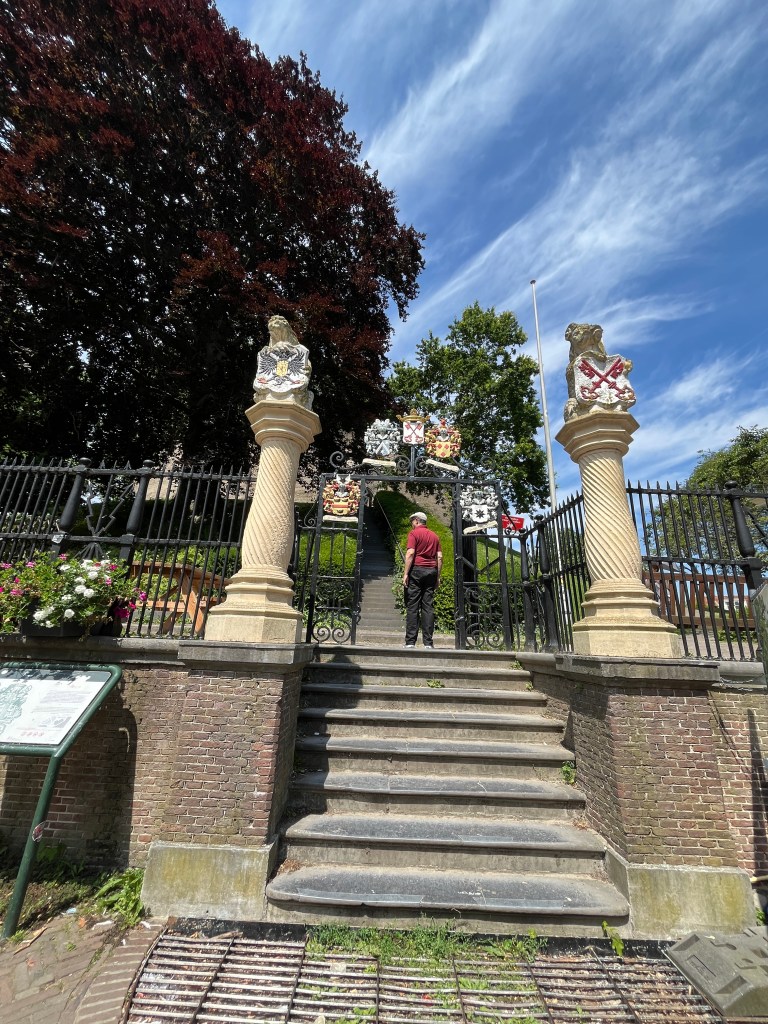
Our first day, we found De Brucht, which is the remains of an old castle.
It was originally built up as a high place to escape flooding, but when foreign armies threatened, they put a castle on top.
in in the midafternoon we started drooping from jet lag, and went up for a nap. Three hours later we were fit for more site-seeing, and wandered the neighborhood. The old, well maintained buildings and canals make everything look like a fairy tale.
De Landstrader, the restaurant just below our hotel, serves wonderful French fries, as well as salads and dinners. We stopped for some food and wine before heading back in for the night. We ate inside as the canal side tables were getting noisy and we like our conversation un-shouted.
The sunset was stunning at almost 10 p.m. as we headed up to our cozy room.





























 Dear Liza